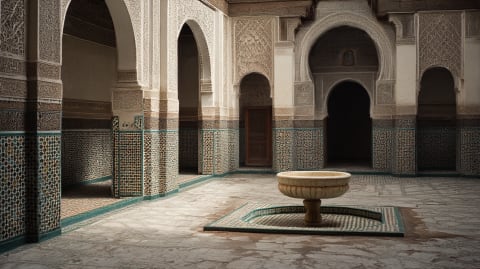
In the 14th century, across the street from the Bou Inania Madrasa in Fes, someone installed a clock that ran on water.
Dar al-Magana — the House of the Clock — is a small wooden structure with thirteen windows and thirteen brass bowls, built into the wall of the street opposite the madrasa. The mechanism, as far as scholars have been able to reconstruct it, used water to drive a series of weights that would strike the brass bowls at intervals, marking the hours of the day. The twelve windows below the row of bowls were said to open on the hour, dropping a weight onto the bowl beneath.
The clock has not worked for centuries. Nobody alive has seen it run. The mechanism was likely damaged or dismantled long ago, and no complete technical description survives. What remains is the wooden facade with its row of windows and bowls, and the brackets that once held the moving parts.
Why it was built is also unclear. The Bou Inania Madrasa across the street already had a minaret from which the hours of prayer were called. One theory is that the clock was astronomical — an instrument for tracking the hours more precisely than a muezzin's judgment. Another is that it was a display of mechanical ingenuity, a statement that Fes in the 14th century could build things the rest of the world had not yet imagined.
The clock sits above head height on a busy commercial street. Most people walk beneath it without looking up. There is no sign explaining what it is. The brass bowls are green with age. The wood is dark and weathered.
A few years ago, a team attempted to reverse-engineer the mechanism from the physical evidence and historical references. The project stalled. The clock remains silent, watching the street with thirteen empty windows.
The Facts
- —In the 14th century, across the street from the Bou Inania Madrasa in Fes, someone installed a clock that ran on water.
- —Another is that it was a display of mechanical ingenuity, a statement that Fes in the 14th century could build things the rest of
Sources
- Le Tourneau, Roger. Fès avant le protectorat. IHEM, 1949
- Hill, Donald. Islamic Science and Engineering. Edinburgh University Press, 1993
- Al-Hassan, Ahmad Y. & Hill, Donald. Islamic Technology: An Illustrated History. UNESCO/Cambridge University Press, 1986
Practical questions