A zellige artisan in Fes works with no ruler. No computer. No printed template. A compass and a straightedge — the same tools Euclid used — and every pattern you see in every mosque, palace, and madrasa in Morocco emerges from these two instruments and the hands that hold them.
The process begins with a circle. The compass steps off points around the circumference. Straight lines connect these points to create stars — 8-pointed, 12-pointed, 16-pointed. The negative space between the stars generates new shapes: crosses, hexagons, kites, darts. These interlock to fill a plane with no gaps. It sounds simple. It is simple, in the way that chess is simple — the rules fit on a napkin and the mastery takes a lifetime.
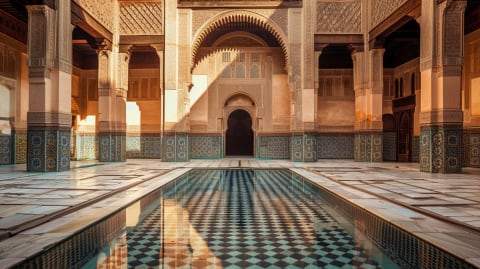
In 1891, the Russian crystallographer Evgraf Fedorov proved that there are exactly 17 distinct ways to tile a plane with repeating patterns. Moroccan artisans had been producing examples of all 17 for at least 500 years before the proof existed. The Alhambra in Granada contains all 17 groups. The Bou Inania madrasa in Fes contains at least 13. The Saadian Tombs in Marrakech layer zellige with carved plaster and painted cedar in combinations that encode multiple symmetry groups on a single wall. The mathematicians formalised what the craftsmen already knew. The craftsmen have not yet returned the compliment.
The colour is not paint. Each piece of zellige is cut from a glazed tile — traditionally in about ten colours derived from mineral oxides. The glaze is applied before firing, then each small piece — called a furma — is chipped by hand with a hammer on a chisel. An experienced cutter produces hundreds of pieces per day. The irregularity is intentional. Slight variations in size and colour create a visual warmth that machine-cut tile cannot replicate, in the same way that a handwritten letter has a quality that a printed one does not.
The assembly is face-down, which takes a particular kind of spatial confidence. Pieces are arranged in reverse on a flat surface, then plaster is poured over the back. When the panel is flipped and mounted, the face is flush. A single wall panel can contain thousands of individual pieces, each placed blind. Getting this wrong is expensive. Getting this right is art.
The tradition is concentrated in Fes, where the maqlems — master craftsmen — train apprentices for years before allowing them to cut a tile unsupervised. The knowledge is transmitted by hand, not by text. There are no manuals. The geometry lives in the fingers of people who could not explain Fedorov's theorem but who could build you a proof of it on your wall in three weeks.
In Fes, we visit the zellige workshops where men cut star patterns by hand, by eye, by inheritance. The geometry is the family business.
Tell us about your trip →Data and visualisation by Dancing with Lions
The Facts
- —Zellige = "little polished stone"
- —Islamic geometric art — no figural imagery
- —Fes: centre of production
- —Each piece cut by hand with a hammer
- —Marinid dynasty refined the craft (13th-15th century)
- —Mathematical tessellations: 17 wallpaper groups represented
- —Earliest Moroccan zellige: Koutoubia minaret, mid-12th century
Sources
- Castéra, Jean-Marc. Arabesques: Art Décoratif au Maroc. ACR Édition, 1999
- Paccard, André. Traditional Islamic Craft in Moroccan Architecture. Éditions Atelier 74, 1980
- Lu, Peter J. & Steinhardt, Paul J. "Decagonal and Quasi-Crystalline Tilings in Medieval Islamic Architecture." Science, 2007