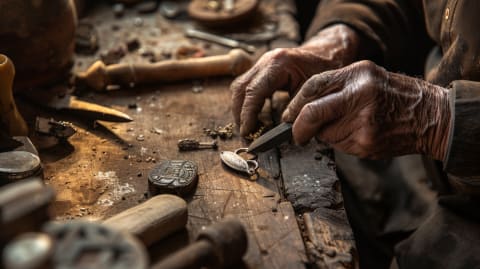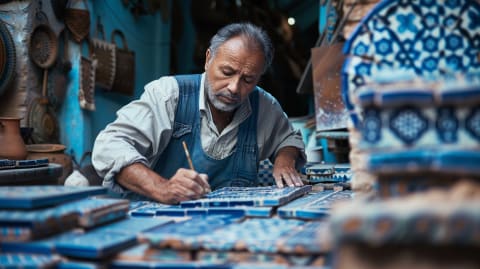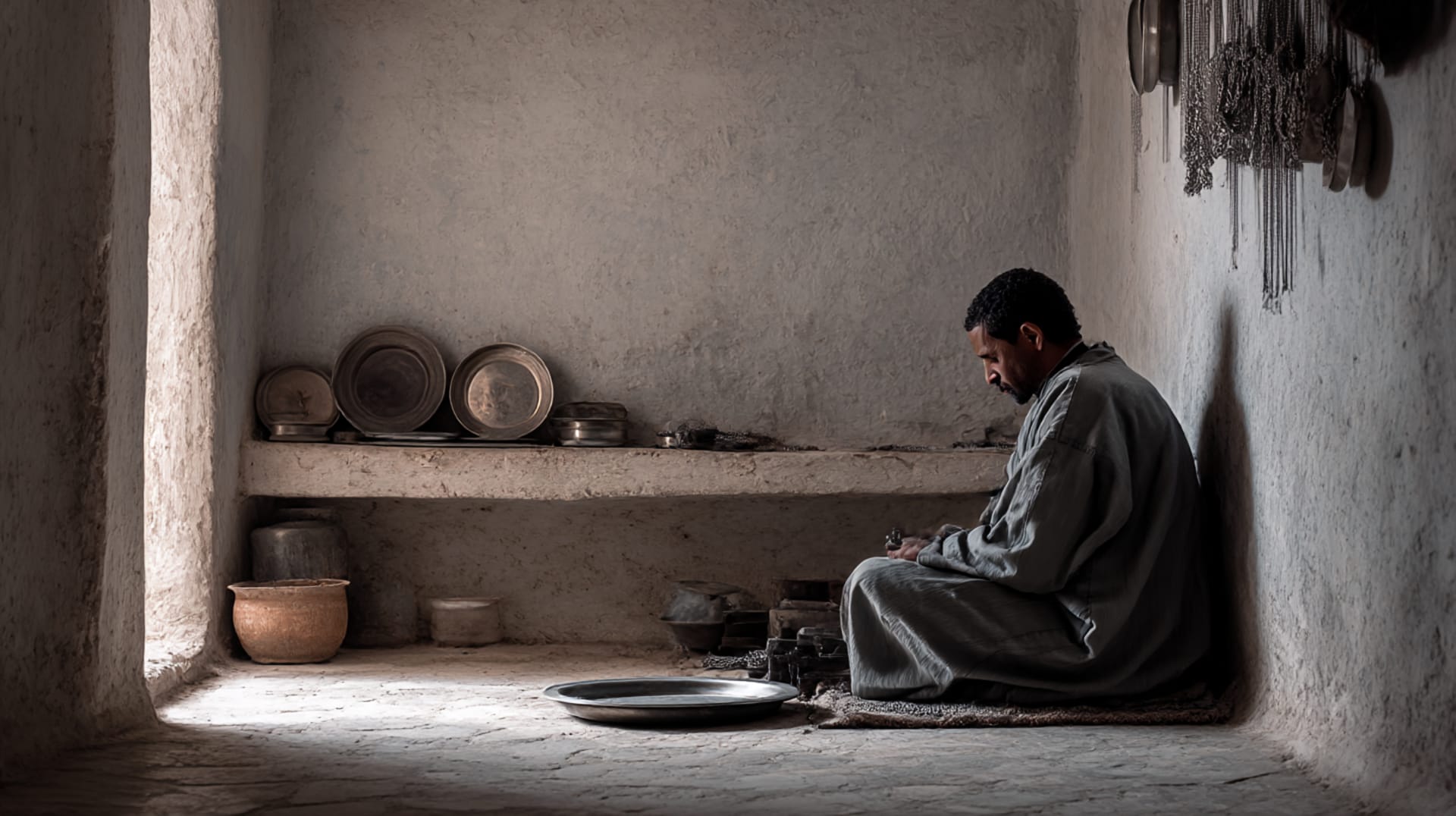
Tiznit is where the Amazigh silver tradition survives — not in museums, but in workshops where men still hammer bracelets the way their grandfathers did.
The town sits in the Souss-Massa region, about 80 kilometres south of Agadir, behind a set of walls that Sultan Hassan I ordered built in 1882. Inside the walls, the old jewellers' souk — the Souk des Bijoutiers — is a row of small workshops where Amazigh silversmiths produce fibulae, bracelets, earrings, rings, and the ornate headdresses worn at weddings.
Amazigh jewellery is silver, not gold. Gold is associated with Arab and urban tradition. Silver belongs to the Amazigh countryside — to the Anti-Atlas, the Souss, the deep south. The designs use symbols with specific meanings: triangles for fertility, circles for protection, the hand of Fatima against the evil eye. Each region has its own style. Tiznit is the marketplace where the styles converge.
The trade has contracted. Machine-made jewellery from Casablanca and imported pieces from India and China are cheaper than handmade silver. Young silversmiths increasingly leave for other work. The workshops that remain are run by older men who learned from their fathers.
But the souk is still there. You can watch a bracelet being made — the hammering, the engraving, the setting of coral or amber — and buy it from the hands that made it. The prices are fair by international standards and high by local standards, which is probably the correct equilibrium.
The old mellah of Tiznit — the Jewish quarter — was home to Jewish silversmiths who worked alongside their Muslim neighbours. The Jewish community left in the 1950s and '60s. Their contribution to the craft tradition is acknowledged but their workshops are empty.
The Facts
- —The town sits in the Souss-Massa region, about 80 kilometres south of Agadir, behind a set of walls that Sultan Hassan I ordered
Sources
- Camps, Gabriel. Les Berbères: mémoire et identité. Actes Sud, 2007
- Becker, Cynthia. Amazigh Arts in Morocco. University of Texas Press, 2006
- Spring, Christopher. North African Textiles. British Museum Press, 1995
Practical questions