At six in the morning, the Jemaa el-Fna is empty. A few carts. A man hosing the asphalt. Cats. The square is just a square — large, irregular, open — and nothing about it suggests what it will become by nightfall.
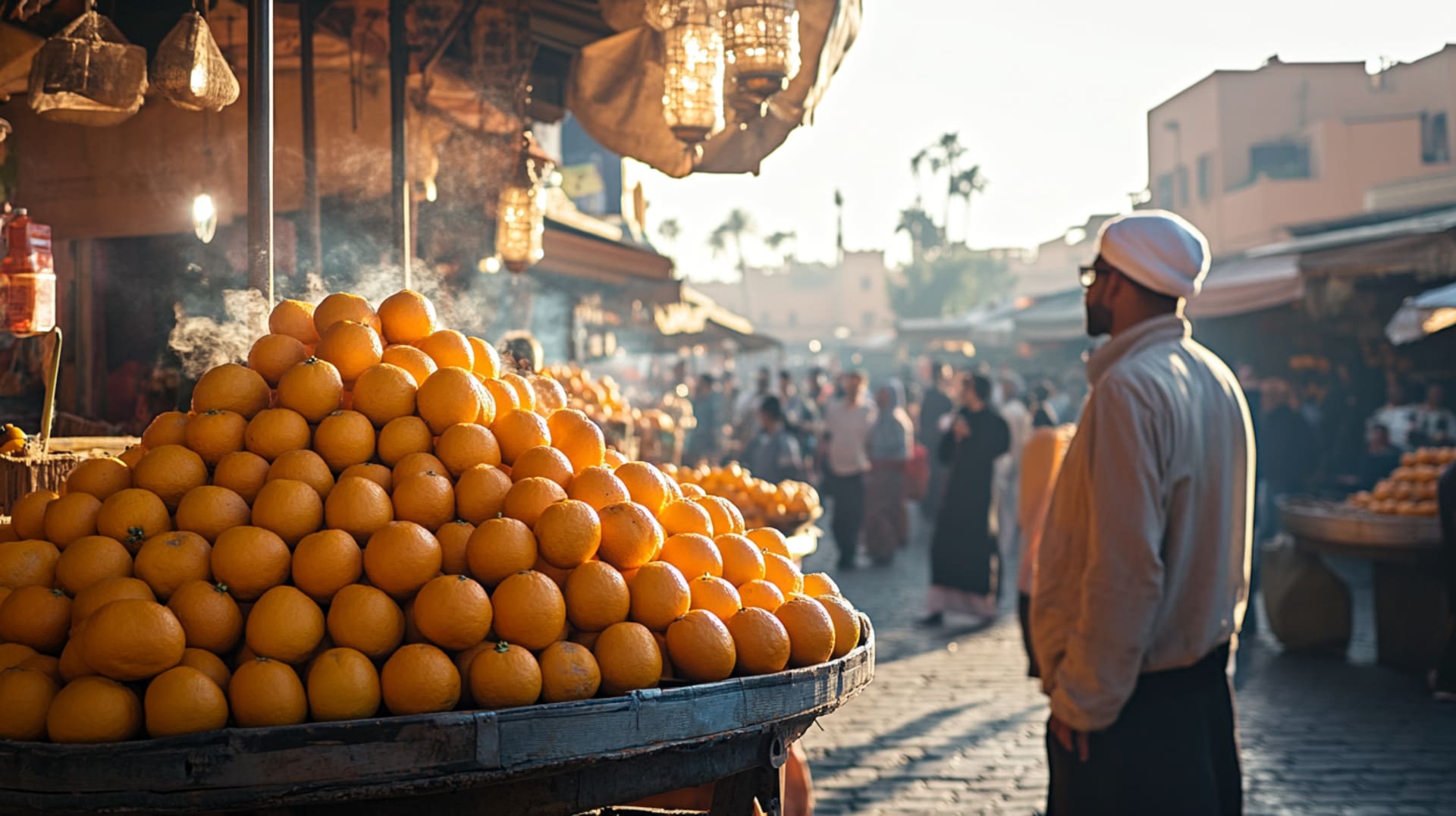
By nine, the orange juice sellers have set up: carts stacked with pyramids of fruit, mechanical presses, glasses at four dirhams each. Fresh-squeezed, cold, sweet in a way that supermarket oranges have never been and will never be. The sellers compete for position. The best spots are hereditary, which means that the right to sell orange juice in a particular square metre of Marrakech is a family inheritance, and it is treated with the seriousness that other families reserve for houses.
By noon, the performers arrive. Snake charmers with cobras and flutes — the cobras are defanged, the dynamic between charmer and tourist is a negotiation older than photography. Henna artists claim the benches. Herbalists arrange their powders and dried animals and deliver medical consultations that blend actual botany with pure theatre. Storytellers — the halqa tradition — gather circles of listeners and tell tales in Darija that tourists cannot follow but cannot stop watching. This is what UNESCO recognised in 2008 when it inscribed the Jemaa el-Fna as a Masterpiece of the Oral and Intangible Heritage of Humanity, which is the longest title the square has ever been given and the one it is least likely to remember.
By sunset, the food stalls open. A hundred of them, assembled nightly from portable kitchens — grilled meats, snail soup, fried fish, sheep's head, bread, harira, pastilla. The smoke rises in columns. The light is kerosene and fluorescent. The noise is total. The competition between stall holders is conducted through volume, gesture, and the physical interception of anyone who makes the mistake of pausing within arm's reach.
The square has been doing this for centuries. The name means "assembly of the dead" — possibly a reference to public executions, possibly to storytellers performing tales of the departed. Nobody is certain. The uncertainty suits the place, which has never been one thing and has never tried to be. It is a market, a theatre, a restaurant, a pharmacy, a concert hall, and a social experiment conducted nightly in the open air. It is the most famous square in Africa, and at six in the morning it is nothing. By nine it is waking. By midnight it is everything. By two a.m., the cats have it back.
At six in the morning, the Jemaa el-Fna is empty. By midnight, it holds ten thousand people. Three days is enough to see both.
Tell us about your trip →The Facts
- —Jemaa el-Fna: empty at 6 AM, transformed by nightfall
- —Orange juice: 4 dirhams, fresh-squeezed, best spots hereditary
- —Snake charmers: defanged cobras, traditional flutes
- —Henna artists, storytellers, musicians arrive by afternoon
- —UNESCO Intangible Cultural Heritage since 2008
- —Food stalls light up at dusk — 100+ stands
- —The name means "Assembly of the Dead" — heads of executed criminals once displayed here
Sources
- Combs-Schilling, M.E. Sacred Performances: Islam, Sexuality, and Sacrifice. Columbia University Press, 1989
- Pandolfo, Stefania. Impasse of the Angels: Scenes from a Moroccan Space of Memory. University of Chicago Press, 1997
- UNESCO. Jemaa el-Fna Square — Masterpieces of the Oral and Intangible Heritage of Humanity, 2001
- Kapchan, Deborah. Gender on the Market: Moroccan Women and the Revoicing of Tradition. University of Pennsylvania Press, 1996.
Practical questions