The first glass is bitter as death. The second is strong as life. The third is sweet as love. You will be served all three. Refusing any is an insult. This is the code, and it has been the code for longer than the tea has been in the country, which tells you that the ritual was waiting for the right drink.
Nobody knows exactly when Moroccan tea culture began. The drink itself arrived late — Chinese gunpowder tea reached Morocco only in the 18th or 19th century, a happy consequence of British merchants losing their Russian markets and needing somewhere to sell surplus. Morocco took one sip and never looked back. But the hospitality code that formed around it — the three glasses, the obligation to accept, the social meaning of refusal — is entirely Moroccan, and it is older than any beverage.
Watch how it's made. The pot is rinsed with boiling water. A fistful of gunpowder tea goes in — the tight-rolled green pellets that unfurl as they steep. A massive block of sugar follows. Then fresh mint, stuffed until the pot can hold no more. More boiling water. Then the waiting, which is the part that separates the patient from the thirsty.
The first brew is poured into a glass and poured back. This is the "spirit" — it cleans the tea, tests the strength, begins the oxygenation. Back and forth, glass to pot, pot to glass. The server is tasting, adjusting, making decisions invisible to anyone who is not holding the pot. There is a science to this, and the science is called experience.
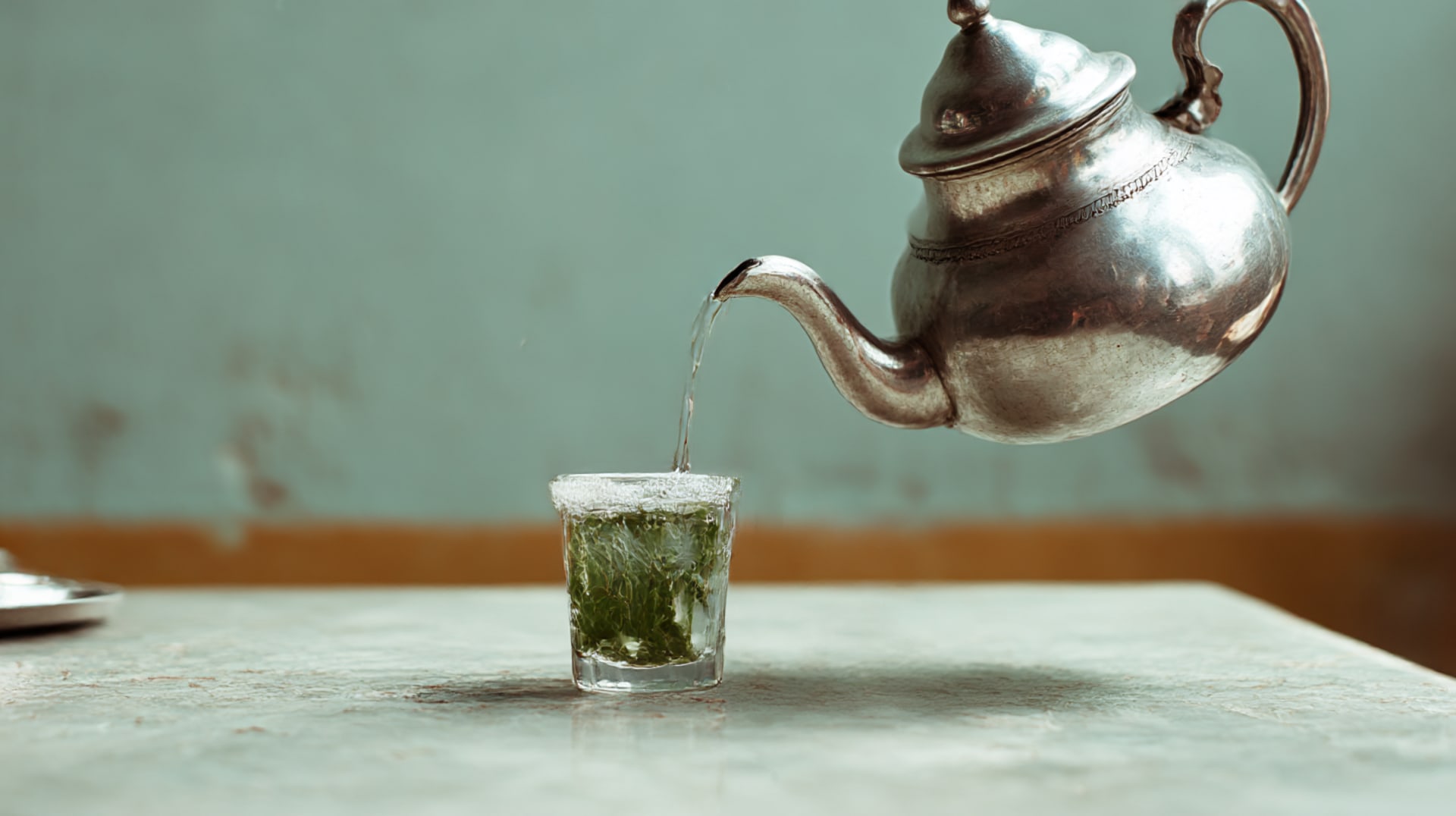
Then the pour. From height — a foot, sometimes two feet above the glass — the tea falls in a controlled arc. This is not performance. The height cools the tea, mixes the sugar, and creates the foam that should crown each glass like a small promise. A pour without foam is a pour without skill. A pour from too low is a pour from someone who has not been paying attention.
Three glasses is the minimum. The proverb varies — some versions reverse the order of life and death, which changes the philosophy considerably but not the number of glasses. What doesn't change is the obligation: you sit, you drink, you are present. The twenty minutes it takes from first boil to final glass is the point. You are not here to hydrate. You are here to be held. And there is always, always, another glass.
Three glasses. The first is bitter like life. The second is strong like love. The third is sweet like death.
Tell us about your trip →The Facts
- —Chinese gunpowder green tea arrived in Morocco 18th-19th century
- —'Atay' (tea) became national drink, replacing earlier beverages
- —Fresh spearmint (nana) is traditional; other herbs regional
- —Sugar is essential — traditionally whole cones, now cubes
- —Pour from height aerates tea and creates foam
- —Three glasses minimum for hospitality
- —Refusing tea is serious social offense
- —Tea service traditionally performed by male head of household
- —Modern variations include adding orange blossom, saffron, or verbena
Sources
- Wolfert, Paula. The Food of Morocco. Ecco/HarperCollins, 2011
- Hal, Fatéma. Les saveurs et les gestes: cuisines et traditions du Maroc. Stock, 1996
- Eickelman, Dale F. Moroccan Islam. University of Texas Press, 1976