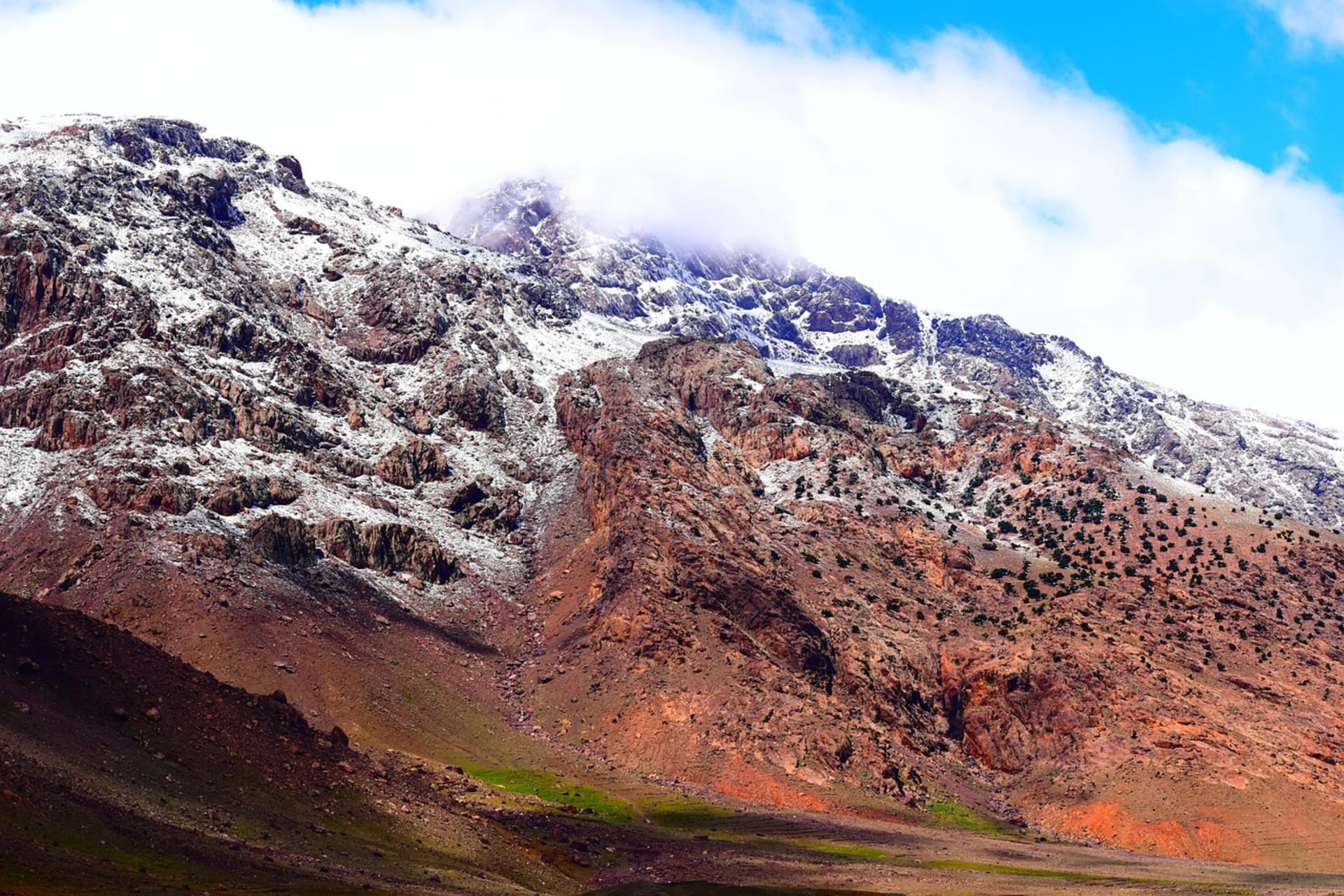
The High Atlas runs 700 kilometres from the Atlantic coast near Agadir to the Algerian border. Jebel Toubkal, at 4,167 metres, is the highest peak in North Africa — a fact that surprises people who picture Morocco as a land of flat deserts and do not expect to find a mountain that would be respectable in the Alps. The range is young, still rising, and carries snow from November to May. The passes — Tizi n'Tichka at 2,260 metres, Tizi n'Test at 2,092 metres — are the only road crossings between Marrakech and the south, which means that everything south of the Atlas has to come through them, and has been coming through them for a thousand years.
The Middle Atlas is gentler — rolling highlands of cedar forest, volcanic lakes, and alpine meadows that look like they were borrowed from Switzerland and returned slightly warmer. Ifrane, at 1,665 metres, is Morocco's coldest city and home to Al Akhawayn University. Michlifen offers skiing in winter — modest by Alpine standards but real, with lifts and equipment rental and the particular satisfaction of telling people you went skiing in Africa.
The Anti-Atlas is the oldest — Precambrian rock, some of it over 2 billion years old, which makes it older than complex life on earth. It is lower and drier than the other ranges, but its geology is extraordinary. The painted desert landscapes around Tafraout — pink granite boulders against almond groves — are unlike anything else in Morocco, or anywhere else, which is a claim the Anti-Atlas can make without exaggeration.
The mountains create Morocco's climate. North of the Atlas receives Mediterranean rainfall. South is Saharan. The mountains capture moisture from Atlantic weather systems and release it as snow, rain, and the rivers that irrigate the plains below. Without the Atlas, Marrakech would be desert. The city owes its existence to the mountains it looks up at every morning, a debt it acknowledges by naming its most famous square after a man — Jemaa el-Fna — and ignoring the mountains that made the square possible.
We build mountain journeys by season — almond blossoms in February, snow on Toubkal in April, walnut harvest in October.
Tell us about your trip →Data and visualisation by Dancing with Lions
The Facts
- —Three ranges: High Atlas, Middle Atlas, Anti-Atlas
- —Jebel Toubkal: 4,167m, highest peak in North Africa
- —High Atlas: snow-capped October-June
- —Middle Atlas: cedar forests, Barbary macaques
- —Anti-Atlas: granite, argan trees, oldest rock in Morocco
- —Tizi n'Tichka: highest paved pass (2,260m)
- —Atlas separates Mediterranean/Atlantic climate from Sahara
- —Still rising: African plate pushing into European plate
Sources
- Hughes, Robert. "Environmental Change in the Atlas Mountains." The Geographical Journal
- Dresch, Jean. "Le massif du Toubkal." Revue de Géographie Alpine
- Moroccan Haut-Commissariat aux Eaux et Forêts. Atlas mountain surveys