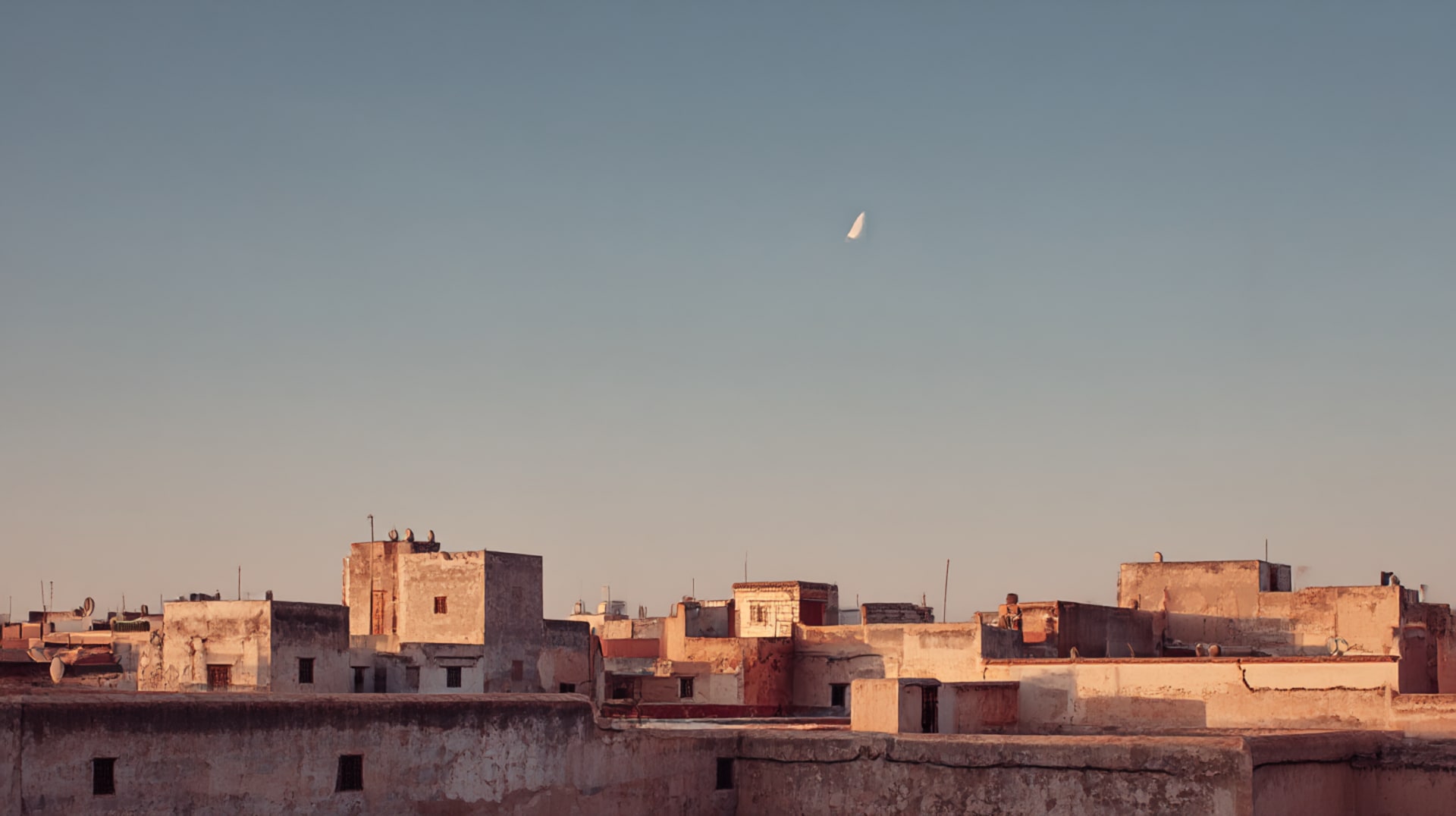
It begins with the moon.
Not a date on a calendar. The moon. A committee of scholars watches the sky on the 29th night of Sha'ban — the month before Ramadan — looking for the hilal, the thin crescent that appears after the new moon. If they see it, Ramadan begins the next day. If clouds cover the sky or the crescent is too faint, they wait one more day. The entire country pauses on that single sliver of light. No algorithm. No forecast. The sky decides.
Ramadan is the ninth month of the Islamic calendar — a lunar calendar, eleven days shorter than the solar one — which means it moves backward through the seasons. Some years it falls in winter, with short days and mild heat. Some years it falls in deep summer, with seventeen hours of daylight and temperatures above forty degrees. The difficulty is not fixed. It shifts. Every Muslim alive will eventually fast through every season.
In 2026, Ramadan began on February 19 and ends around March 20 — a winter Ramadan, with shorter fasting days and cool evenings. In 2027, it is expected to begin around February 8. By the 2030s it will fall in December. By the 2040s, in the heat of summer. The calendar circles. The faith holds.
The fast is one of the five pillars of Islam, alongside the declaration of faith, prayer, alms-giving, and pilgrimage to Mecca. It is not optional and it is not symbolic. From the first light of dawn to the moment the sun sets, nothing passes the lips. No food. No water. For roughly fifteen hours in a Moroccan spring, or seventeen in summer, the body empties itself. The purpose is not suffering. It is awareness. Of hunger, which most of the world knows involuntarily. Of thirst, which is the most basic human need. Of discipline, which is the muscle that prayer alone cannot build. And of gratitude, which requires knowing what absence feels like before you can understand what presence means.
The rhythm of the country changes. Work slows. Voices soften. The streets empty in the late afternoon as families prepare to break the fast at sunset. Then, when the adhan sounds from every mosque in the country at the same moment, the silence lifts. The meal is communal. The generosity is structural — families cook more than they need because someone nearby needs more than they have. Zakat, the giving of alms, intensifies during the holy month. What you saved by not eating, you give. This is not charity in the Western sense. It is obligation, built into the architecture of the faith.
After the evening meal, the city comes alive in a way that surprises visitors who expected solemnity. The streets fill. Children stay up late. Families visit each other. The energy that left the daytime has not disappeared — it has changed shift. Ramadan is not deprivation. It is a rearrangement of hours, a retuning of priorities, a month-long practice in remembering what matters.
Prayer deepens. Tarawih — the long evening prayers specific to Ramadan — fill the mosques after the last prayer of the day. Some worshippers complete the entire Quran over the course of the month, reading one thirtieth each night. The discipline of the body during the day is matched by the discipline of the spirit at night.
Laylat al-Qadr — the Night of Power — falls on one of the odd-numbered nights in the last ten days, most commonly the 27th. It is the night the first verses of the Quran were revealed to the Prophet Muhammad. Mosques fill beyond capacity. Many spend the entire night in prayer. The spiritual weight of this single night is described in the Quran as greater than a thousand months.
Then Eid al-Fitr. The morning after the last fast. New clothes. Families together. The joy is enormous — not because the discipline is over, but because it was completed. The month asked something difficult and the answer was yes, every day, for thirty days, because faith is not what you believe. It is what you do when the sun is high and the water is close and nobody is watching.
Ramadan journeys are among the most beautiful we offer. The ftour tables at sunset, the empty medinas at noon, the generosity of strangers.
Tell us about your trip →Data and visualisation by Dancing with Lions
The Facts
- —Ramadan: 9th month of Islamic lunar calendar
- —One of the five pillars of Islam
- —Begins when hilal (new crescent moon) is sighted by scholars
- —Lunar calendar: ~11 days shorter than solar year — Ramadan shifts through all seasons
- —Fast: dawn (fajr) to sunset (maghrib), no food or water
- —Tarawih: long evening prayers specific to Ramadan
- —Laylat al-Qadr (Night of Power): 27th night, first Quranic revelation
- —Zakat (alms-giving) intensifies during Ramadan
- —Eid al-Fitr: celebration marking the end of the month
- —Full cycle: every 33 years Ramadan returns to the same season
Sources
- Eickelman, Dale F. Moroccan Islam: Tradition and Society in a Pilgrimage Center. University of Texas Press, 1976
- Hammoudi, Abdellah. The Victim and Its Masks. University of Chicago Press, 1993
- Combs-Schilling, M. Elaine. Sacred Performances. Columbia University Press, 1989