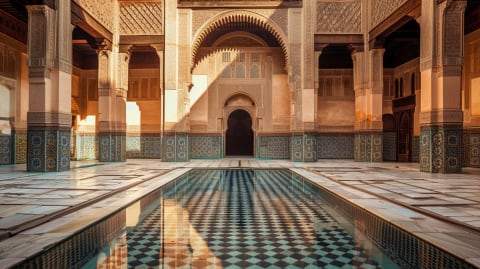
Fajr — dawn prayer — is called when the first light appears on the eastern horizon. In Marrakech, this ranges from 5am in June to quarter to seven in December. The city is still asleep. The medina is empty. The air is clean in a way it won't be again until tomorrow. Photographers call this blue hour — cool, shadowless, the colours of tadelakt and zellige glowing without competition from the sun. If you are awake for it, the city belongs to you and the cats and nobody else.
Then the sun arrives, and everything changes.
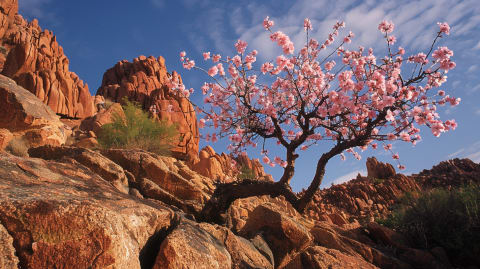
Sunrise in Morocco is theatrical in a way that sunrises in flatter countries cannot manage. The Atlas Mountains catch the first light while the valleys remain in shadow — a slow reveal, like a curtain being drawn across 700 kilometres of peaks. Marrakech, sitting on the Haouz Plain at 460 metres, receives light that has already crossed the High Atlas, filtered and softened. The pisé walls of the medina shift from grey to pink to orange in the first twenty minutes. The transformation is so reliable that photographers set their alarms by it and so beautiful that they do so without complaint.
The midday light is brutal and nobody pretends otherwise. From 11am to 3pm in summer, the sun sits directly overhead. Shadows disappear. Colours bleach. Photographers stop. The medina's narrow streets, which looked so charming at dawn, reveal their true purpose: they are shade machines. The covered souks, the moucharabieh screens, the deep doorways — all of it is light management technology, designed by people who understood that the sun is not always your friend and built accordingly.
Golden hour arrives in the late afternoon, and the city exhales. The light turns warm. Shadows lengthen. Surfaces that looked flat at noon suddenly have texture, depth, warmth. This is the famous Marrakech light — the one in every travel magazine, the one that made Matisse change his palette, the one that Churchill crossed a continent to paint. It lasts roughly 45 minutes before sunset, and it is the reason half the photographs you've seen of this city look the way they do.
Maghrib — sunset prayer — marks the moment the sun disappears below the horizon. The call to prayer and the last light arrive together, which feels deliberate even though it's astronomy. In Ramadan, this is the moment of ftour — the breaking of the fast — and the entire city pauses in a silence so complete you can hear the first spoon hit the first bowl of harira three streets away.
The Moroccan day is a light calendar. The five daily prayers track the sun's position. The agricultural calendar tracks the seasons. The photographic calendar tracks the quality of light. All three measure the same thing — the angle of the earth relative to its star — and all three have been doing so for longer than any clock.
We plan arrivals and departures around this light. The hour before maghrib in Fes is the reason we built The Slow Journey North.
Tell us about your trip →Data and visualisation by Dancing with Lions
The Facts
- —Dawn prayer: blue-gray light
- —Sunrise: pink walls
- —Mid-morning: warm gold
- —Midday: white-hot, flat shadows
- —Afternoon: amber, long shadows
- —Golden hour: deep orange on pisé
- —Sunset: maghrib call, purple Atlas
- —Blue hour: medina lanterns
- —Night: starlight on terraces
Sources
- World Meteorological Organization. Morocco climate profile
- Moroccan Direction de la Météorologie Nationale. Climate data
- Benabdallah, S. "Moroccan climate variability." International Journal of Climatology
Further Reading
Practical questions