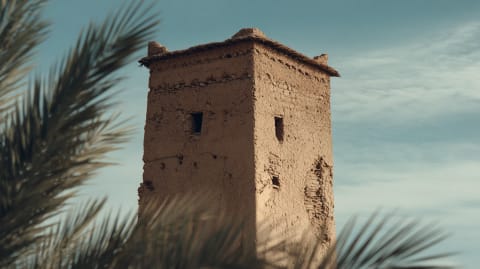
The oasis works in three layers. Date palms form the canopy — their fronds provide shade and reduce evaporation. Fruit trees occupy the middle tier — pomegranates, figs, almonds, apricots. Vegetables and cereals grow on the ground level — henna, alfalfa, barley, mint. Each layer protects the one below. Remove the palms and the system collapses.
Morocco has approximately 6.6 million date palms concentrated in three valleys: the Draa (the longest river in Morocco, 1,100 kilometres from the Atlas to the Atlantic), the Ziz (which feeds the Tafilalet oasis, the largest in Morocco), and the Todra-Dadès corridor.
The Medjool is the prestige date — large, soft, intensely sweet. It originated in the Tafilalet. Morocco, along with Israel and California, is one of the world's primary producers. But 453 cultivars have been documented in Moroccan oases — each with its own texture, sweetness, and use. Many exist in only a single oasis.
Bayoud disease — a fungal infection caused by Fusarium oxysporum — has devastated Moroccan palm groves since the early 20th century. Over 12 million palms have been lost. The disease spreads through irrigation water and has no cure — infected palms must be destroyed. Resistant varieties are being developed, but the replanting is slow.
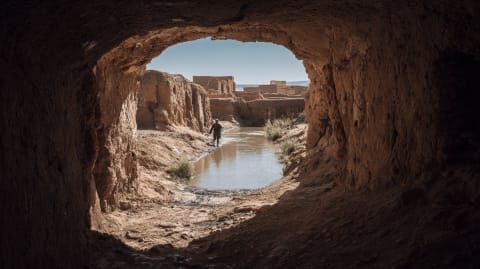
The khettara — underground irrigation channels — once fed these oases by tapping the water table with no pumps or energy input. The system is gravity-driven: a series of vertical shafts connected by a gently sloping tunnel that carries groundwater to the surface. The technology may have originated in Persia (where it is called qanat) or may have been independently invented in North Africa. Either way, it is failing — the water table has dropped below the level most khettaras can reach.
The oasis road from Ouarzazate to Zagora follows the Draa River. We stop where the irrigation channels meet the palms — the engineering is ancient and alive.
Tell us about your trip →Data and visualisation by Dancing with Lions
The Facts
- —Morocco: ~6.6 million date palms
- —Tafilalet: largest traditional oasis in the world
- —Draa Valley: 200km of palm groves
- —Over 200 date varieties in Morocco
- —Medjool: "king of dates," originated here
- —Bayoud disease destroyed millions of palms
- —Date harvest: October-November
- —Palm fronds used for baskets, roofing, rope
Sources
- FAO. Date palm cultivation report
- Moroccan Ministry of Agriculture. Draa-Tafilalet oasis data
- Mezzine, Larbi. Le Tafilalt. Faculté des Lettres, Rabat, 1987