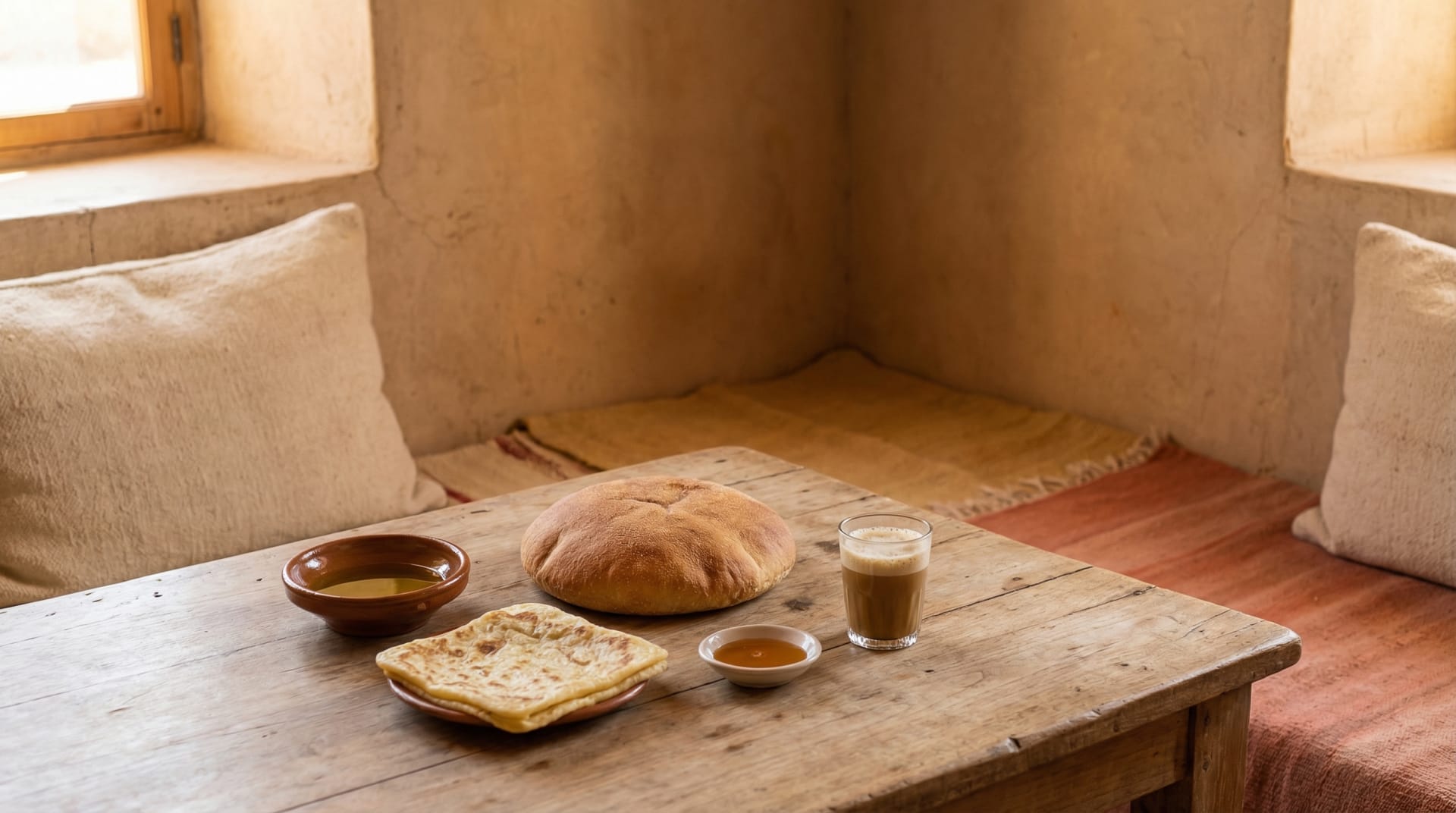
The bread arrives first. Khobz — the round daily loaf, baked at the neighbourhood ferran before dawn. Msemen — the layered, pan-fried flatbread, flaky and slightly chewy, folded in squares. Baghrir — the thousand-hole semolina pancake, spongy with a surface like a crumpet, served hot from the griddle. Harcha — a semolina cake, dense and crumbly, fried in oil. On a good morning, all four appear on the table at once.
Then the spreads. Olive oil, green and peppery, in a shallow bowl for dipping. Honey — orange blossom or thyme, depending on the region. Amlou — a thick paste of roasted almonds, argan oil, and honey that is often called Moroccan peanut butter, though the comparison is an insult to amlou. Jben — a fresh, soft white cheese, sometimes salted, sometimes plain. La Vache Qui Rit — the Laughing Cow cheese triangles that appear on every Moroccan breakfast table for reasons that probably say something about the Protectorate's cultural legacy.
Eggs. Hard-boiled, or fried with cumin. In some regions, a berber omelette — eggs cooked in a tagine dish with tomatoes, peppers, and onions.
Olives. Always olives. Green, black, cracked, cured. Moroccans put olives on the breakfast table the way Americans put butter on theirs.
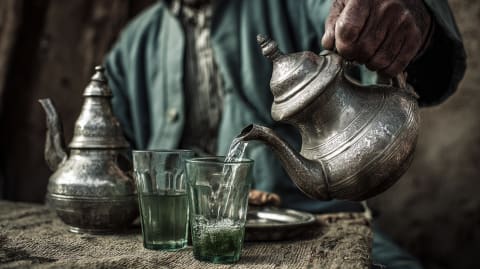
Tea or coffee. Mint tea in the countryside and for formal occasions. Nous-nous — espresso with steamed milk — in the cities. Café noir if you need it strong.
The Moroccan breakfast is not a meal you order. It is a meal that appears. In a riad, it will be laid out on the courtyard table or the rooftop terrace when you come down. In a local café, you point at the msemen on the griddle and the man hands you one folded around honey for five dirhams. In a family home, the table is set before anyone speaks, because breakfast in Morocco is not a conversation — it is a fact of the morning, as reliable as the call to prayer.
The Facts
- —Khobz: daily round bread, baked at ferran
- —Msemen: layered flatbread, pan-fried
- —Baghrir: thousand-hole semolina pancake
- —Harcha: semolina griddle cake
- —Amlou: almond + argan oil + honey paste
- —Olives: always present at breakfast
- —Nous-nous: espresso with steamed milk
- —Café msemen: ~5 MAD
Sources
- Wolfert, Paula. The Food of Morocco. Ecco/HarperCollins, 2011
- Morse, Kitty. Cooking at the Kasbah. Chronicle Books, 1998
- Roden, Claudia. Arabesque. Knopf, 2005
Practical questions