The herboriste — the traditional herbalist — occupies a specific location in every souk. The stall is unmistakable: pyramids of dried herbs, roots, bark, and resins; jars of oils and honeys; bundles of dried flowers hanging from the ceiling. The smell is dense and layered — mint, eucalyptus, cumin, rose, and things you cannot name.
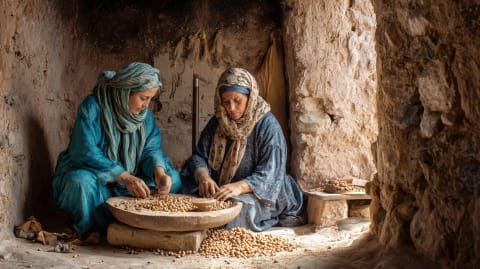
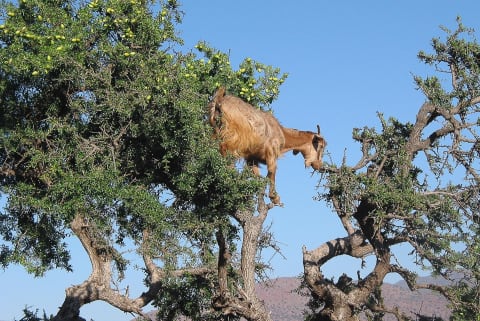
Argan oil is the star export. Cold-pressed from the kernels of the argan tree — endemic to the Souss region — it has become a global cosmetic ingredient. Culinary argan oil (from roasted kernels) has a nutty, toasted flavour used in amlou (a paste with almonds and honey) and salad dressings. Cosmetic argan oil (from raw kernels) is lighter and used for skin and hair. The cooperatives that produce it — mostly women's cooperatives — have become a model for rural development.
Black seed (habba sawda, Nigella sativa) is Morocco's most widely used traditional remedy. A hadith attributed to the Prophet Muhammad states that black seed cures everything except death. Moroccans take it for digestion, immunity, respiratory issues, and general health. Modern research has identified thymoquinone — the active compound — as having anti-inflammatory and antioxidant properties.
Khôl (kohl) is the traditional eyeliner — ground antimony or lead sulphide applied with a thin stick (mirwed). It is cosmetic, cultural, and medicinal — traditionally believed to strengthen eyesight and protect against the evil eye. Modern health authorities warn against lead-based khôl, and many producers have shifted to plant-based alternatives.
Rose water from the Dadès Valley, orange blossom water from the Khemisset region, eucalyptus oil from the Rif — the herboriste stocks regional products from across the country. Ghassoul clay from the Middle Atlas is used as a hair and skin treatment. Henna from the Draa Valley is applied for ceremonies and hair colouring.
The herboriste is not a doctor, but the role overlaps. For many Moroccans — particularly in rural areas where clinics are distant — the attar is the first point of consultation for minor ailments. The knowledge is transmitted through apprenticeship, not formal education. The pharmacopoeia is oral, regional, and centuries deep.
The herbalists of the Rahba Kedima in Marrakech are one of our quieter recommendations. No hard sell — just knowledge stacked floor to ceiling.
Tell us about your trip →Data and visualisation by Dancing with Lions
The Facts
- —Attarin: herbalist/apothecary stalls in medina
- —Traditional remedies: argan oil, black seed (nigella), henna
- —Khôl: antimony-based eyeliner, ancient practice
- —Aker fassi: lip/cheek stain from poppy and pomegranate
- —Orange blossom water: digestive and calming
- —Ras el hanout also sold as medicine
- —Herbal knowledge passed generationally
- —Coexists with modern pharmacies
Sources
- Bellakhdar, Jamal. La pharmacopée marocaine traditionnelle. Ibis Press, 1997
- Wolfert, Paula. The Food of Morocco. Ecco/HarperCollins, 2011
- Lardos, Andreas. "Historical approaches to the traditional uses of medicinal plants." Journal of Ethnopharmacology, 2006