The cannons on Essaouira's ramparts have not been fired in two hundred years. They face the ocean as if still waiting.
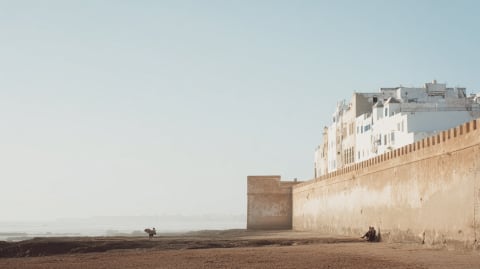
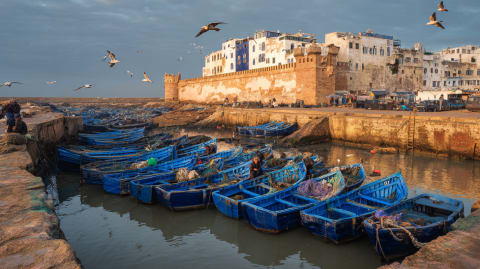
The Skala du Port is the sea-facing bastion of Essaouira, a fortified platform built in the 18th century as part of the city's coastal defences. It sits above the harbour, overlooking the fishing port and the Iles Purpuraires — the small islands offshore where the Romans once harvested murex snails for Tyrian purple dye.
The Portuguese cannons that line the rampart — heavy iron pieces on wooden carriages — were collected from various European sources over the centuries. They are not all Portuguese, despite what the guides say. Some are Spanish. Some are Dutch. They represent the accumulated military hardware of a port city that traded with everyone and defended itself against the same.
Orson Welles filmed parts of Othello on the skala in 1949. The ramparts stood in for the fortress of Cyprus. If you have seen the film, the walls are recognizable.
Today the skala is the most photographed spot in Essaouira. The combination of stone ramparts, bronze cannons, crashing waves, and the view across the harbour to the medina is the image that appears on every postcard and every Instagram feed. Painters set up easels here. Fishermen sell sardines below.
The cannons have oxidised to a deep green. The stone has been weathered smooth by salt and wind. Everything is in its correct state of decay, which is to say: beautiful and finished and pointing at nothing.
The Facts
- —The Skala du Port is the sea-facing bastion of Essaouira, a fortified platform built in the 18th century as part of the city's
- —Orson Welles filmed parts of Othello on the skala in 1949.
Sources
- Parker, Richard. A Practical Guide to Islamic Monuments in Morocco. Baraka Press, 1981
- Deverdun, Gaston. Marrakech: des origines à 1912. Éditions Techniques Nord-Africaines, 1959
- Meakin, Budgett. The Moorish Empire. Swan Sonnenschein, 1899
Practical questions