In the 1760s, Sultan Mohammed III wanted a new port. He asked a French architect to design it. The result is the only city in Morocco built on a European grid.
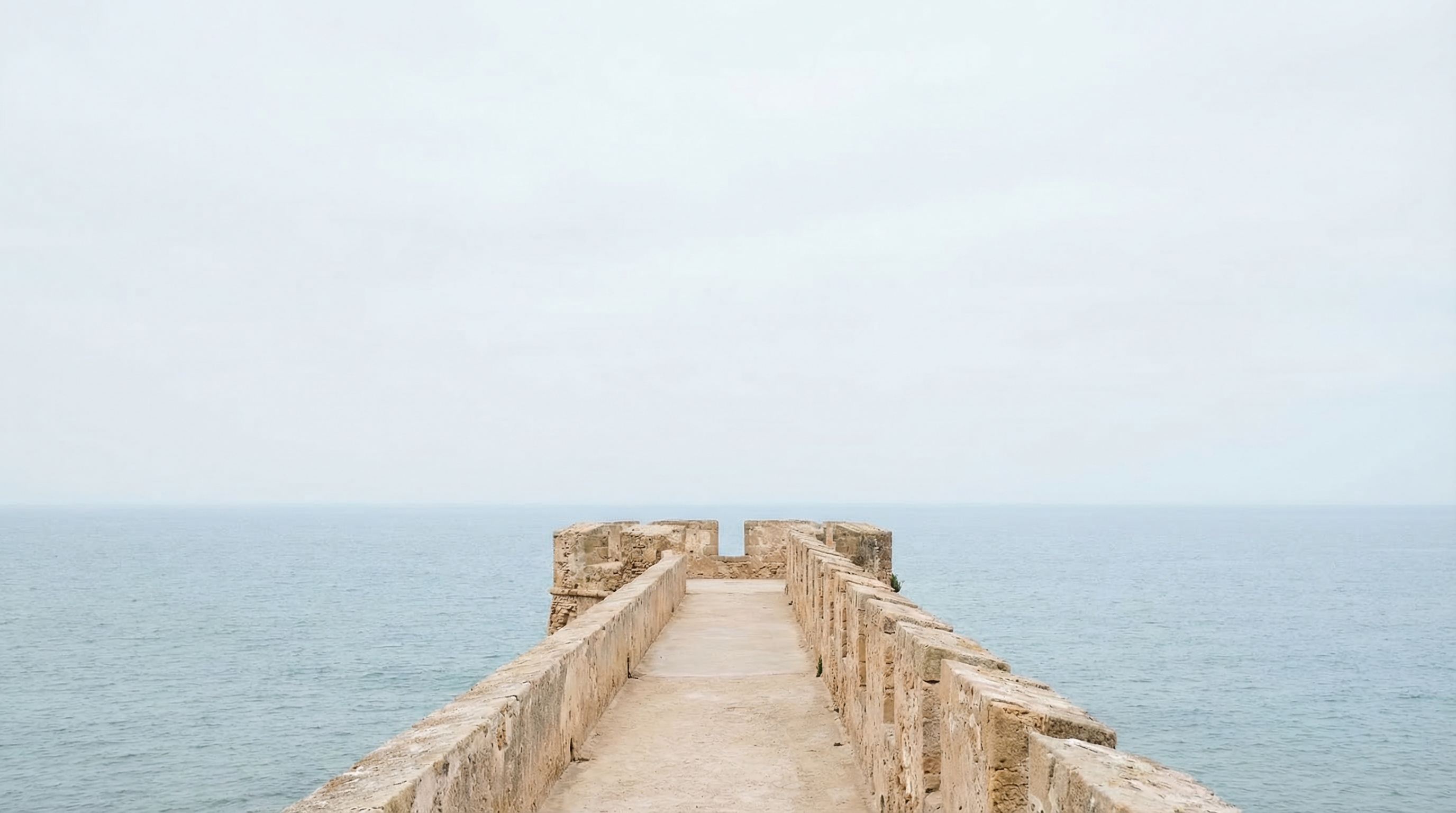
Essaouira — then called Mogador — was not an organic city like Fes or Marrakech, where streets grew along donkey paths and neighbourhoods accumulated over centuries. It was planned. Theodore Cornut, a French engineer who had been captured by the Moroccans and put to work, laid out the medina on a grid pattern influenced by European military architecture. The ramparts that face the sea — the skala — were modelled on Vauban fortifications, the same defensive system the French used on their own Atlantic coast.
The result is a medina unlike any other in Morocco. The streets are straight. They intersect at right angles. You can see from one end of town to the other. In Fes or Marrakech, the medina is a labyrinth. In Essaouira, it is a diagram.
The ramparts face the Atlantic, and the Atlantic has been trying to take them back since the day they were built. The Portuguese cannons that line the skala — left over from an earlier colonial presence — point out to sea, green with oxidation. The wind blows constantly. Essaouira is the windiest city on the Moroccan coast, which is why surfers came and the beach resort industry did not.
Mohammed III built Essaouira as a trading port to rival Agadir, which was controlled by a rebellious tribe. He invited European merchants, Amazigh traders, and Jewish brokers to establish businesses. The Jewish community became one of the most prominent in Morocco — at its peak, nearly forty percent of the population of the mellah was Jewish.
The walls are still there. The grid is still there. The wind has not stopped.
The Facts
- —The Jewish community became one of the most prominent in Morocco — at its peak, nearly forty percent of the population of the
Sources
- UNESCO World Heritage. Medina of Essaouira (formerly Mogador), nomination file, 2001
- Caillé, Jacques. La ville de Rabat jusqu'au protectorat français. Vanoest, 1949
- Deverdun, Gaston. Marrakech: des origines à 1912. 1959
Practical questions