The man unrolls sixty carpets in forty minutes. He does not expect you to buy sixty. He expects you to understand that each one is different, and that the differences matter.
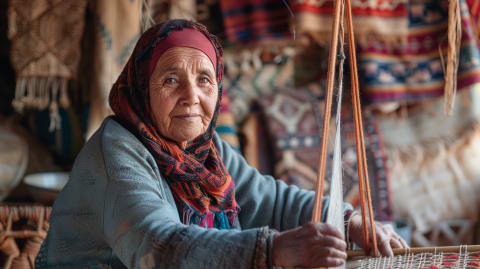
Moroccan carpets divide into two families. Pile carpets come from the Middle Atlas — thick, knotted, heavy, made for cold mountain winters. The wool is hand-spun from the family’s own sheep, dyed with natural pigments (pomegranate for yellow, indigo for blue, madder root for red), and knotted by women on vertical looms in patterns that are passed mother to daughter. A single carpet takes two to six months. The density is measured in knots per square centimetre — higher is finer, but not necessarily better. A coarse tribal carpet has a character that a fine urban one does not.
Flat-weave carpets — kilims and hanbels — come from the plains and the south. They are lighter, thinner, woven rather than knotted, and geometric rather than figurative. The Haouz region around Marrakech produces flat-weaves with bold black and white stripes. The Tazenakht area in the Anti-Atlas produces the deep saffron-and-crimson Ouzguita carpets. Azilal produces the shaggy, abstract, almost modern-looking boucherouite rugs made from recycled fabric scraps — the ones that sell for thousands in design shops in Brooklyn and Shoreditch.
The symbols are a language. The diamond — ubiquitous in Amazigh textile design — represents the feminine, protection, the eye. Zigzag lines are water or mountains. Crosses ward off the evil eye. Hands (the khamsa) appear as protection. Some motifs are tribal markers. Others are personal — a woman weaving her dowry carpet might encode the number of children she wants, or a memory of a specific place. Reading a carpet requires knowing which tribe made it, which is why the salesman’s lecture matters more than it seems.
The buying ritual is a performance with real stakes on both sides. Tea is served. Carpets are unrolled. The seller tells you the origin, the materials, the technique. The first price is high — often four to eight times what the seller expects to receive. Your counter-offer should be low — one-quarter to one-third of the asking price. The negotiation converges from both sides. Walking out is expected and strategic. Being called back means you are close to the real price. The final number should feel fair to both parties — if you feel you ‘won,’ you probably paid market rate. If the seller looks unhappy, you went too low and the relationship is damaged.
How to tell quality: flip the carpet over. The back should be as clear as the front — tight, even knots with the pattern visible in reverse. Pull a tuft gently — it should resist. Smell the wool: lanolin is good, chemical dye smells sharp and acrid. Natural dye smells like earth. Vegetable-dyed carpets fade gently over decades. Chemical-dyed carpets fade unevenly and quickly. A vegetable-dyed carpet costs more and is worth more — both as an object and as a future heirloom.
The best carpets in Morocco are not in the tourist souks. They are in the cooperative showrooms of the Middle Atlas towns — Azrou, Ifrane, Midelt — where the women who made them set the prices. They are in the auction markets (souk des tapis) held weekly in towns like Tazenakht, where dealers buy wholesale. And they are in the homes of collectors who have spent decades learning the difference between a tourist carpet and a tribal one.
A good carpet is not cheap. A great carpet is an investment that appreciates. The floor you are standing on is someone’s six months of work, her mother’s patterns, her grandmother’s wool. Price accordingly.
Sixty carpets in forty minutes. The man expects you to understand each one is different. Ten days on the textile trail and you will.
Tell us about your trip →The Facts
- —Two families: pile carpets (Middle Atlas) and flat-weave (kilims/hanbels)
- —Pile carpets: hand-spun wool, natural dyes (pomegranate, indigo, madder root)
- —Single carpet takes 2-6 months
- —Density measured in knots per square centimeter
- —Flat-weaves are lighter, geometric, for warmer climates
- —60 carpets unrolled in 40 minutes — standard merchant presentation
- —Patterns passed mother to daughter
Sources
- Fiske, Patricia, W. Russell Pickering, and Ralph Yohe, eds. From the Far West: Carpets and Textiles of Morocco. The Textile Museum, Washington, 1980
- Pickering, W. Russell. "Moroccan Flatweaves." Hali, 1979
- Sijelmassi, Mohamed. Les arts traditionnels au Maroc. Flammarion, 1986
- Besancenot, Jean. Costumes du Maroc. Éditions de l'Érable, 1942.
Further Reading
Practical questions