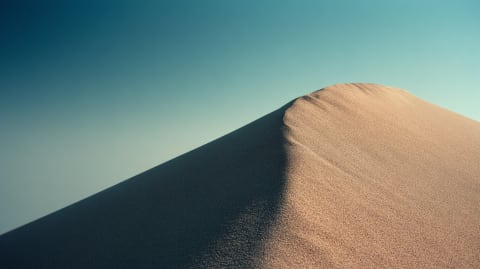
Agafay has no sand.
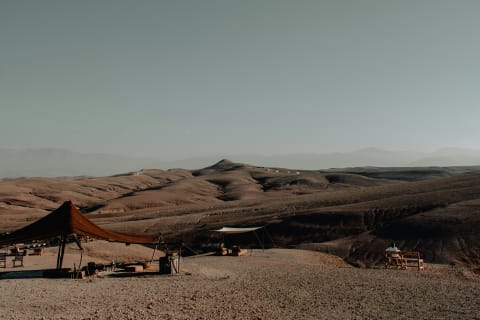
Forty-five minutes from Marrakech, on the road toward the Atlas Mountains, the land opens into a rolling grey-brown landscape of rocky hammada — flat, dry, treeless, scattered with stones. It looks like the surface of the moon and photographs like the Sahara if you frame it carefully. This is Agafay, and the tourism industry has turned it into a desert experience for people who do not have time to reach the real one.
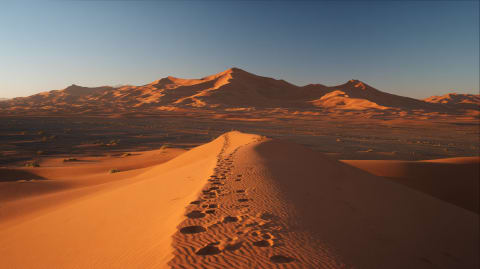
The Sahara is ten hours from Marrakech. Agafay is forty-five minutes. The glamping camps that have sprouted across the plateau — white canvas tents, swimming pools, sunset cocktails, camel rides — serve the traveller who has three days in Morocco and wants a desert photo. The experience is real enough: the silence, the stars at night, the vastness. What is missing is the sand.
Agafay is technically not a desert at all. It is an arid plain, a stony plateau between the Haouz agricultural belt and the foothills of the Atlas. In winter it can rain. In spring, patches of green appear. Shepherds graze flocks here when there is something to eat.
The camps range from modest to extravagant. Some sit near the road and you can hear traffic. Others are set deeper into the plateau, far enough from the highway that the illusion holds. A few are genuinely beautiful — well-designed, well-run, with food and service that justify the price.
The honest camps tell you it is not the Sahara. The dishonest ones let you believe it is. Either way, the sunset from Agafay, with the Atlas Mountains turning pink and the plain stretching flat to the horizon, is worth the drive.
Sources
- Porch, Douglas. The Conquest of the Sahara. Knopf, 1984
- Julien, Charles-André. History of North Africa. Routledge, 1970
- Choplin, Armelle & Lombard, Jérôme. "Saharan Urbanization." Geographical Review
Practical questions