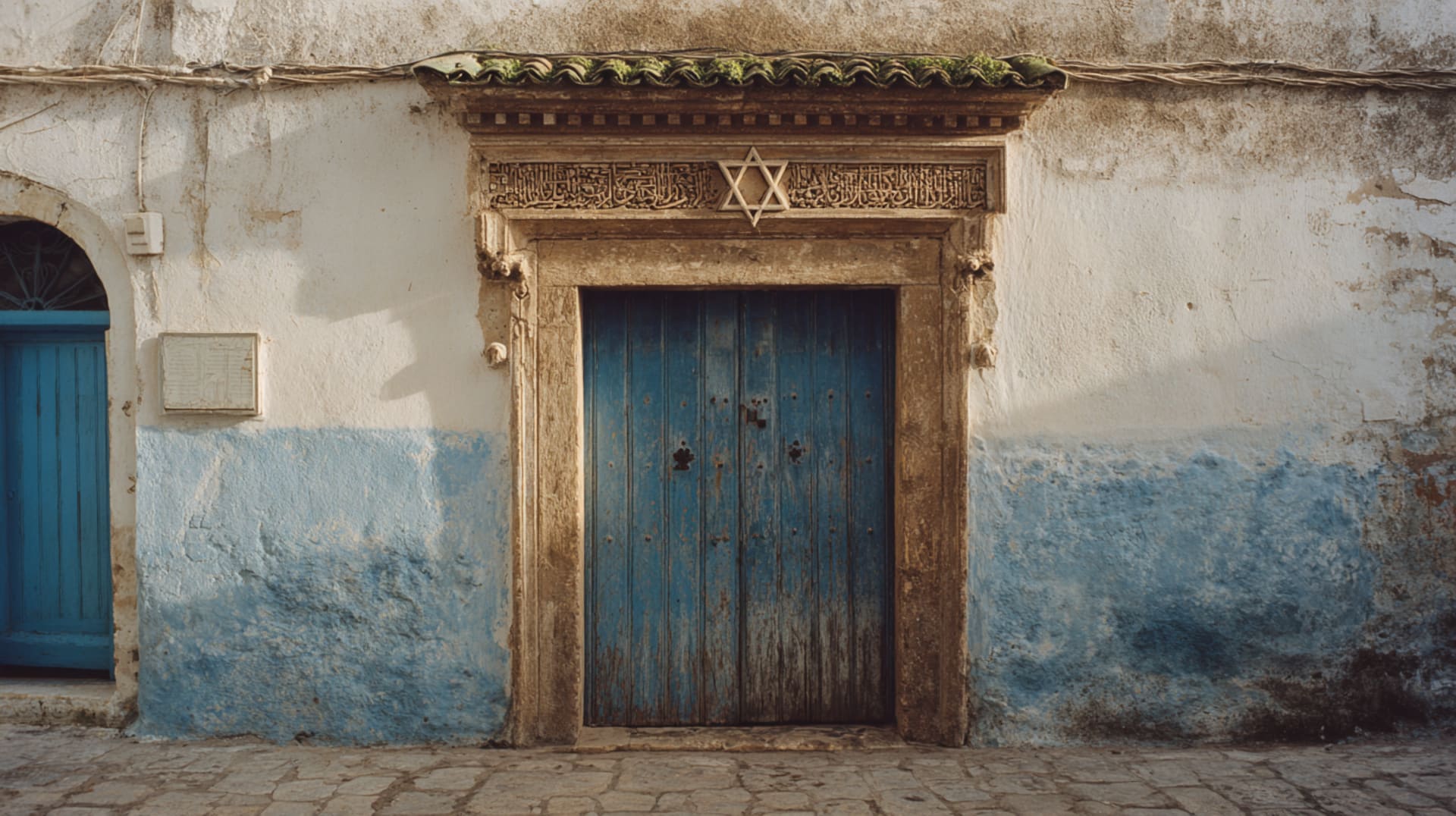
Walk the mellah and the Stars of David are still carved above the doorways. Not hidden, not discreet. Displayed, on the facades of houses in a majority-Muslim city. Nobody chiselled them off after the families left.
By the late 1880s, Jews were nearly forty percent of Essaouira. Not in a quarter. Not behind walls. Everywhere. Some wealthier families lived outside the mellah entirely — unusual in Morocco. In Essaouira, the containment had loosened. The Jews were running the port.
This was by design. In the 18th century, Sultan Sidi Mohamed ben Abdallah chose Essaouira as his trading gateway to Europe. He appointed Jewish families — the tujjar as-sultan, the merchants of the king — to run international commerce from the harbour. These were not token appointments. The merchants controlled trade networks from sub-Saharan Africa to London and Amsterdam. They spoke Arabic, Hebrew, French, English, Spanish, and Portuguese. They understood letters of credit, maritime insurance, and customs law.
The Chaim Pinto Synagogue still functions. Named after a rabbi born in Agadir in 1749 who built his synagogue in the mellah and taught Torah until his death in 1845. Every September, 1,500 pilgrims gather for the hiloula. Joseph Sebag, whose ancestors fled the Spanish Inquisition, may be the last permanent Jewish resident.
The Simon Attias Synagogue — named after a great Jewish merchant — now houses a museum and research centre. The Slat Lkahal, where the community held assemblies and young people sang songs written by rabbi-poets, was renovated in 2010.
Bayt Dakira — the House of Memory — opened in 2020. Not a museum exactly. A space for inter-religious dialogue, in the heart of the mellah where Jewish and Muslim Essaouirans lived side by side for three centuries.
The Jewish cemetery sits on cliffs overlooking the Atlantic. Cubist tombstones with Amazigh design elements, unlike any other Jewish cemetery in the world. The wind never stops.
Forty percent. That is not a minority. That is a city built by two communities. The doorways remember.
The Stars of David are still carved above the doorways in Essaouira. Forty percent. Nobody chiselled them off.
Tell us about your trip →The Facts
- —Jews were ~40% of Essaouira by late 1880s
- —Stars of David still carved above doorways — never chiselled off
- —Sultan Sidi Mohamed ben Abdallah chose Essaouira as trading gateway to Europe
- —Appointed Jewish tujjar as-sultan (merchants of the king)
- —Jewish families ran international commerce from the harbour
- —Some wealthy families lived outside the mellah — unusual in Morocco
- —Not token appointments — merchants controlled trade
Sources
- Gottreich, Emily. The Mellah of Marrakesh. Indiana University Press, 2007
- Laskier, Michael. The Alliance Israélite Universelle and the Jewish Communities of Morocco. SUNY Press, 1983
- Haut-Commissariat au Plan. Census data on religious minorities
Further Reading
Practical questions