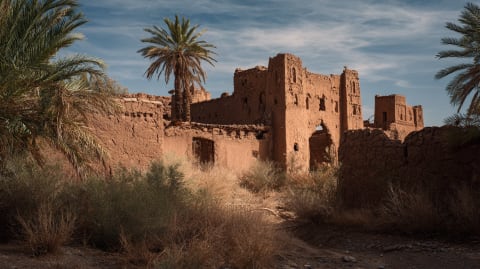
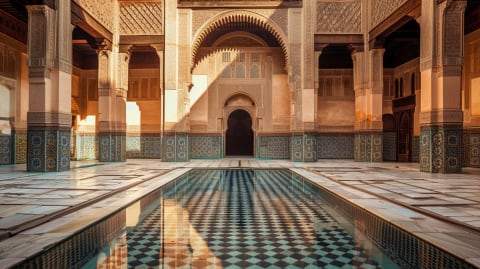
The house changed hands for four centuries. The garden kept growing.
Le Jardin Secret sits in the northern part of the Marrakech medina, behind an unremarkable door on a street you would not find without a map. Inside, two gardens — one Islamic, one exotic — occupy the courtyard of a house that was first built in the Saadian era, roughly the 16th century.
The property was rebuilt in the mid-19th century by a powerful qaid and then again by a later owner. Over the centuries it served as a private residence for members of the Moroccan elite. It fell into ruin in the 20th century, was purchased and restored between 2008 and 2016, and opened to the public as a garden and cultural space.
The Islamic garden follows the classical chahar bagh pattern — a four-part division with water channels running between the quadrants, a model that traces back to Persian gardens and was refined across the Islamic world. The plants are those mentioned in the Quran or traditional to Moroccan gardens: citrus, jasmine, pomegranate, rose.
The exotic garden was added during the 19th-century rebuild, reflecting the period's fashion for importing tropical plants. It contains species from across the subtropics — a Victorian collector's impulse applied to a Moroccan riad.
The most striking feature is the original water system. The house sits on a khettara — one of the underground irrigation channels that supplied the medina — and the restoration uncovered and reactivated the historic water infrastructure. The channels that irrigate the garden today follow the same routes they followed in the 16th century.
There is a tower you can climb for a view across the medina rooftops to the Atlas Mountains. A café serves tea in the courtyard. The garden is quiet. In a city of 900,000 people, behind a door you almost miss, someone has been growing things for four hundred years.
The Facts
- —Inside, two gardens — one Islamic, one exotic — occupy the courtyard of a house that was first built in the Saadian era, roughly
- —The property was rebuilt in the mid-19th century by a powerful qaid and then again by a later owner.
- —It fell into ruin in the 20th century, was purchased and restored between 2008 and 2016, and opened to the public as a garden and
- —The exotic garden was added during the 19th-century rebuild, reflecting the period's fashion for importing tropical plants.
- —The channels that irrigate the garden today follow the same routes they followed in the 16th century.
- —In a city of 900,000 people, behind a door you almost miss, someone has been growing things for four hundred years.
Sources
- Wilbaux, Quentin. La médina de Marrakech: formation des espaces urbains. L'Harmattan, 2001
- Ragette, Friedrich. Traditional Domestic Architecture of the Arab Region. Edition Axel Menges, 2003
- Touri, Abdelaziz. Patrimoines du Maroc. UNESCO/Ministry of Culture
Practical questions