In 1980, on his birthday, Hassan II told Casablanca what he wanted. Not beside the ocean. On it.
The verse from the Quran he cited was specific: "His throne was upon the water." The king wanted worshippers to pray on firm ground while the Atlantic moved beneath them. The architect he chose, Michel Pinseau, was French but had lived in Morocco long enough to know what was being asked. What followed was seven years of construction that turned a rocky outcrop on the Casablanca shoreline into the second-largest mosque in the world.
The numbers are hard to process at human scale. The minaret rises 210 metres — 60 stories — with a laser at its tip that points toward Mecca after sundown. The prayer hall fits 25,000 worshippers inside, another 80,000 in the courtyard. Notre-Dame de Paris would fit inside the central hall. The roof is retractable, opening in five minutes on a rolling chain mechanism so the faithful can see the sky. The floors are heated. Parts of the floor are glass, so you kneel and pray over the sea.
At the peak of construction, 1,400 men worked by day and 1,100 by night. Ten thousand craftsmen from every region of Morocco — 854 master carpenters, 80 master plasterers, 100 master zellige cutters. Every material came from within the country: cedar from the Middle Atlas, marble from Agadir, granite from Tafraout. Only the white granite columns and the glass chandeliers were imported — from Murano, in Italy. The doors are titanium, because salt air corrodes everything else.
The mosque was supposed to open in 1989, for the king's 60th birthday. It opened in August 1993.
The cost remains a subject Moroccans discuss carefully. Estimates range from 500 million to 800 million dollars. In 1988, Hassan II launched a national contribution campaign. Every Moroccan was invited to give — starting from one dirham. Twelve million people contributed within 40 days. Each received a certificate with a photograph of the mosque. Whether all contributions were entirely voluntary is a question that has been asked since and answered differently depending on whom you ask.
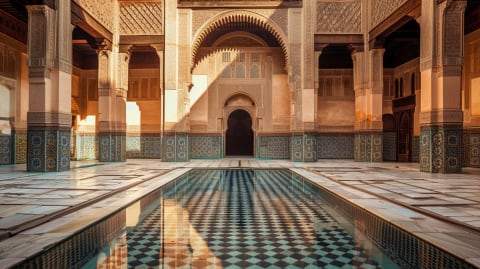
What is not debatable is the building itself. The exterior tilework alone — pale blues, ivories, yellows — took years. The interior stucco was carved by hand, not moulded. The cedar ceilings follow patterns that trace back to the Marinid era. The zellige on the floors uses geometry that has been refined for eight centuries.
Within ten years of completion, the ocean had already begun its work. Major restoration was required. The building was engineered to withstand earthquakes, but saltwater is patient. The restoration ran from 2005 to 2008 and cost 10 million euros.
The mosque is one of two in Morocco open to non-Muslims. Guided tours run several times daily. Three hundred thousand foreign tourists visit every year.
Hassan II died in 1999, six years after his mosque opened. He is not buried there. His mausoleum is in Rabat, beside the unfinished tower his ancestor started eight centuries earlier. But in Casablanca, on the Atlantic, the laser still traces a line toward Mecca every evening. The faithful still kneel on heated marble while the ocean moves beneath the glass.
The Facts
- —In 1980, on his birthday, Hassan II told Casablanca what he wanted.
- —The minaret rises 210 metres — 60 stories — with a laser at its tip that points toward Mecca after sundown.
- —The prayer hall fits 25,000 worshippers inside, another 80,000 in the courtyard.
- —At the peak of construction, 1,400 men worked by day and 1,100 by night.
- —Ten thousand craftsmen from every region of Morocco — 854 master carpenters, 80 master plasterers, 100 master zellige cutters.
- —The mosque was supposed to open in 1989, for the king's 60th birthday.
- —It opened in August 1993.
Sources
- Parker, Richard. A Practical Guide to Islamic Monuments in Morocco. Baraka Press, 1981
- Marçais, Georges. L'architecture musulmane d'occident. Arts et Métiers Graphiques, 1954
- UNESCO World Heritage. Medina of Essaouira, nomination file, 2001
Practical questions