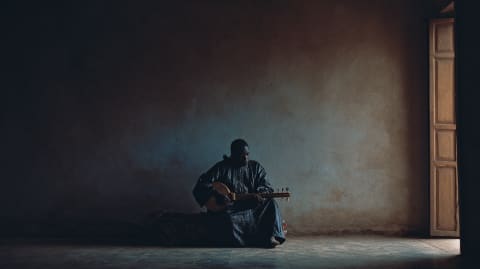
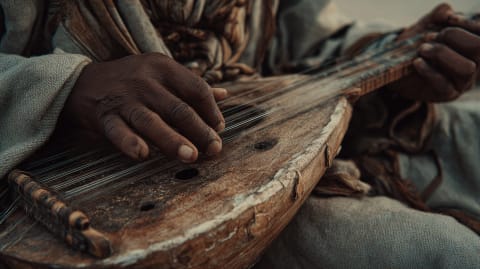
The guembri strikes a note so low you feel it in your ribs before your ears catch up. Three strings, carved from a single piece of walnut or mahogany, covered with camel skin. It does not sound like a guitar. It does not sound like a bass. It sounds like something older than both — a pulse that comes up through the floor and settles in your chest.
The Gnawa are descendants of enslaved people brought from West Africa — from what is now Mali, Guinea, Ghana, Senegal — along the trans-Saharan routes that carried gold and salt northward and human beings with them. The music they carried survived the crossing. It survived conversion, assimilation, centuries of forgetting. It survived because you cannot kill a rhythm that lives in the body.
In Morocco, West African percussion traditions fused with Sufi Islam — specifically the trance practices of the zaouias — and produced the lila: an all-night ceremony of music, dance, and spiritual healing that runs from sunset to sunrise. If you've never sat through one, it is hard to explain what happens at 3am when the guembri has been playing for six hours and the room has entered a state that is not quite music and not quite prayer and not quite anything you have a word for.
The lila follows a colour sequence. Each colour corresponds to a spirit family — the mlouk. White for the saints. Blue for the sea spirits. Red for the slaughterhouse spirits. Black for the Gnawa ancestors. Green for the forest. Yellow for the feminine spirits. The maalem — the master musician — moves through these colour-coded suites in a fixed order. Participants dressed in the corresponding colour may enter trance during their suite. It is specific, structured, and ancient. It looks like chaos. It is not.
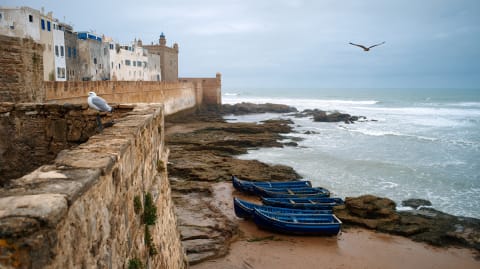
Essaouira is the spiritual capital. The annual Gnawa and World Music Festival, founded in 1998, draws hundreds of thousands of people who come to hear the music in the open air and feel the Atlantic wind and think they understand. But the real practice happens in private — in homes, at shrines, in the zaouias of Marrakech's Rahba Kedima and the Mellah, where the candles burn and the incense thickens and the maalem plays until the spirits decide they are done.
UNESCO inscribed Gnawa on the Intangible Cultural Heritage list in 2019. The musicians were pleased. The spirits were not consulted.
Essaouira in June, during the Gnawa Festival, is a journey we build every year. The music fills the ramparts.
Tell us about your trip →Data and visualisation by Dancing with Lions
The Facts
- —Origins: sub-Saharan Africa via trans-Saharan slave trade
- —Guembri: 3-string bass lute, walnut body, camel skin
- —Lila: all-night trance ceremony
- —Seven colour-coded musical suites (mluk)
- —UNESCO Intangible Cultural Heritage since 2019
- —Essaouira Gnawa Festival: largest annual gathering
- —Parallels to blues, gospel, jazz — same African root
Sources
- Kapchan, Deborah. Traveling Spirit Masters: Moroccan Gnawa Trance and Music in the Global Marketplace. Wesleyan University Press, 2007
- Pâques, Viviana. La religion des esclaves. Istituto Italo-Africano, 1991
- Ennaji, Mohammed. Serving the Master: Slavery and Society in Nineteenth-Century Morocco. St. Martin's Press, 1999
Practical questions