The spatial logic of a Moroccan souk follows a single rule: the cleaner and more valuable the trade, the closer it sits to the mosque. This is not a guideline. It is a law of urban physics that has been organising Islamic markets since at least the 9th century.
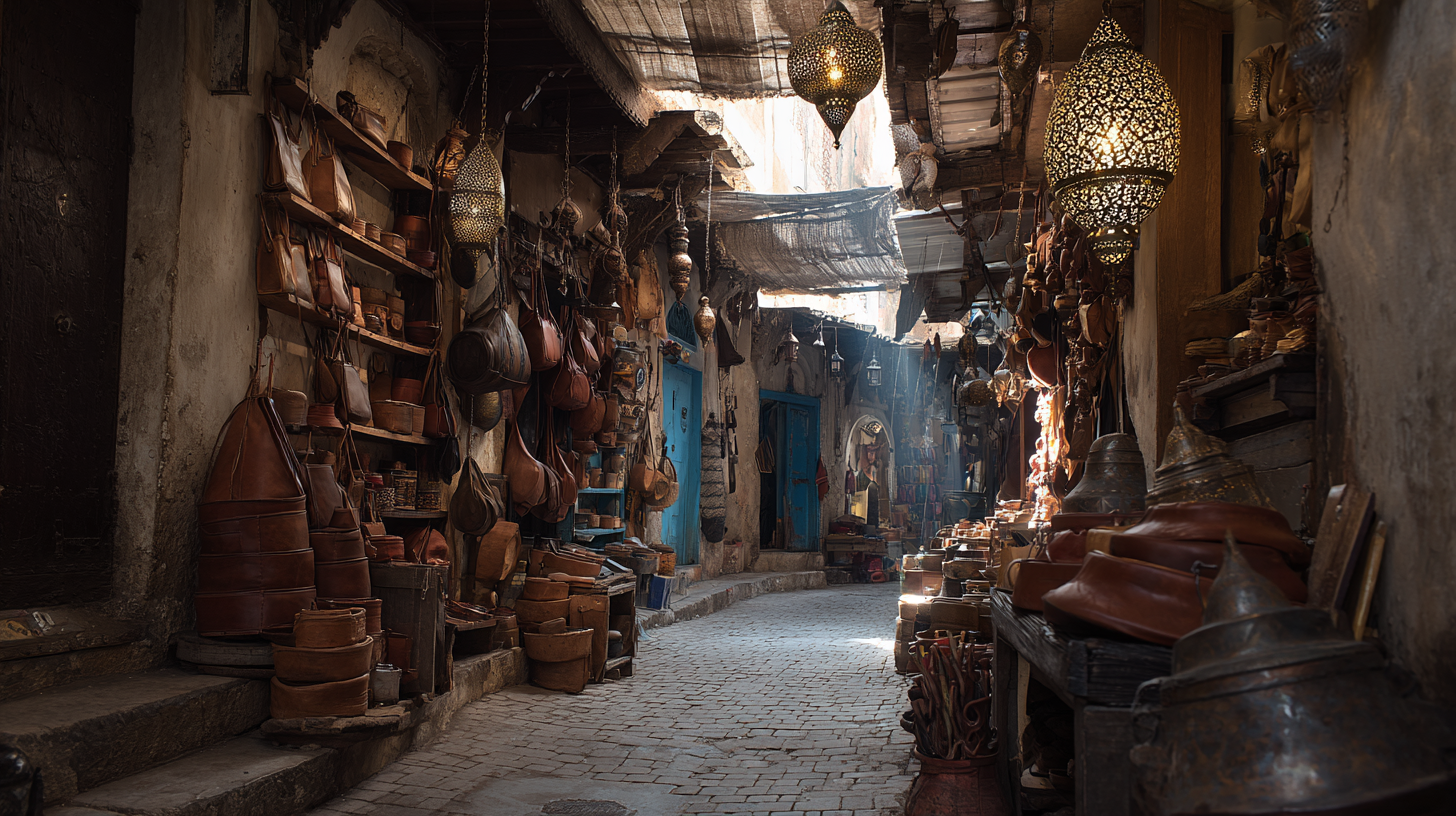
Books and perfume are nearest — knowledge and scent, the two cleanest trades. Leather and metalwork occupy the middle ring. Tanneries and dyers are pushed to the edges, where the smell and runoff can drain away from the sacred centre. The hierarchy is theological, practical, and olfactory. God is in the details. And the details smell.
Within each section, the guild system organises traders. Every souk has an amine — a guild master elected by the craftsmen — who mediates disputes, sets quality standards, and historically controlled prices. The amine system predates the French protectorate by centuries. It still functions in Fes and Marrakech, which tells you either that the system works or that nobody has been able to replace it, which is the same thing.
Pricing is not random, though it looks that way to anyone encountering it for the first time. The first price quoted to a tourist is typically 3 to 5 times the final price. Between locals, the markup is 20 to 40 percent. Between a regular customer and a trusted shopkeeper, prices are often fixed — no negotiation at all. The relationship determines the price, not the object. This is not haggling. It is a social calculus in which the variables include how well you know each other, how long you plan to stay in the city, and whether your children attend the same school.
Negotiation has a structure as formal as a dance. The seller offers high. The buyer counters low — typically 30 percent of the ask. The seller acts offended. The buyer moves to leave. The seller calls them back. Tea may appear. They meet somewhere between 40 and 60 percent of the opening price. The whole performance takes 15 minutes and both parties enjoy it, which is the part that visitors from fixed-price economies find most disorienting: the negotiation is not adversarial. It is social. The transaction is a conversation that happens to end with money changing hands.
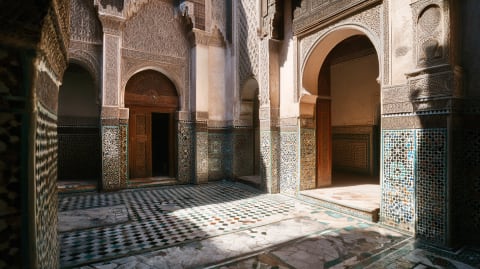
The fondouk — the merchants' inn — was the wholesale layer. Goods arrived by caravan, were stored and traded in the fondouk's courtyard, then distributed to the souks. Many fondouks survive as workshops, warehouses, or cheap hotels — the architecture of commerce repurposed but not demolished, which is the medina's way of remembering what it used to be while becoming what it needs to be now.
The souk unfolds in a sequence that has not changed since the medieval period. Spices near the mosque. Leather downwind.
Tell us about your trip →Data and visualisation by Dancing with Lions
The Facts
- —Souks organized by trade since medieval period
- —Clean trades (textiles, spices) near the mosque
- —Noisy/dirty trades (tanneries, metalwork) at edges
- —Kissaria: covered market for luxury goods
- —Fondouks: merchant warehouses with courtyards
- —Prices negotiable — fixed-price shops are modern addition
- —Hereditary stall positions in many markets
Sources
- Geertz, Clifford. "Suq: The Bazaar Economy in Sefrou." In Meaning and Order in Moroccan Society. Cambridge University Press, 1979
- Eickelman, Dale F. Moroccan Islam. University of Texas Press, 1976
- Troin, Jean-François. Les souks marocains. Edisud, 1975
Practical questions