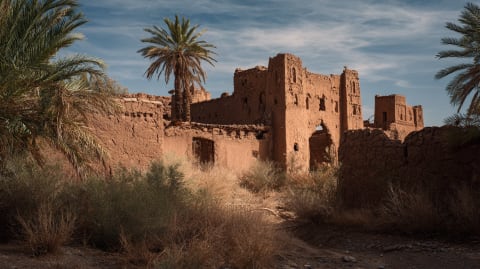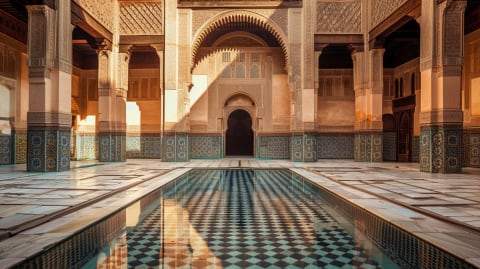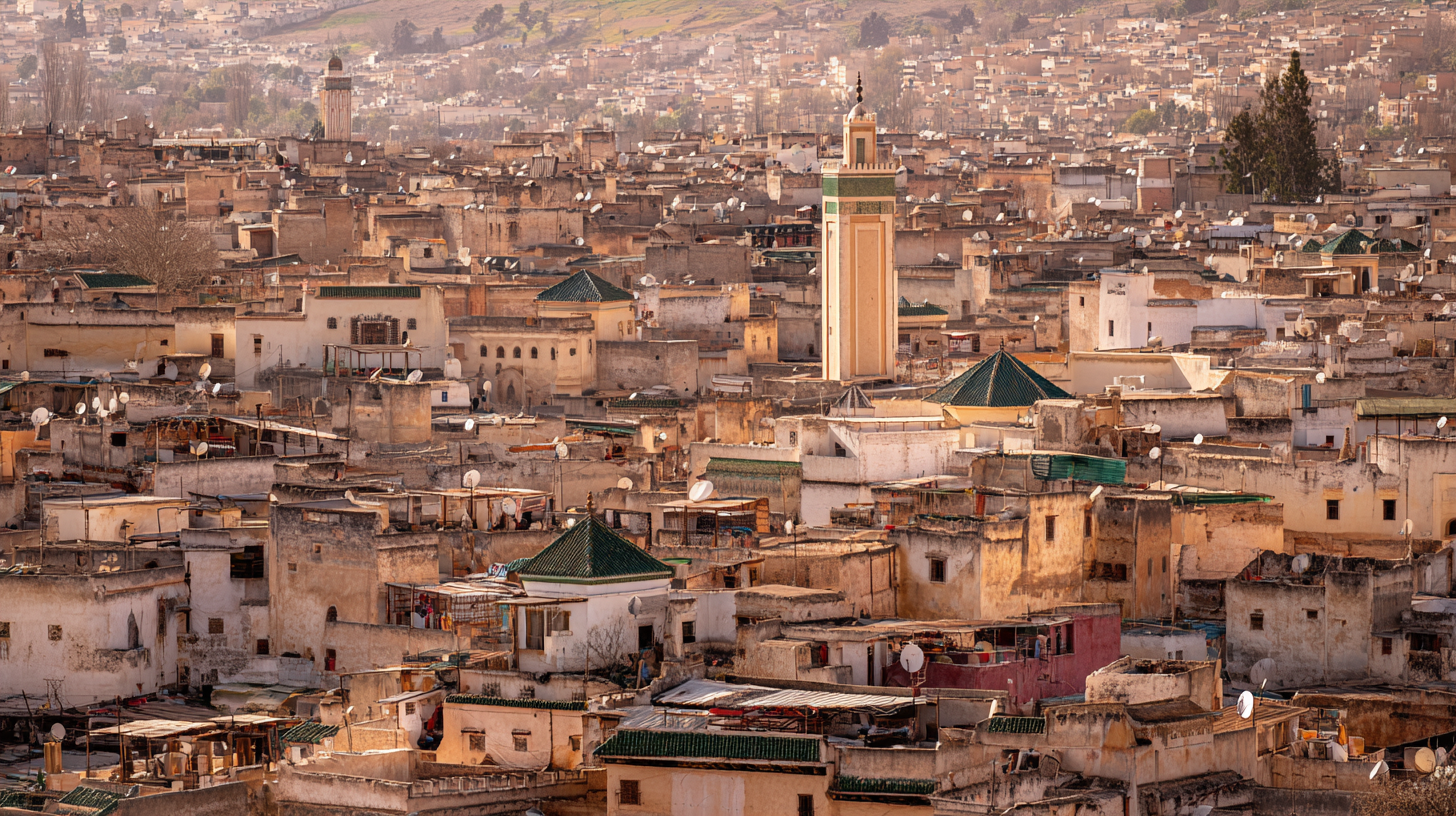
Nine historic medinas. Each one is a walled city with its own personality, its own grudges, and its own unshakeable conviction that it is the best of the nine.
Fes el-Bali is the largest car-free urban area in the world. Marrakech is the most visited. Essaouira is the most photogenic. Tetouan is the most Andalusian. Chefchaouen is the most blue, obviously. They share the same underlying structure the way siblings share a family resemblance — you can see it if you know where to look, but each one insists on being different.
The mosque is the centre. From it, the main commercial streets radiate outward like arteries. These are the widest passages — wide enough for a loaded donkey, which was the SUV of medieval urban planning. The souks line these arteries, organised by guild and trade: the cleanest, most valuable trades closest to the mosque, the noisiest and smelliest pushed to the edges. Secondary streets branch off into residential quarters. Tertiary passages — derbs — dead-end at clusters of houses where only residents and their guests have any business being.
This is not random organic growth, though it looks like it to anyone arriving with a map and expectations. It is a planned hierarchy of public to private, commercial to domestic, sacred to profane. The mosque anchors the public sphere. The derb anchors the private. Between them, a gradient that every Moroccan navigates instinctively and every tourist navigates with their phone held up like a divining rod.
The gates — babs — control entry. Marrakech has 19. Fes has 14. The gates were locked at night until the French protectorate, which tells you what the protectorate changed and what the gates were originally for.
The ramparts are not just defensive. They are a thermal boundary. The mass of packed earth absorbs heat during the day and releases it at night. The narrow streets create shade. The courtyard houses create convection. The entire medina functions as a passive cooling system — a fact that modern urban planners, having spent decades designing cities that require air conditioning to survive, are now studying with the interest of people who have just noticed that the old way worked better.
The medina is a maze only if you are trying to go somewhere specific. Three days is enough to stop trying.
Tell us about your trip →Data and visualisation by Dancing with Lions
The Facts
- —Medina = "city" in Arabic
- —Concentric layout: mosque at center, trades radiating outward
- —Derbs (dead-end lanes) create private residential clusters
- —Fondouks: merchant lodging and storage
- —Kissaria: covered luxury market
- —Walls separate medina from ville nouvelle
- —UNESCO-listed medinas: Fes, Marrakech, Essaouira, Tétouan, Meknes, Rabat
Sources
- Wilbaux, Quentin. La médina de Marrakech: formation des espaces urbains. L'Harmattan, 2001
- Bianca, Stefano. Urban Form in the Arab World. Thames & Hudson, 2000
- UNESCO World Heritage Centre. Medina of Fez, nomination file, 1981