The fennec fox has ears the size of its face. This is not a design flaw — it is the Sahara's answer to air conditioning.
In a desert where daytime temperatures exceed 50°C, those enormous ears act as radiators: blood vessels close to the surface release heat into the air. They also function as satellite dishes, detecting prey moving beneath the sand with a precision that would embarrass most surveillance equipment. The fennec is nocturnal, emerging after sunset to hunt beetles, lizards, and the occasional jerboa. During the day, it sleeps in burrows that stay cool while the surface bakes. A creature that has solved problems most engineers are still working on.
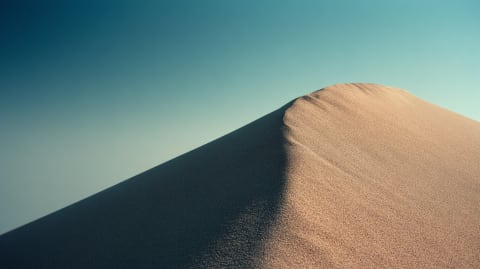
In the dunes of Erg Chebbi and Erg Chigaga, children sometimes keep fennecs as pets. It's how most tourists encounter them — a tiny fox with impossible ears, peering from a basket at a desert camp, looking mildly offended by the whole arrangement. But in the wild, fennecs are ghosts. You find their tracks in the morning sand — evidence of an entire civilisation that operates while you sleep, and erases itself by dawn.
The Sahara's wildlife is a gallery of creatures that refused to leave when the water did.
The Dorcas gazelle extracts all the moisture it needs from plants and rarely drinks water. The jerboa — a mouse that moves like a miniature kangaroo — survives on seeds and never drinks at all, which is either miraculous or mortifying depending on how much water you've consumed today. The desert hedgehog, among the smallest of its kind, can go weeks without food by entering a state of torpor that looks remarkably like wisdom.
Then there are the returns. The addax — a spiral-horned antelope with a white coat that reflects heat — was hunted nearly to extinction across the Sahara. In Morocco, it had been gone for decades. Recently, addax have been reintroduced to the protected areas around Erg Chigaga and Iriqui National Park. At night, travellers occasionally spot them in headlights — pale ghosts grazing at the edge of the dunes, looking as though they never left.
The Berber skink doesn't walk across the desert — it swims. Its wedge-shaped snout and smooth scales let it dive beneath the surface and move through sand the way a fish moves through water. The Saharan striped polecat, rarer still, hunts at night in the rocky outwash beyond the ergs. Neither animal has any interest in being photographed, which only increases the satisfaction when you see one.
At dawn, when the first light hits the dunes and the air is still cold enough to see your breath, the tracks tell the story. Beetles have drawn calligraphy across the sand. A sidewinder has left its signature S-curves. Somewhere in the distance, a fennec is sleeping with its enormous ears folded flat, dreaming whatever fennecs dream about — which, based on the evidence, is mostly beetles.
The desert looks empty. It is not. It is a kingdom with a night shift.
The Sahara holds kingdoms that most maps forgot. Our desert guides grew up on these stories — they're the real itinerary.
Tell us about your trip →The Facts
- —Fennec fox — world's smallest fox, enormous ears for heat radiation and prey detection
- —Dorcas gazelle — survives without drinking, extracts moisture from plants
- —Jerboa — desert rodent that never drinks water, moves like a kangaroo
- —Addax — critically endangered antelope, recently reintroduced to Iriqui National Park
- —Berber skink ('sand fish') — 'swims' beneath the sand surface
- —Saharan striped polecat — rare nocturnal predator, called 'tadghagha' locally
- —M'hamid el Ghizlane — village name means 'the plain of the gazelles'
- —Sand cat, African wildcat, and golden wolf also present in Moroccan Sahara
Sources
- Gaudio, Attilio. Le Maroc du sud. Karthala, 2001
- Terrasse, Henri. Kasbas Berbères de l'Atlas et des Oasis. 1938
- Naji, Salima. Art et architectures berbères du Maroc. Édisud, 2001