The lagoon appears like a mirage — a long arm of the Atlantic reaching into the Sahara. Which is, more or less, exactly what it is.
Khenifiss is the largest lagoon on the Moroccan coast: a 20-kilometre sliver of water between Tan-Tan and Tarfaya where the desert meets the sea and neither seems entirely sure what to do about the other. Golden dunes on one side. Salt flats shimmering white on the other. And in the middle, filling the shallows with a colour that has no business existing in this landscape: pink.
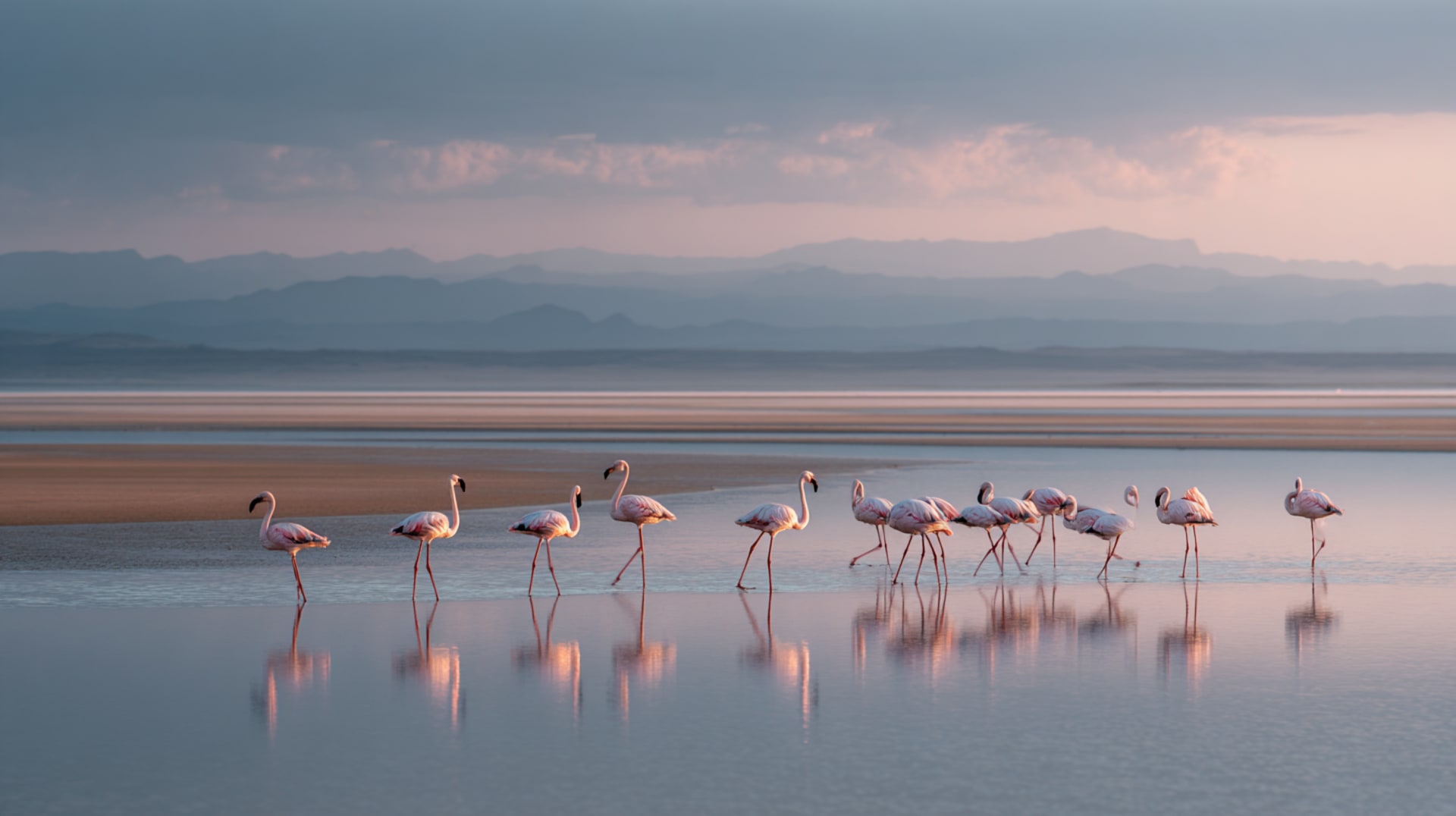
The flamingos arrive by the thousands. Every winter, roughly 20,000 birds descend on Khenifiss — flamingos, spoonbills, marbled ducks, Audouin's gulls — following ancient flyways from Scandinavia and Britain, stopping here to feed on the rich mudflats before continuing south or settling in for the season. Nobody told them about borders. Nobody informed them that a lagoon in the western Sahara is an unlikely place for the world's second most important flamingo site. They come anyway, as they have for longer than anyone has been counting.
The pink is chemistry, but that doesn't make it less beautiful. Flamingos are born grey — ungainly, awkward, the colour of wet cement. Their pink comes from carotenoid pigments in the algae and crustaceans they filter from the water, the same compounds that make carrots orange and tomatoes red. The richer the feeding, the pinker the bird. At Khenifiss, where nutrients pool in the shallow lagoon like a buffet laid out by the tides, the flamingos turn the colour of a Saharan dawn. They stand on one leg, motionless, watching the water with the profound patience of creatures who have been perfecting this exact stance for 10 million years.
The national park was established in 2006, though the lagoon has been protected since 1962 — early enough that the bureaucrats, for once, arrived before the damage. It is a Ramsar wetland of international importance. It sits on UNESCO's tentative list. The combination of coastal, wetland, and desert ecosystems in a single place is almost unique: sabkhas, ergs, and open Atlantic, all within walking distance of each other, all pretending this is perfectly normal.
The road from Tan-Tan is long, empty, and beautiful in the way that vast, indifferent landscapes are beautiful — which is to say, it makes you feel small and alive at the same time. The flamingos at the end of it are worth every kilometre. They are also, in a 40-kilometre lagoon in the Sahara, a quiet reminder that nature does not consult our sense of what belongs where.
The flamingos at Souss-Massa are a quiet detour south of Agadir. We add it to coastal itineraries when the season is right.
Tell us about your trip →The Facts
- —Khenifiss National Park — 185,000 hectares, established 2006
- —Largest lagoon on Moroccan coast — 20km long
- —World's second most important flamingo site
- —~20,000 waterfowl winter here annually
- —Ramsar wetland of international importance since 1980
- —On UNESCO World Heritage tentative list since 1998
- —Home to globally significant populations of marbled teal, ruddy shelduck, and Audouin's gull
- —Free entry, accessible from N1 highway between Tan-Tan and Tarfaya
Sources
- Thévenot, Michel et al. The Birds of Morocco. British Ornithologists' Union, 2003
- BirdLife International. Important Bird Areas: Morocco
- Moroccan Haut-Commissariat aux Eaux et Forêts. Wetlands census data