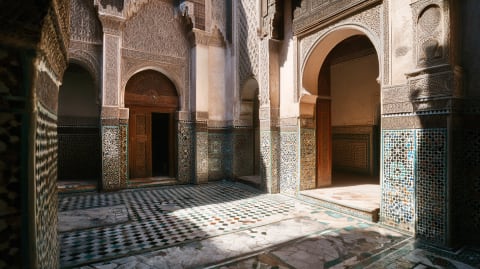
The word means "salt" in Arabic. The first Jewish quarter in Morocco was built on salty, marshy ground near the royal palace in Fes — close enough for the sultan's protection, separate enough to be its own world. That was 1438. Jews had already been in Morocco for two thousand years.
The evidence is carved in stone at Volubilis, the Roman city in the hills above Meknès. Olive oil lamps with menorahs. Tombstones with Hebrew inscriptions. When the Romans arrived, Jews were already there — traders and farmers who had crossed from Carthage or sailed from Judea after the Temple fell. They were in Morocco before the Arabs, before Islam, before the dynasties that would shape the country's identity. They were, in the most literal sense, here first.
By 1948, there were 275,000 Jews in Morocco — the largest Jewish community in any Muslim country on earth. Casablanca alone had 80,000. Every major city had its mellah: Fes, Marrakech, Essaouira, Meknès, Rabat. The quarters were cramped and crowded, the balconies leaning over narrow streets in a way that made neighbours of everyone whether they wanted it or not. But the mellahs were also autonomous — Jewish courts, kosher butchers, synagogues, cemeteries, a complete society within the walls. The alliance with the throne was real. When other powers threatened the Jews, the sultan often intervened. Not always. But often enough to matter.
Then came 1948. The founding of Israel changed everything with the speed of a door slamming.
Between 1948 and 1973, nearly all of Morocco's Jews departed — to Israel, to France, to Canada, to the United States. Some left for Zionist conviction. Some left after riots in Oujda and Jerada killed 44 Jews in 1948. Some left because their neighbours had left, and a community is only a community when enough people stay. The departure was not a single event but a slow emptying — families leaving one by one, houses going dark, synagogues losing their minyans, schools closing for lack of children. A two-thousand-year presence dissolving in a single generation.
What remains is remarkable for its presence, not its size.
Today, roughly 2,500 Jews live in Morocco — the largest population in any Arab country. Most are in Casablanca, where Neve Shalom is the last Jewish day school in the Arab world. The Museum of Moroccan Judaism — the only Jewish museum in any Arab country — holds the memory: Torah scrolls, wedding dresses, the silver filigree work that Jewish craftsmen made famous in cities that no longer remember their names.
But the most extraordinary remnants are the pilgrimages. Every year, Moroccan Jews — now living in Israel, France, Montreal, Los Angeles — return for the hiloulot, the saint festivals held at the tombs of revered rabbis across the country. They fly thousands of kilometres to light candles, sing prayers in Berber-accented Hebrew, eat food their grandmothers made, and weep for a country that was home and is home and is no longer home, all at once.
The mellahs are quiet now. The balconies still lean. The Stars of David are still carved above doorways that open to families who pray facing Mecca. But something persists — in the hiloulot, in the songs that old men in Tel Aviv still sing in Berber, in the fact that two thousand years of presence cannot be undone by fifty years of absence.
The mellahs are still standing in every imperial city. The doorframes still carry the marks. Eight days connects them all.
Tell us about your trip →The Facts
- —2,000+ years of Jewish presence in Morocco — archaeological evidence at Volubilis (2nd century BCE)
- —1438: First mellah established in Fez, near royal palace for protection
- —1948: 275,000 Jews in Morocco — largest Jewish community in Muslim world
- —Today: ~2,500 Jews remain, mostly in Casablanca
- —Museum of Moroccan Judaism in Casablanca — only Jewish museum in Arab world
- —Tinghir-Jerusalem documentary (2013) by Kamal Hachkar — won Best New Director at Tangier Film Festival
- —200+ Jewish cemeteries restored under King Mohammed VI
- —Mohammed V refused Vichy anti-Jewish laws during WWII
- —Annual hiloulot pilgrimages to rabbi tombs draw thousands from Israel and diaspora
Sources
- Gottreich, Emily. The Mellah of Marrakesh. Indiana University Press, 2007
- Laskier, Michael. The Alliance Israélite Universelle and the Jewish Communities of Morocco. SUNY Press, 1983
- Corcos, David. Studies in the History of the Jews of Morocco. Rubin Mass, 1976