The garden came first. Not the designer. Not the blue. The garden.
In 1917, a French painter named Jacques Majorelle arrived in Marrakech with damaged lungs and a letter from his doctor recommending dry air. He was the son of Louis Majorelle, the celebrated Art Nouveau furniture designer from Nancy. He bought land on the edge of a palm grove and began planting. He would not stop for forty years.
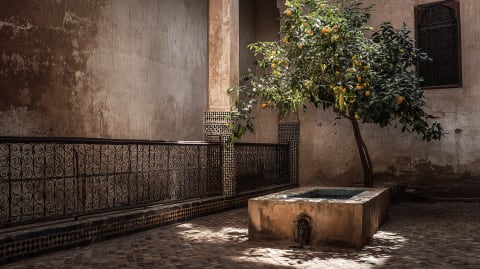
The garden grew into an obsession — three hundred species from five continents, structured around a long central pool, dense with bamboo, bougainvillea, cacti, banana trees, coconut palms, and water lilies. In 1931, he commissioned the architect Paul Sinoir to build a Cubist studio on the grounds. In 1937, he mixed an ultramarine blue so intense he patented it. He painted everything in it. The blue is still called Majorelle blue. It is the most recognisable colour in Marrakech.
The garden bankrupted him. He opened it to the public in 1947 to pay for its upkeep. After a car accident, he was repatriated to Paris, where he died in 1962. The garden was abandoned. The plants died. The blue faded. A developer planned to demolish it and build a hotel.
The couturier
Yves Saint Laurent arrived in Marrakech in February 1966 with Pierre Bergé, his partner in business and life. He was thirty years old. He had already been fired from Dior, conscripted into the French army during the Algerian War, committed to a military hospital, and treated with electroshock therapy. He and Bergé had launched the house of Yves Saint Laurent in 1962. It succeeded. But the damage from the hospital never fully healed. He would struggle with depression and addiction for the rest of his life.
Marrakech was not inspiration. It was medicine. He said it himself: "In Morocco, I understood that my own chromatism was that of zelliges, zouacs, djellabas, and caftans." The ochre walls. The saffron, cobalt, and terracotta piled in the souks. The light that Matisse had chased half a century earlier. Saint Laurent had been designing in grey and black. Morocco handed him a colour palette that his nervous system recognised before his mind did.
They bought a house in the medina within the week — Dar el-Hanch, the House of the Snake. Saint Laurent painted a serpent on the dining room wall. The house became a meeting place. Andy Warhol came. Mick and Bianca Jagger came. In 1974, they moved to Dar es Saada in the Guéliz district and asked Bill Willis — the American who had invented modern Moroccan interior design — to decorate it.
The fashion that followed drew explicitly on Moroccan craft. Caftans, embroidered jackets, gold thread, flowing silhouettes. He was not copying. He was translating — the Berber carpet became an evening gown, the djellaba became a column dress, the souk became the atelier. The pieces sold in Paris for tens of thousands of francs. The artisan in the medina who wove the original fabric still earned fifty dirhams a day.
The rescue
In 1980, Saint Laurent and Bergé learned that Majorelle's garden was about to be demolished. They bought the complex — garden, studio, villa. They renamed the villa "Oasis" and moved in. Willis handled the restoration. The garden was replanted. Madison Cox redesigned the landscaping in 2000. The blue was repainted, brighter than Majorelle himself might have chosen, but unmistakable.
This was the gift. Whatever else the story contains — the extraction, the translation, the millions made from Moroccan colour in a Paris atelier — Saint Laurent and Bergé saved the garden. Without them, it would be a hotel parking lot.
The museum nobody enters
Majorelle's Cubist studio — the blue building at the heart of the garden, the one nine hundred thousand visitors photograph every year — is not empty. It houses the Musée Pierre Bergé des Arts Berbères. The Berber Museum.
Six hundred objects. Silver jewellery from the Anti-Atlas — fibulae, bracelets, headdresses, the heavy ornamental pieces that Amazigh women wore as both protection and identity. Textiles from the High Atlas and the Sahara. Costumes. Ceramics. Wooden artefacts. The collection was assembled by Bergé over decades, and the curation draws on the ethnographic framework established by Bert Flint, the Dutch anthropologist whose own Maison Tiskiwin sits a twenty-minute walk away in the medina.
Flint spent fifty years arguing that Amazigh material culture was art — not craft, not folklore, not souvenir. The Berber Museum inside Majorelle is the proof. The silver jewellery represents a nine-thousand-year-old tradition. The textiles encode family lineage, fertility prayers, and protection symbols in every knot. The objects are not decorative. They are a language.
Most visitors do not enter. They photograph the blue wall, buy a postcard of the garden, and leave. The Instagram geotag for Jardin Majorelle has millions of posts. The Berber Museum has almost no queue.
The accounting
What did Morocco give Yves Saint Laurent? A colour palette. A design language. A place to recover. Forty years of collections drawn from the medina, the mountains, and the desert. A second life.
What did Saint Laurent give Morocco? A garden saved from demolition. A museum. A street name — Rue Yves Saint Laurent. Nine hundred thousand visitors a year who come to see a French designer's legacy in a Moroccan city.
In 2017, the Musée Yves Saint Laurent Marrakech opened next to the garden. Designed by Studio KO, the building — 4,000 square metres of terracotta, concrete, and terrazzo — holds five thousand pieces of clothing, an auditorium, and a library. The architecture is the best thing built in Marrakech in decades.
Inside, the haute couture hangs in climate-controlled silence. The caftans. The Mondrian dresses. The le Smoking tuxedos. Some were made in Paris. All were imagined here.
Saint Laurent died in 2008. Bergé scattered his ashes in the Majorelle Garden and placed a Roman column they had found together on a beach in Tangier as a memorial. When Bergé died in 2017, his name was added to the stone. Two names on a column between the bamboo and the bougainvillea.
The blue wall is behind them. The Berber Museum is in front of them. Most people face the wrong direction.
Sources
- McLeod, Madison. Pierre Bergé & Yves Saint Laurent in Morocco. Abrams, 2017
- Bergé, Pierre. Yves Saint Laurent. Éditions de la Martinière, 2010
- Majorelle, Louis. Aquarelles marocaines. Self-published, 1922
Further Reading
Practical questions