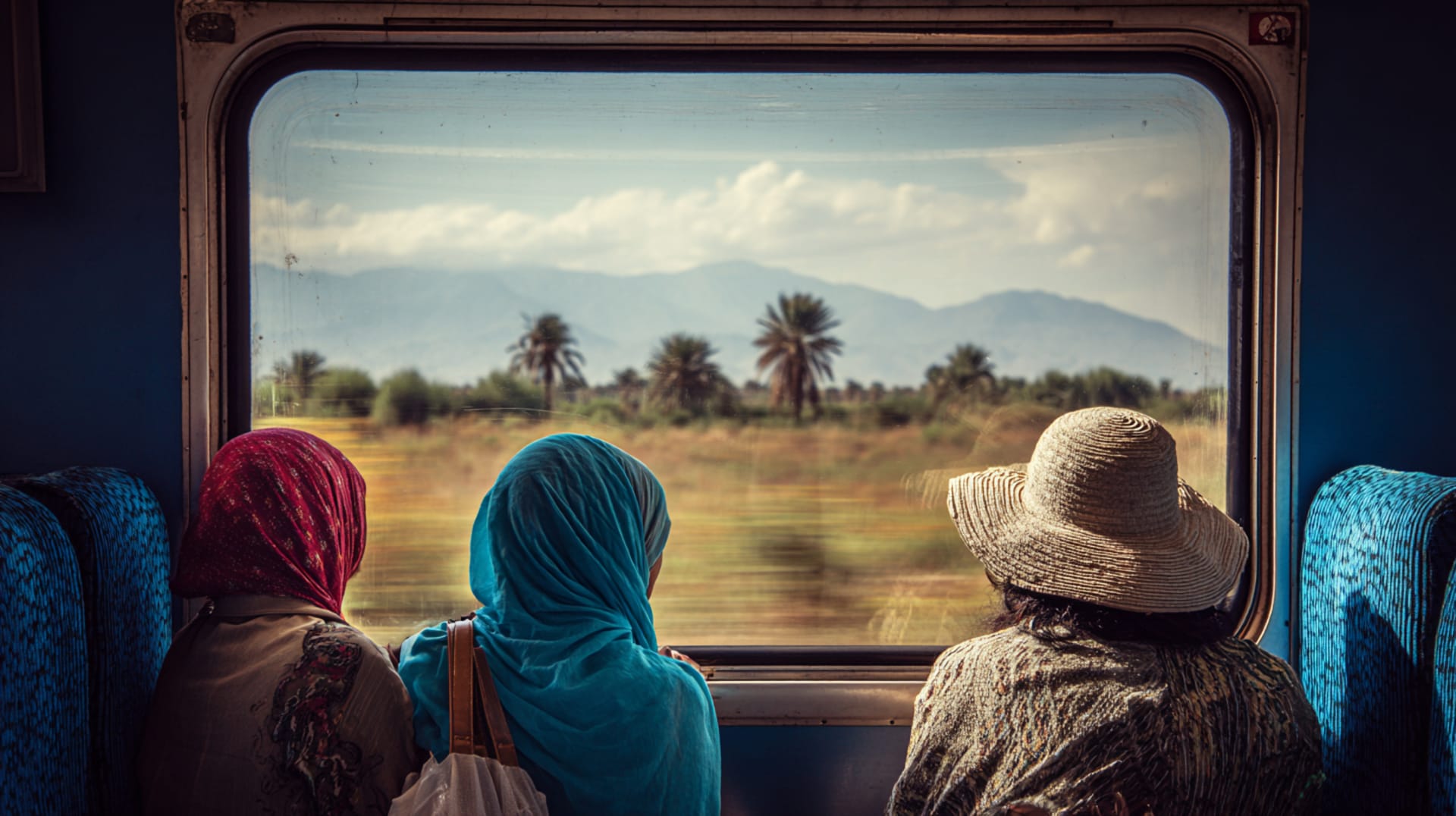
The song wrote itself on the train. Graham Nash — then of The Hollies, not yet of Crosby, Stills & Nash — was travelling across Morocco in 1966. He took the train from Casablanca to Marrakech: three hours through flat agricultural plains, past the Atlas Mountains, into the red city. The train was crowded. Chickens in the aisles. Farmers and merchants and tourists compressed together. The light through the windows was gold. Nash watched the landscape and hummed a melody.
He didn't record it for three years. By 1969, he'd joined Crosby and Stills and they needed songs for a debut album. "Marrakech Express" fit the moment: optimistic, adventurous, redolent of incense and possibility. It became a hit. It became an anthem for a generation that believed the road led somewhere better, and that somewhere was probably south.
The song promised something Morocco didn't quite deliver. There was no psychedelic paradise waiting at the Marrakech station — just a chaotic city that had been there for a thousand years before the hippies arrived and would remain long after they left. But the song sold the dream, and people followed the song. They still do. "Marrakech Express" is one of the most effective pieces of tourism marketing ever produced, and nobody involved intended it as marketing, which is why it works.
The train still runs. ONCF operates the Casablanca-Marrakech route multiple times daily, now in modern coaches with air conditioning and no chickens. The journey takes the same three hours. The light through the windows is the same gold. Nash's Morocco was a moment. The train he rode on is still a train. The distance between the song and the reality is the distance between every travel anthem and the place it describes — close enough to recognise, far enough to disappoint, and beautiful enough that nobody cares about the gap.
The train still runs. Tangier to Marrakech. The express that named the song.
Tell us about your trip →The Facts
- —Graham Nash wrote the song after a 1966 Morocco trip
- —It was released on CSN's debut album in May 1969
- —The song reached #28 on the Billboard Hot 100
- —The Casablanca-Marrakech train journey takes approximately 3 hours
- —The song helped establish Morocco as a hippie trail destination
Sources
- Nash, Graham. Wild Tales: A Rock & Roll Life. Crown Archetype, 2013
- Crosby, David & Gottlieb, Carl. Long Time Gone. Doubleday, 1988
- Pennell, C.R. Morocco Since 1830. NYU Press, 2000