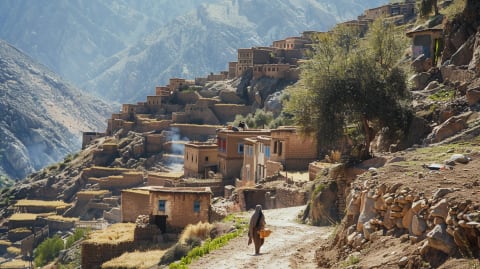
Every region of Morocco has its saints. The Atlas Mountains have their own — buried in shrines that sit on ridgelines and beside streams, visited by shepherds and pilgrims who know the paths.
Moulay Ighi is one of many mountain saints whose shrine — a small whitewashed building with a green-tiled roof — marks a point in the landscape where the sacred and the practical overlap. These shrines often sit at water sources, at the junction of paths, or at the boundary between tribal territories. They are meeting places, boundary markers, and prayer sites simultaneously.
The tradition of saint veneration in Morocco — maraboutism — predates the formal Islamic establishment and has always existed in tension with it. Orthodox scholars question the theology. Rural communities continue the practice. The shrine is not a mosque. The saint is not a prophet. But the building is there, the candles are lit, and the women who come to tie cloth strips to the tree beside the shrine do so for reasons that are older than anyone's objection.
In the Atlas, these shrines mark the seasonal routes of transhumant pastoralists. The herders pass the shrine twice a year — once going up, once coming down — and stop to pay respects. The saint protects the route. The route sustains the saint's memory.
Most mountain shrines receive no tourists. They are not on any map that a visitor would carry. They are on the maps that the people who live here carry in their heads.
Sources
- Cornell, Vincent J. Realm of the Saint. University of Texas Press, 1998
- Eickelman, Dale F. Moroccan Islam. University of Texas Press, 1976
- Hammoudi, Abdellah. The Victim and Its Masks. University of Chicago Press, 1993
Practical questions