For two hundred years, the only visitors were stray cats and storks.
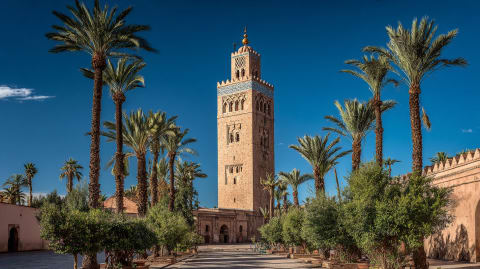
The Saadian Tombs sit behind the Kasbah Mosque in Marrakech, in a necropolis that has been receiving the dead since the 14th century. But the rooms that matter — the ones with the Carrara marble and the cedar ceilings and the twelve columns — those were built by Ahmad al-Mansur, the sultan they called the Golden One, between 1578 and 1603. He built them to house his dead and to remind anyone who entered that the Saadian dynasty did not do things modestly.
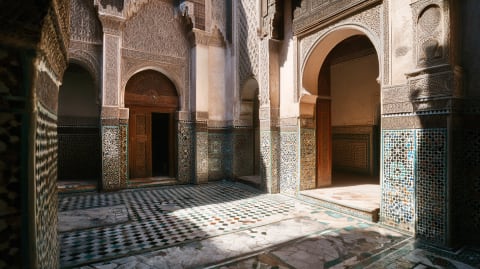
The Hall of Twelve Columns is the centrepiece. Al-Mansur lies there beneath a canopy of marble pillars imported from Italy, surrounded by gilded stucco and muqarnas vaulting that catches the light in ways the craftsmen calculated. Sixty-six princes are buried in the complex. More than a hundred chancellors and wives fill the surrounding chambers, each positioned closer to or farther from the sultan depending on their rank in life.
Then the Saadians fell. And Moulay Ismail arrived.
Ismail — the Warrior King, the Bloodthirsty, the man who reigned for 55 years and is said to have fathered over 800 children — had a particular relationship with the past. He systematically dismantled the El Badi Palace, the Saadians' greatest architectural achievement, stripping it of marble and gold and hauling the materials north to build his own capital in Meknes. But the tombs he left alone. The explanation handed down is superstition: he feared the spirits of the dead would pursue him if he disturbed their rest. So instead of destroying them, he walled them in. He sealed every entrance except a single narrow passage through the mosque. Then he forgot about them.
Everyone forgot about them.
Two centuries passed. The mausoleums grew weeds. The courtyard gardens went wild. The zellige cracked. The gilding dulled. Nobody in Marrakech could tell you what lay behind the wall beside the Kasbah Mosque.
Then, in 1917, a French aerial survey of Marrakech — commissioned by Resident-General Hubert Lyautey — photographed the city from above. In the images, behind the wall, the green-tiled roofs of the mausoleums were visible. The Service des Beaux-Arts sent a team in.
What they found was remarkably intact. The marble columns still stood. The stucco, though damaged, still showed its patterns. The graves were undisturbed. The French restored what they could, using the surviving decoration as a model for what had been lost, and opened the site to the public for the first time.
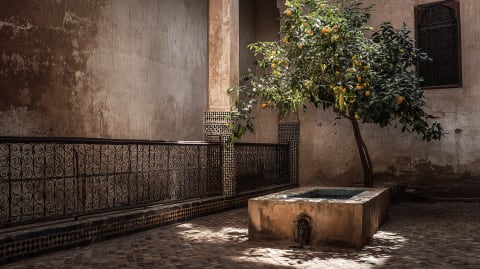
Today the tombs draw thousands of visitors daily. You enter through the same narrow corridor — the only gap Moulay Ismail left — and emerge into a courtyard of orange trees and mosaic-tiled graves. The Chamber of the Twelve Columns is small enough that you can see the whole room from the doorway. You are not allowed inside.
The tombs were damaged again in the September 2023 earthquake. Restoration is ongoing.
What strikes you, standing in that courtyard, is not the grandeur. It is the fact that a rival king could not bring himself to destroy what was there. He walled it in, sealed it shut, and walked away. The dead waited two hundred years for someone to look down from the sky and notice.
The Facts
- —The Saadian Tombs sit behind the Kasbah Mosque in Marrakech, in a necropolis that has been receiving the dead since the 14th
- —But the rooms that matter — the ones with the Carrara marble and the cedar ceilings and the twelve columns — those were built by
- —Ismail — the Warrior King, the Bloodthirsty, the man who reigned for 55 years and is said to have fathered over 800 children —
- —Then, in 1917, a French aerial survey of Marrakech — commissioned by Resident-General Hubert Lyautey — photographed the city from
- —The tombs were damaged again in the September 2023 earthquake.
Sources
- Deverdun, Gaston. Marrakech: des origines à 1912. 1959
- Cornell, Vincent J. Realm of the Saint. University of Texas Press, 1998
- Terrasse, Henri. Histoire du Maroc. Atlantides, 1949
Practical questions