The smell is the price of admission. Ammonia, lime, pigeon dung, and something older — the accumulated chemistry of nine hundred years of animal hides being turned into leather by hand, in stone vats, in the open air. The leather shops on the terraces above hand you a sprig of mint. Hold it to your nose. It helps.
The Chouara Tannery in Fes is the oldest in the world that is still operating. Founded in the 11th century, it occupies a shallow pit in the northeast corner of the medina, downwind from the mosques and the residential quarters — placed there deliberately, because the process stinks and the runoff needs the river. The same urban logic that positions the souk by trade positions the tannery by smell.
The process runs in three stages. First, the raw hides — goat, sheep, cow, occasionally camel — are soaked in a mixture of quicklime, water, and salt. This loosens the hair and fat. The hides sit in the white vats for three days, turned by workers who stand waist-deep in the solution. The work is physical, repetitive, and done by hand because machines would damage the hides.
Second, the softening. The limed hides are transferred to vats of pigeon dung mixed with water. The ammonia in the dung acts as a natural enzyme, breaking down remaining proteins and making the leather supple. This is the step that produces the worst of the smell. It is also the step that gives Moroccan leather its distinctive softness — the same technique produces a different result from the chrome-tanning used in industrial leather production, which is faster but harsher.
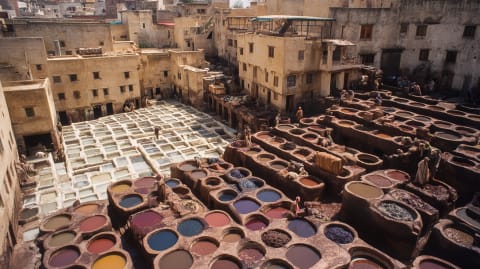
Third, the dyeing. The hides move to the colour vats — the ones you see from the terrace, the honeycomb of circles in saffron, crimson, indigo, and green. The dyes are traditionally vegetable-based: poppy for red, indigo for blue, saffron for yellow, mint for green, cedar bark for brown. Synthetic dyes have entered the process — they are cheaper and more consistent — but the best workshops still use natural pigments for their premium leather.
The dyed hides are carried to the rooftops to dry in the sun. In Fes, the tannery rooftops are visible from several terraces in the surrounding quarter — the aerial view of the coloured vats has become one of Morocco’s most photographed images. The geometry is incidental. The vats are round because that is the efficient shape for soaking. The colours shift with the production schedule. The composition changes daily.
The workers are a guild. Tanning is hereditary in Fes — families have worked the same vats for generations. The work is hard: the chemicals irritate skin, the hours are long, the smell never leaves your clothes. Wages are low by European standards, high by medina standards. The guild system provides structure — apprentices learn from masters, techniques are transmitted orally, and the tannery operates as a self-regulating community within the larger city.
What to buy: look for vegetable-tanned leather, not chrome-tanned. Vegetable-tanned leather smells earthy. Chrome-tanned leather smells sharp and chemical. The vegetable-tanned product ages better — it develops a patina over years, darkening and softening. Chrome-tanned leather stays uniform but cracks. The price difference reflects the process. A vegetable-tanned bag from a Fes workshop is not the same product as a chrome-tanned bag from a factory in Casablanca, even if they look similar in the shop.
The smell is the price of admission. The Chouara Tannery has been operating since the 11th century. Mint helps.
Tell us about your trip →The Facts
- —Chouara Tannery, Fes: oldest operating tannery in the world
- —Founded 11th century
- —Placed downwind from mosques/residences — deliberately
- —Three stages: soaking (lime + pigeon dung), dyeing, finishing
- —Pigeon dung used as ammonia source
- —Nine hundred years of continuous operation
- —Mint sprigs offered to visitors for the smell
- —Stone vats, open air, process unchanged
Sources
- Becker, Howard S. Art Worlds. University of California Press, 1982
- Amselle, Jean-Loup. Mestizo Logics: Anthropology of Identity in Africa and Elsewhere. Stanford University Press, 1998
- Pomeranz, Kenneth, and Steven Topik. The World That Trade Created. M.E. Sharpe, 1999
- Geertz, Clifford. "Suq: The Bazaar Economy in Sefrou." In Meaning and Order in Moroccan Society. Cambridge University Press, 1979.
Further Reading
Practical questions