Taroudant has the most intact set of city walls in Morocco. Inside them, the city decided not to become Marrakech.
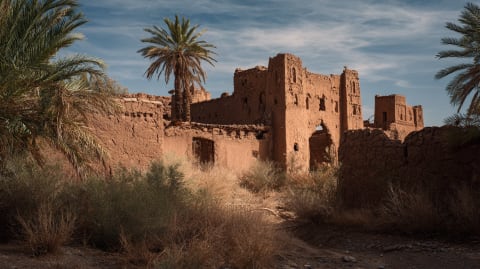
The walls are Saadian — built in the 16th century, 7.5 kilometres in circumference, punctuated by towers and gates, made of the same red-brown pisé as Marrakech's ramparts. But where Marrakech exploded outward — the ville nouvelle, the Palmeraie, the suburbs — Taroudant stayed inside its walls. The population is roughly 80,000. The medina is the city. The souks are intact and largely tourist-free.
Taroudant was briefly a Saadian capital before the dynasty moved to Marrakech. It sits in the Souss Valley, the agricultural plain between the High Atlas and the Anti-Atlas, surrounded by citrus and olive groves. The valley is one of the most productive farming regions in Morocco.
The souks are split between the Arab souk and the Amazigh souk. The Arab souk sells spices, cloth, and household goods. The Amazigh souk sells local produce, argan oil, and the silverwork for which the region is known. The pace is unhurried. Shopkeepers negotiate without urgency.
The ramparts are best seen at sunset, when a circuit on foot or by calèche takes you around the full perimeter. The walls glow the same red as Marrakech but the traffic is donkeys, not motorcycles, and the sound is birdsong from the olive groves outside the gates.
Guidebooks call Taroudant "little Marrakech." The people of Taroudant do not use this phrase.
The Facts
- —The walls are Saadian — built in the 16th century, 7.5 kilometres in circumference, punctuated by towers and gates, made of the
- —The population is roughly 80,000.
Sources
- Deverdun, Gaston. Marrakech: des origines à 1912. Éditions Techniques Nord-Africaines, 1959
- Wilbaux, Quentin. La médina de Marrakech. L'Harmattan, 2001
- Terrasse, Henri. Histoire du Maroc. Atlantides, 1949
Practical questions