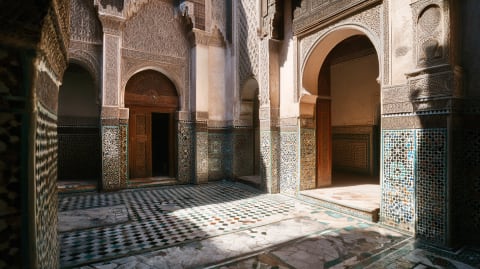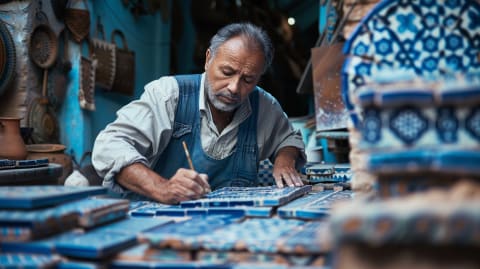
Zellige is the one that takes your breath away. Small pieces of glazed terracotta — chipped by hand into geometric shapes with a tool that hasn't changed in five centuries — assembled face-down on a flat surface to create patterns of such complexity that mathematicians study them and computers struggle to replicate them. The tiles come from Fes. The colours — white, black, green, blue, yellow, brown — come from mineral oxides in the glaze. A single panel can contain thousands of pieces. The man assembling them works from memory. There is no printed template. There never has been.
Tadelakt is the one you want to touch. A polished lime plaster, mixed from Marrakech limestone, applied in layers, and burnished with a river stone in slow, aching circles until it shines. Then sealed with olive oil soap — the black soap of the hammam, nothing synthetic, nothing modern. The result is a waterproof surface with a deep, warm lustre that makes everyone who sees it for the first time run their hand across it. It lines hammams, fountains, and the interiors of riads. No two surfaces are identical, because no two hands polish the same way.
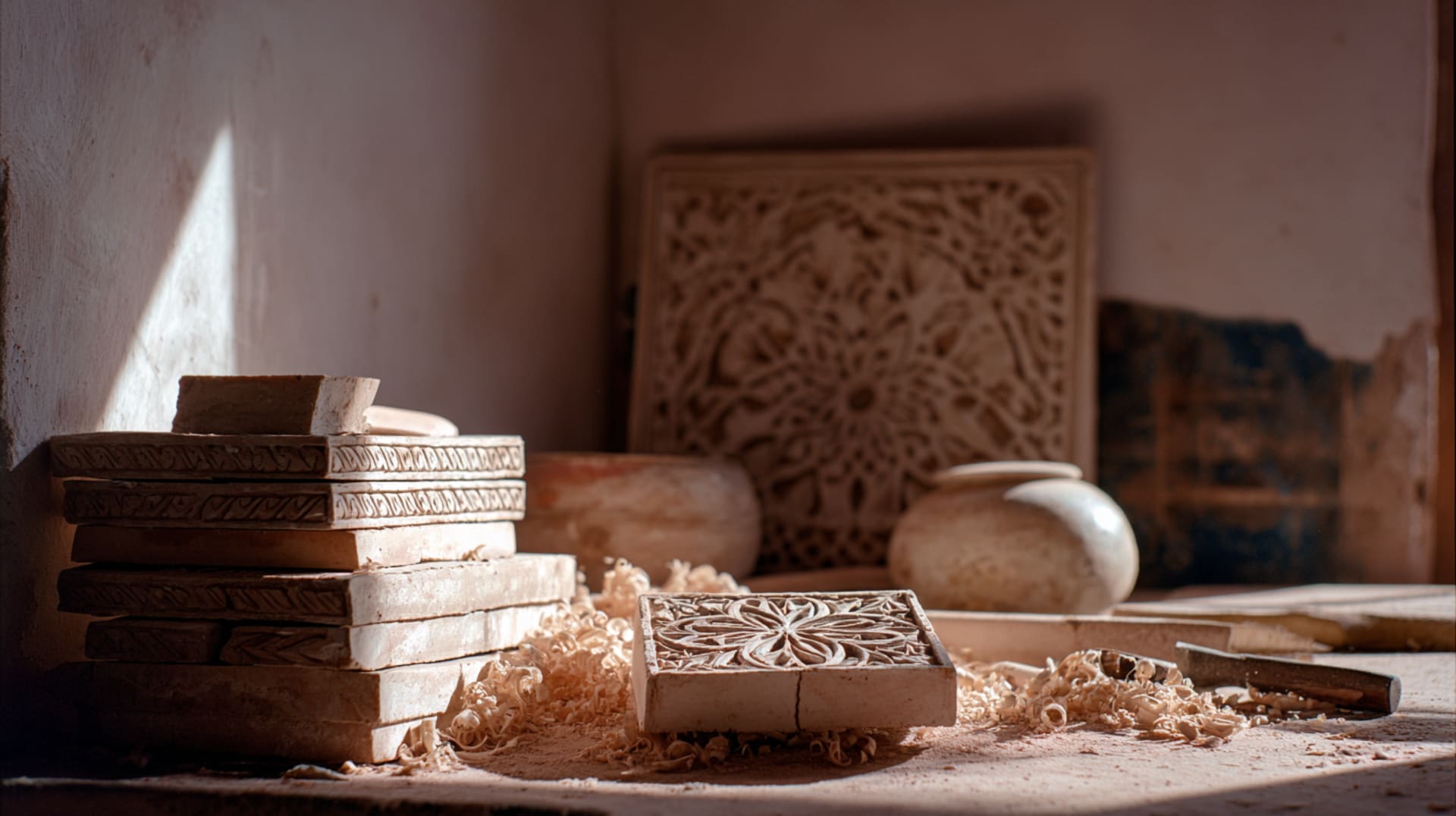
Gebs is the one working against the clock. Wet plaster applied to walls and carved while still soft — arabesques, geometric interlaces, calligraphic inscriptions — all cut freehand before the surface dries and the window closes. Fes and Marrakech have distinct gebs traditions: Fes favours denser, more intricate carving; Marrakech allows the plaster to breathe. The material is fragile and requires periodic restoration, which means the craft never stops being needed, which means the craft survives. There is a lesson in that, if you want one.
Bejmat is the one underfoot. Rectangular floor tiles — unglazed terracotta in their traditional form, laid in herringbone or running bond patterns, warm orange-red from the local clay. They appear in every riad, mosque, and palace. They absorb heat during the day and release it slowly at night, contributing to the passive cooling that makes a medina house liveable without air conditioning. You walk on them without thinking. They're working anyway.
Zouak is the one overhead. Painted wood — ceilings, doors, shutters, furniture — decorated with geometric and floral patterns in colours drawn from mineral pigments: cobalt for blue, saffron for yellow, henna for red. The cedar ceilings of Marrakech and the painted doors of Fes are zouak. The work is done lying on your back on scaffolding, brush in hand, neck aching, pattern memorised. It is painstaking, exacting, and — when the scaffolding comes down and you see the whole thing for the first time — worth every hour.
We arrange workshop visits in Fes and Marrakech — zellige cutters, tadelakt plasterers, zouak painters. By introduction, not by catalogue.
Tell us about your trip →Data and visualisation by Dancing with Lions
The Facts
- —Zellige: cut-tile mosaic (Fes)
- —Tadelakt: waterproof plaster (Marrakech)
- —Bejmat: rectangular floor tiles
- —Gebs: carved plaster
- —Zouak: painted wood
- —Tadellakt: polished lime plaster
- —Moucharabieh: carved lattice screens
- —Each craft has master artisans (maalems) and apprentice guilds
Sources
- Paccard, André. Traditional Islamic Craft in Moroccan Architecture. Éditions Atelier 74, 1980
- Spring, Christopher. North African Textiles. British Museum Press, 1995
- Becker, Cynthia. Amazigh Arts in Morocco. University of Texas Press, 2006