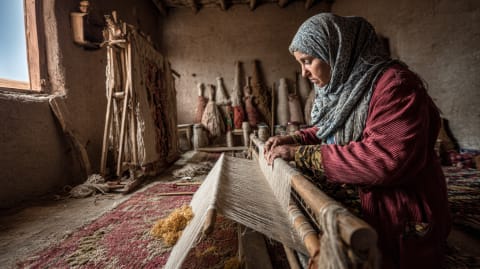
Ask her what her people call themselves and she'll say it without hesitation: Imazighen. The free people. Ask about the word "Berber" and she'll tell you it's Greek — barbaroi — meaning those who don't speak our language. She prefers her own name. So would you.
Three languages survive, and they are not dialects of one language — they are as different from each other as French is from Spanish. Tashelhit in the Souss and Anti-Atlas, spoken by roughly 8 million people. Tamazight in the Middle Atlas and central Morocco, roughly 5 million. Tarifit in the Rif mountains of the north, roughly 4 million. A Tashelhit speaker dropped into a Tarifit village would need to switch to Darija to order tea. The linguistic diversity of a single country, tucked into three mountain ranges.
The script is Tifinagh — one of the oldest writing systems still in use anywhere on earth. Libyco-Berber inscriptions have been found dating to at least the 3rd century BCE, carved into rock across the Sahara by people who had things to say and the alphabet to say them. The modern Neo-Tifinagh was standardised by IRCAM — the Royal Institute of Amazigh Culture — and became an official script of Morocco in the 2011 constitution. You see it now on government buildings, road signs, and banknotes, which sounds bureaucratic until you remember that a generation ago, it wasn't on anything at all.
The numbers tell a complicated story. In 1960, approximately 45% of Moroccans spoke an Amazigh language as their mother tongue. By 2014, the figure was 24.8%. The shift is not persecution — it is urbanisation, intermarriage, and the quiet gravitational pull of Darija Arabic in cities, media, and commerce. A language doesn't need to be banned to shrink. It just needs to be unnecessary at the bank.
The Amazigh organised themselves historically into three great confederations: the Masmuda of the plains and western mountains, the Sanhaja of the Sahara, and the Zenata of the eastern territories. The Almoravids were Sanhaja. The Almohads were Masmuda. The dynasties that built the Morocco tourists visit today were Amazigh dynasties — a fact that gets mentioned in museums but not always on the plaques.
The recognition is recent. Yennayer, the Amazigh New Year, became a national holiday only in 2018. Tifinagh became official only in 2011. The free people are still, in some ways, becoming free.
Every journey we design crosses Amazigh territory. The language shifts as you climb — Tashelhit in the south, Tamazight in the Middle Atlas, Tarifit in the Rif.
Tell us about your trip →Data and visualisation by Dancing with Lions
The Facts
- —Amazigh = "free people" in Tamazight
- —Three main language groups: Tashelhit (south), Tamazight (central), Tarifit (north)
- —Tifinagh script: one of the oldest writing systems in Africa
- —Tamazight became official language in 2011 constitution
- —IRCAM (Institut Royal de la Culture Amazighe) founded 2001
- —Yennayer (Amazigh New Year): January 14, national holiday since 2018
- —~40-60% of Moroccans identify as Amazigh
Sources
- Hoffman, Katherine & Miller, Susan. Berbers and Others: Beyond Tribe and Nation in the Maghrib. Indiana University Press, 2010
- Chaker, Salem. Manuel de linguistique berbère. Bouchène, 1991
- Camps, Gabriel. Les Berbères: mémoire et identité. Actes Sud, 2007