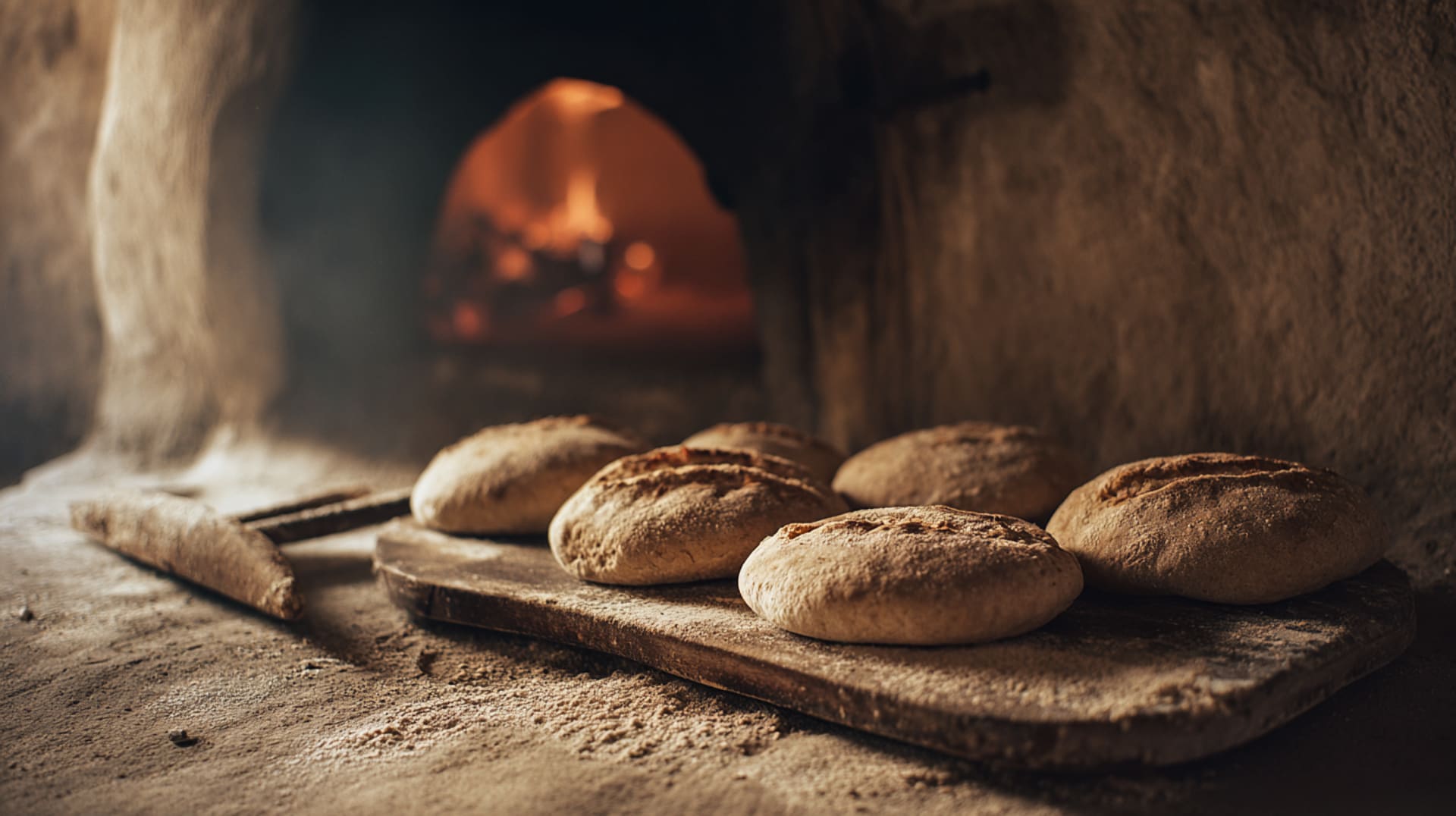
This is the ferran — the communal oven. Every neighbourhood in the medina had one. Some still do. The system worked like this: women kneaded the dough at home, shaped the loaves, pressed their family's mark into the surface, and sent a child to carry them to the oven on a wooden board. The ferrani charged one or two dirhams per loaf, baked them in a wood-fired oven alongside everyone else's bread, and the child returned an hour later to collect the finished rounds, still warm, balanced on the same board. The ferran was a bakery, a meeting point, and a news service. The women who waited for their bread exchanged everything the neighbourhood needed to know.
Until the 1980s, most Moroccan families used the ferran. Modern home ovens and commercial bakeries have reduced the tradition, but in the medinas and in the countryside, the smell of the communal oven still anchors the morning.
The bread
Khobz is the word. Round, thick, crusty outside, soft inside. Scored before baking — the marks create crumb and vent steam, but they also identify. A family's bread mark is as personal as a signature. Sizes range from small personal rounds to family loaves of thirty centimetres or more. It appears at every meal — breakfast, lunch, dinner — and to serve food without bread is to serve no meal at all.
The word carries weight beyond the table. In Darija, khobz means both bread and livelihood. "Ghadi n-qelleb 3la khobz" — I'm going to look for bread — means I'm going to work. Another word for bread is aïch, which means life. When bread falls on the ground, it is picked up, kissed, and placed somewhere higher. To step on bread is deeply offensive. To waste it is haram. Stale bread is dried, ground into breadcrumbs, soaked in soup, or fed to animals. Nothing is thrown away. The right hand tears the bread. The left stays in the lap. A knife never touches it — cutting bread with a blade is considered disrespectful to the grain.
At the start of any meal, the head of the household breaks the first piece. Bismillah is spoken. Then everyone eats, scooping tagine and salad and harira with torn pieces of khobz, each person working from the section of the communal dish in front of them — an unspoken etiquette of territory that children learn before they learn to read.
Eight breads
Khobz is the foundation, but Morocco has at least eight breads that answer different questions: how much time do you have, what flour is in the house, is there an oven nearby?
Msemen — square, layered, folded like an envelope and cooked on a griddle. The layers come from stretching the dough paper-thin, brushing it with oil, and folding it back on itself, again and again. A good msemen is crisp outside and pulls apart in sheets. Baghrir — the thousand-hole pancake. Semolina batter poured onto a hot surface, where the bubbles form a sponge of tiny craters that soak up butter and honey. It is cooked on one side only and is the breakfast bread of Ramadan. Rghaif — layered flatbread, stuffed or plain, the hand-stretched cousin of msemen. Harcha — semolina griddle cake, dense and golden, split and filled with cheese or butter. Batbout — pocket bread, puffed on the griddle, torn open and stuffed. Tafarnout — the Amazigh bread, baked in embers or in a clay tannourt oven, made with barley or corn because wheat was a lowland crop that didn't grow in the mountains. Krachel — sweet anise rolls, glazed with egg, served at celebrations and with morning coffee.
Each one has a geography. Msemen and baghrir are urban — they require a griddle and a certain patience with lamination. Tafarnout is rural Atlas, made with whatever grain the altitude allows. Khobz is everywhere, the bread of the ferran and the bakery, the bread that means bread and also means work.
The dependency
Morocco cannot feed itself on wheat. This is the fact that shapes everything from the bread on the table to the kingdom's foreign policy.
Annual demand is roughly 9.6 million tonnes. In a good year — when the rains come on time and the Atlas snowmelt fills the reservoirs — domestic production covers perhaps half of that. In a bad year, it covers a quarter. The year 2024 was a bad year: two consecutive droughts dropped production to 2.47 million tonnes, down over forty percent. Morocco imported 6.3 million tonnes of wheat at a cost of 1.78 billion dollars. The country imports more wheat than any Arab nation.
The government manages this dependency with a subsidy system that is less an economic policy than a survival mechanism. A reference price is set at 270 dirhams per quintal. When the import price exceeds this threshold, the state pays the difference. The purpose is simple: keep the price of bread stable. The consequences of failure are not theoretical. In 1981, when the government raised bread and flour prices, Casablanca erupted. The official death toll was sixty-six. The real number was almost certainly higher. The bread riots permanently reshaped Moroccan economic policy — bread price stability became, and remains, a political imperative. In 2007, bread prices triggered unrest again. The government doubled down on subsidies and has never looked back.
France was historically the dominant supplier — over fifty percent of imports as recently as 2022. But the supply chain is shifting. Russia has emerged as a major source, shipping over a million tonnes by mid-2025. Morocco is diversifying because it has no choice: a country that depends on imports for sixty percent of its staple food cannot afford to depend on a single supplier.
Behind the numbers is a structural reality. Agriculture accounts for ten percent of Morocco's GDP but employs forty-five percent of the workforce. It takes 1,300 cubic metres of water to produce one tonne of wheat — and Morocco is running out of water. The dams that irrigate the growing regions are below thirty percent capacity. The Al Massira dam, which supplies Marrakech and Casablanca, dropped below five percent in 2024. Climate models project a further ten to twenty percent decline in rainfall by 2050.
Morocco is not going to grow its way out of this. The wheat will keep arriving on ships. The subsidy will keep the price stable. The bread will keep appearing at every meal. The boy will keep carrying the board on his head. The ferrani will keep reading the fork marks. And the word for bread will keep meaning the word for life.
Every journey includes bread — not as a food stop, but as a way of reading a city. The ferrah ovens tell you which neighbourhood you're in.
Tell us about your trip →Data and visualisation by Dancing with Lions
The Facts
- —Khobz = bread and livelihood in Darija — "ghadi n-qelleb 3la khobz" (I'm going to look for bread) means "I'm going to work"
- —Bread dropped on the ground is kissed and placed somewhere higher — stepping on bread is deeply offensive
- —Morocco imports 60%+ of its wheat — approximately 6.3 million tonnes in 2024, costing $1.78 billion
- —Domestic wheat production collapsed to 2.47 million tonnes in 2024 after two consecutive drought years
- —The 1981 Casablanca bread riots killed at least 66 people after the government raised flour prices
- —Government sets wheat reference price at 270 MAD/quintal — subsidies activate above this threshold
- —Ferran (communal oven) fee: traditionally 1-2 dirhams per loaf
- —Each family marks their loaf with distinctive fork patterns, knife scores, or thumb prints
- —Morocco has 120+ industrial mills for soft wheat, 20 for durum, 8 for barley flour
- —Agriculture accounts for 10% of GDP but employs 45% of the workforce
Sources
- USDA Foreign Agricultural Service. Morocco Grain and Feed Update, 2024-2025
- FAO. Crop Prospects and Food Situation, March 2025
- World Grain. Focus on Morocco, December 2025
- Milling Middle East & Africa. Morocco wheat import subsidy extension, March 2025
- ONICL (Office National Interprofessionnel des Céréales et des Légumineuses). Flour extraction regulations
- Wolfert, Paula. The Food of Morocco. Ecco/HarperCollins, 2011
- Hal, Fatéma. Les saveurs et les gestes: cuisines et traditions du Maroc. Stock, 1996
- Pennell, C.R. Morocco Since 1830: A History. NYU Press, 2000