They arrived with recipes and heartbreak.
After 1492, when Granada fell and Spain decided it only wanted Christians, the boats crossed south. Families who had lived in Córdoba for seven centuries landed in Tangier, Tétouan, Fes, Rabat, carrying whatever they could hold — and what they held was mostly invisible. How to fold pastry into a hundred layers. How to tune an oud to the Andalusian modes. How to plant a courtyard garden so the jasmine blooms in sequence from April to October. How to build a horseshoe arch.
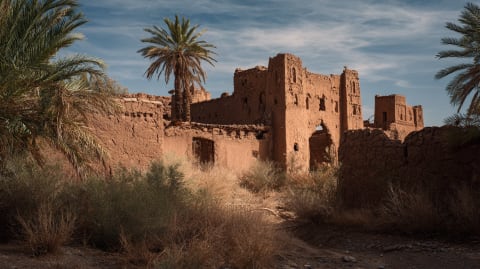
The horseshoe arch — now the visual signature of Moroccan design — was actually a Visigothic form adopted by the Umayyads in Córdoba, perfected in the Alhambra, and carried to Morocco by people who were told they no longer belonged in the country their ancestors had built. The muqarnas, the honeycomb vaulting in every Moroccan palace, reached its peak in Granada before crossing south. The Giralda in Seville and the Koutoubia in Marrakech were built by the same dynasty, to the same proportions, within the same generation. Architecture doesn't need a passport. It just needs someone who remembers how.
The music survived the crossing. Andalusi classical music — performed today in Fes, Tetouan, and Oujda — traces its theory to Ziryab, the 9th-century musician who established the nuba suite form in Córdoba. When the Muslims were expelled from Spain in 1492 and again in 1609, they carried the repertoire south. Morocco, Algeria, Tunisia, and Libya each preserved different portions. Eleven of the original twenty-four nubat survive. The thirteen that were lost are the silence between the songs.
The expulsions reshaped Morocco's coast. Tetouan was rebuilt by Andalusian refugees. Chefchaouen was populated by them. Rabat and Salé received thousands. The Moriscos brought architecture, agriculture, and a particular bitterness about what they had lost. The whitewashed walls and tiled courtyards of northern Morocco are not Moroccan inventions — they are Andalusian memories, built in exile, maintained with the stubbornness of people who refused to forget where they came from.
The strait is 14 kilometres wide. Everything that crossed it — armies, refugees, music, geometry, sorrow — fit through that narrow gap. The corridor is still open. The traffic still flows. The conversation, eight centuries later, is still not finished.
The walk from Bab Boujloud to the Qarawiyyin in Fes follows the route the Andalusian refugees took. We trace it with you.
Tell us about your trip →Data and visualisation by Dancing with Lions
The Facts
- —Al-Andalus: Muslim Iberia (711-1492)
- —Refugees settled in Fes, Tétouan, Chefchaouen, Rabat, Salé
- —Andalusian music tradition survives in Morocco
- —Architectural influence: horseshoe arches, muqarnas, garden design
- —Culinary legacy: pastilla, almond pastries, preserved lemons
- —Chefchaouen founded 1471 by Mouriscos
- —Tétouan rebuilt by Andalusian refugees after 1492
Sources
- Menocal, María Rosa. The Ornament of the World. Back Bay Books, 2002
- Harvey, L.P. Muslims in Spain 1500 to 1614. University of Chicago Press, 2005
- Abun-Nasr, Jamil. A History of the Maghrib in the Islamic Period. Cambridge University Press, 1987
Further Reading
Practical questions