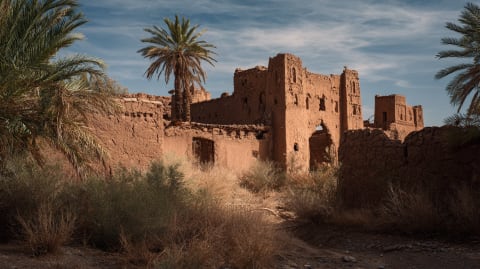
A kasbah is a fortified house. A ksar is a fortified village. Southern Morocco has over 4,000 of them, which is a lot of fortification for a region that is mostly empty, and tells you something about what the emptiness contained.
They cluster along the Drâa and Dadès valleys, perch on ridges above palm oases, and guard the passes through the High Atlas. The material is pisé — rammed earth. A wooden form is filled with earth, straw, and water, then compacted by hand or foot. The form is raised, another layer added. A wall rises at roughly 60 centimetres per day. When the form is removed, the wall stands — massive, thick, naturally insulated. Cool in summer. Warm in winter. Dissolving slowly in the rain, which is the one thing pisé asks you to protect it from, and the one thing most owners no longer do.
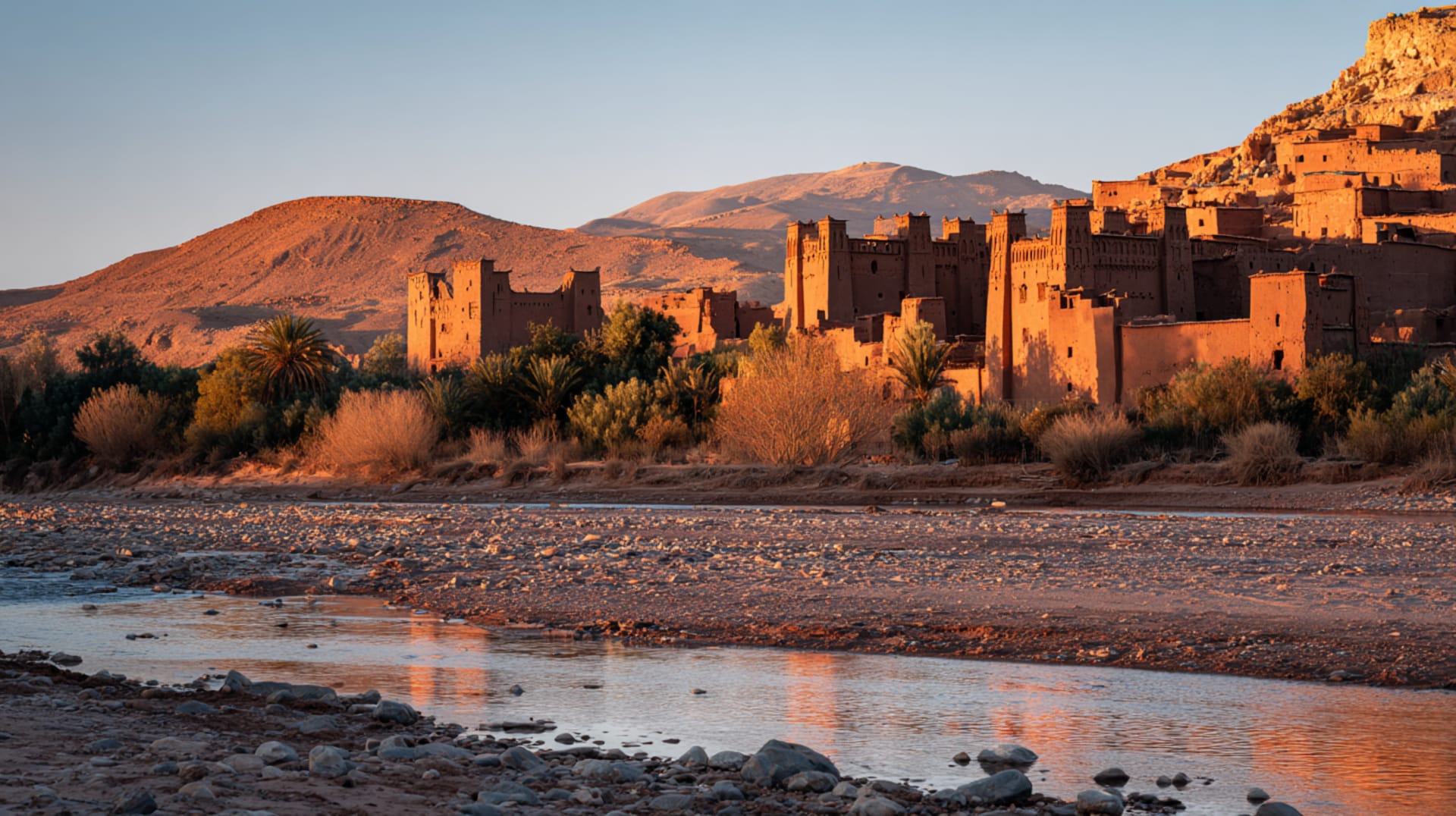
Aït Benhaddou is the most famous — UNESCO World Heritage since 1987, film location for Lawrence of Arabia, Gladiator, and Game of Thrones. It sits on a hillside above the Ounila River, towers and walls cascading downward in a geometry that looks sculpted rather than built. Six families still live inside. The rest have moved to the modern village across the river, where the plumbing works and the stairs are less likely to surprise you.
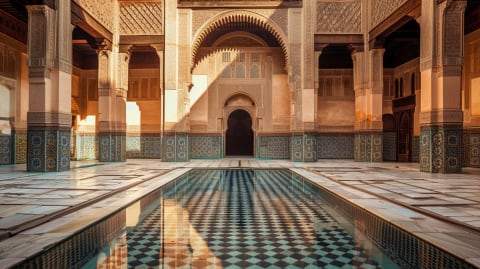
The Glaoui dynasty controlled this corridor in the 19th and early 20th centuries. Thami el-Glaoui built or expanded kasbahs from Telouet to Ouarzazate. The Kasbah of Telouet — his mountain stronghold — contains some of the finest zellige and painted cedar work in Morocco, slowly crumbling because nobody has maintained it since his fall from power in 1956. It is the most beautiful ruin in the Atlas, and the most political.
Skoura's palm groves contain over 40 kasbahs in various states of preservation. The Kasbah Amridil — still inhabited — is one of the most photogenic in the country, which is a competitive category in a valley where every bend in the road produces another.
The buildings are dissolving. Pisé requires annual maintenance — mud plaster applied before the rains. Without it, the walls melt. Climate change has intensified the problem: erratic rainfall erodes walls that were built for predictable seasons. UNESCO protects a handful. The rest return to the earth they were made from, slowly, quietly, without anyone filming them for Game of Thrones.
A thousand kasbahs line the route from Ouarzazate to Tinghir. The road follows the river, the river follows the valley.
Tell us about your trip →Data and visualisation by Dancing with Lions
The Facts
- —Route des Mille Kasbahs: Ouarzazate to Tinghir
- —Kasbahs built from rammed earth (pisé)
- —Ait Benhaddou: UNESCO World Heritage Site
- —Taourirt Kasbah, Ouarzazate: largest surviving
- —Pisé walls dissolve without maintenance
- —Draa and Dadès valleys: highest concentration
- —Glaoui family built many during 19th-20th century
Sources
- Naji, Salima. Art et architectures berbères du Maroc. Édisud, 2001
- Terrasse, Henri. Kasbas Berbères de l'Atlas et des Oasis. Horizons de France, 1938
- UNESCO World Heritage. Ksar of Ait-Ben-Haddou, nomination file, 1987