Jews have lived in Morocco for over 2,000 years — longer than Islam has existed, longer than Arabic has been spoken here, longer than most of the empires that have claimed the territory. The earliest communities may have arrived with Phoenician traders. By the Roman period, Jewish settlements were established across North Africa. When Muslims and Jews were expelled from Spain in 1492, tens of thousands crossed to Morocco and joined the Toshavim, the indigenous Jewish population that was already old when the refugees arrived.
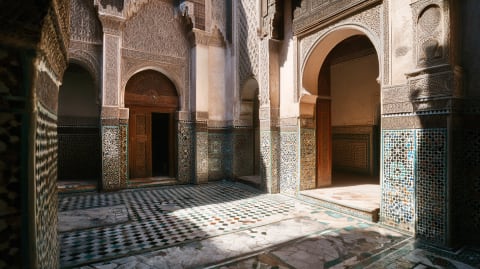
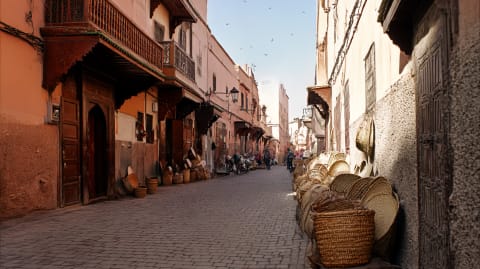
The mellah was the Jewish quarter. The word means "salt" — the etymology is debated and none of the explanations are pleasant. Every major Moroccan city had one: Fes in 1438 was the first, followed by Marrakech, Meknes, Essaouira, Safi, Tetouan. The mellahs were not ghettos in the European sense — they were distinct quarters with their own synagogues, markets, cemeteries, and communal ovens, often adjacent to the royal palace. The proximity to the king was protection. It was also a reminder of who provided it.
The peak population was approximately 265,000 in 1948. Then Israel was founded. Operation Yachin moved over 90,000 Moroccan Jews to Israel between 1961 and 1964. Others went to France, Canada, South America. By the 1970s, a community of a quarter-million had shrunk to a few thousand. The departure was not expulsion — Morocco never expelled its Jews. It was gravity: the pull of a new state, the push of regional conflict, the slow erosion of a community that could only remain a community if enough people stayed.
Today roughly 2,000 Jews remain, mostly in Casablanca. The mellahs survive as architecture — the buildings are there, the synagogues are there, the cemeteries are meticulously maintained. The 2011 constitution recognised Jewish heritage as a foundational component of Moroccan identity. The Bayt Dakira in Essaouira and the Museum of Moroccan Judaism in Casablanca preserve what can be preserved in glass cases.
But a community is not a museum. A community is people in houses, children in schools, arguments in synagogues. What remains in Morocco is memory tended with genuine care by a country that did not cause the departure and has chosen to honour the presence. It is not nothing. It is also not what it was.
The mellahs of Fes and Marrakech are stops we weave into city walks. The Lazama Synagogue in Marrakech opens quietly, without signs.
Tell us about your trip →Data and visualisation by Dancing with Lions
The Facts
- —Jewish presence in Morocco: 2,000+ years
- —Peak population: ~275,000 (1940s)
- —Current population: ~2,000-3,000
- —Mellahs (Jewish quarters) in every imperial city
- —Mohammed V refused to hand over Jews during WWII
- —Museum of Moroccan Judaism: only Jewish museum in Arab world
- —Hiloula pilgrimages continue annually
- —Stars of David still visible on mellah doorways
Sources
- Laskier, Michael. The Alliance Israélite Universelle and the Jewish Communities of Morocco. SUNY Press, 1983
- Gottreich, Emily. The Mellah of Marrakesh. Indiana University Press, 2007
- Schroeter, Daniel. The Sultan's Jew: Morocco and the Sephardi World. Stanford University Press, 2002
Further Reading
Practical questions