The fondouk was the hotel of the medieval trade route. The Nejjarine is the most beautiful one left.
A fondouk — sometimes called a caravanserai — was a building where travelling merchants stored their goods on the ground floor and slept on the upper floors. Every major trading city in the Islamic world had dozens. Fes had more than two hundred.
Most are gone. Some are now private houses. A few are warehouses. The Fondouk Nejjarine, built in the 18th century at the edge of the carpenters' quarter (nejjarine means carpenters in Arabic), was restored in the 1990s and reopened as the Museum of Wooden Arts and Crafts.
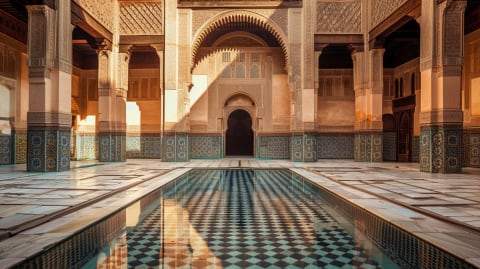
The building is arranged around a central courtyard with a fountain in the middle. Three floors of carved wooden galleries rise above the courtyard, supported by cedar columns. The restoration was painstaking — the carved plaster, the zellige fountain basin, the painted cedarwood balustrades were all conserved or replicated using traditional methods. It was restored by the Fondation Mohammed Karim Lamrani and reopened in 1998 as a museum of wood arts and crafts.
The collection inside includes carved doors, window screens, musical instruments, Quran stands, and domestic objects made from cedarwood and thuya. But the building is the real exhibit. Standing in the courtyard, looking up through three levels of carved wood, you see the architecture of hospitality — a building designed to receive strangers, house them safely, and send them on their way. The merchants are gone. The building remembers how to welcome.
The Facts
- —The Fondouk Nejjarine, built in the 18th century at the edge of the carpenters' quarter (nejjarine means carpenters in Arabic),
- —It won the Aga Khan Award for Architecture in 1998.
Sources
- Le Tourneau, Roger. Fès avant le protectorat. IHEM, 1949
- Revault, Jacques et al. Palais et demeures de Fès. CNRS, 1985
- UNESCO World Heritage. Medina of Fez, nomination file, 1981
Practical questions