The most famous film ever set in Casablanca was made entirely on a sound stage in Burbank, California, between May 25 and August 3, 1942. The airport where Bogart delivers the most quoted farewell in cinema history was Van Nuys Airport in the San Fernando Valley. The train station where Rick watches Ilsa disappear into the rain was a leftover set from Bette Davis's Now, Voyager. The exotic bazaar was a redressed backlot. The fog was a machine. The aeroplane in the final scene was a plywood cutout, and the ground crew walking around it were dwarfs hired to make the model look full-sized.
The director, Michael Curtiz, was Hungarian. He had never been to Morocco. Neither had the producer, Hal B. Wallis. Neither had the stars.
The whole thing started with a twenty-seven-year-old English teacher from New York.
In the summer of 1938, Murray Burnett and his wife Frances traveled to Nazi-occupied Vienna to help Jewish relatives smuggle money out of Austria. The Anschluss had happened that March. Burnett saw troops in the streets, propaganda on every wall, and the systematic dismantling of Jewish life. On the way home, the couple stopped on the French Riviera — Cap Ferrat — and walked into a nightclub called the Café Américain. A Black pianist played jazz for a room full of French, Germans, and refugees, all drinking together in a place where the war hadn't quite arrived yet.
Two years later, Burnett wrote a play called Everybody Comes to Rick's. A cynical American bar owner in Casablanca. A woman he loved in Paris. A Czech resistance leader. Letters of transit. The song "As Time Goes By," which had been Burnett's favourite since his days at Cornell.
No Broadway producer would touch it. The script landed at Warner Bros., where a story analyst called it "sophisticated hokum" — approvingly. Story editor Irene Diamond convinced Hal Wallis to buy the rights in January 1942 for $20,000. It was the most anyone in Hollywood had ever paid for an unproduced play. The title was changed to Casablanca.
Twin brothers Julius and Philip Epstein wrote the screenplay, with Howard Koch handling the politics and Casey Robinson tightening the romance. Seven writers worked on the material at various points. Nobody thought they were making anything special. It was simply another Warner Bros. release — one of five hundred that year dealing with war subjects. Bogart was paid his contract rate. Ingrid Bergman didn't know how the film would end because the writers hadn't decided. Dooley Wilson, who played Sam the pianist, couldn't actually play the piano. The tracks were recorded by Elliot Carpenter, playing just off camera.
The set for Rick's Café Américain cost $9,200 — more than half the film's entire $18,000 set budget.
The film premiered at the Hollywood Theatre in New York on November 26, 1942, timed to coincide with the Allied invasion of North Africa and the capture of the actual Casablanca two weeks earlier. It won Best Picture, Best Director, and Best Screenplay. It became the most frequently broadcast film on American television. Harvard students watched it every year during finals week, a tradition that started at the Brattle Theater in 1957 and continued for decades.
Murray Burnett received almost no credit. In 1974, Ingrid Bergman said in an interview: "Casablanca based on a play? No, I don't think so." Koch wrote that the play provided "an exotic locale and a character named Rick who ran a café, but little in the way of a story adaptable to the screen." Burnett sued for $6.5 million and lost. In 1991, Koch finally admitted in a letter to the Los Angeles Times that the complaint had been justified. Burnett died in 1997. He never got the recognition he deserved.
For sixty years after the film, tourists arrived in Casablanca looking for Rick's Café and found nothing. The bar had never existed. The city had no connection to the film beyond its name.
Then Kathy Kriger showed up.
Kriger was a retired American diplomat who had served as a commercial attaché in Morocco. After 9/11, she decided to build the thing everyone had been looking for. She cashed in her 401(k), created an investment company called The Usual Suspects — the fundraising pitch was "Of all the gin joints in all the towns in all the world, I'd like you to buy into mine" — and found a crumbling 1930s riad on Boulevard Sour Jdid, at the edge of Casablanca's Ancienne Médina, with two royal palms flanking the front door.
She needed someone who understood how to turn a fantasy into a real Moroccan interior. She called Bill Willis.
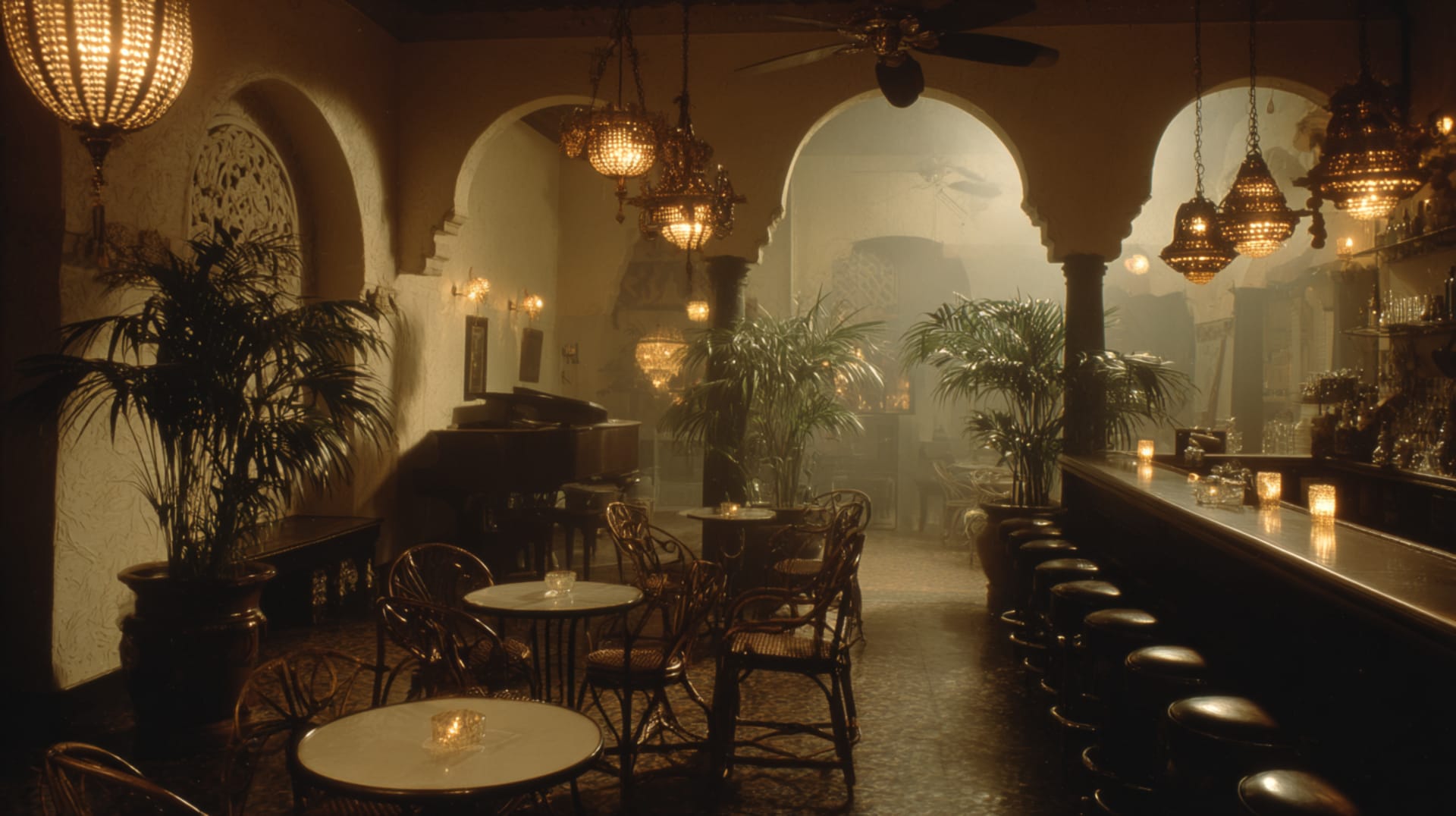
Willis — the American designer from Memphis who had spent forty years reinventing Moroccan craft for the Gettys, the Rothschilds, and Yves Saint Laurent — designed the interior of Rick's Café. White arches, brass chandeliers, zellige tile, tadelakt walls, carved cedar screens, a baby grand piano tucked into an alcove. He made it look like the movie, but built it with the real thing. Every material was Moroccan. Every surface was handmade.
Rick's Café opened on March 1, 2004, to rave reviews. The film plays on a loop upstairs. Issam Chabaa plays "As Time Goes By" on the piano every night. The signature cocktail is the Sour Jdid, named after the boulevard.
Kriger died in Casablanca in 2018, aged 72. She chose to be buried there. The staff who have kept her vision alive since opening day — including Issam — say her presence still fills the place.
The irony is layered. An English teacher from New York wrote a play inspired by a nightclub on the French Riviera, set it in a city he barely knew. Hollywood turned it into the most famous film of the 1940s without leaving California. Sixty years later, an American diplomat built the fictional bar for real, in the actual city, designed by an American who had made Moroccan interiors his life's work. Fiction became fact. Burbank became Casablanca. The plywood became zellige.
Play it again.
Not a single frame of Casablanca was shot in Morocco. The film locations route visits the places Hollywood actually used.
Tell us about your trip →The Facts
- —Not a single frame shot in Morocco
- —Filmed on Burbank soundstage, May 25 – August 3, 1942
- —Airport scene: Van Nuys Airport, San Fernando Valley
- —Train station: leftover set from Bette Davis's Now, Voyager
- —Fog was a machine
- —Airplane in final scene: plywood cutout
- —Ground crew: dwarfs hired to make model look full-sized
- —Director Michael Curtiz: Hungarian, never visited Morocco
- —Started with an unproduced play: "Everybody Comes to Rick's"
Sources
- Koch, Howard. Casablanca: Script and Legend. Overlook Press, 1973
- Harmetz, Aljean. Round Up the Usual Suspects: The Making of Casablanca. Hyperion, 1992
- Warner Bros. Production archives