A Moroccan cooking class starts at the souk. Every good one does. The teacher — usually a woman, because Moroccan home cooking is women's work and has been for centuries — walks you through the market and names things. This is cumin. This is ras el hanout. These preserved lemons have been in salt for three months. These olives are from the Meknes region. You buy what you need. The prices she pays are not the prices you would pay alone.
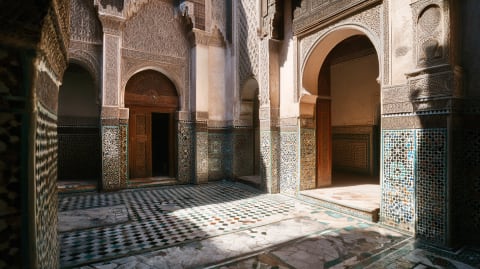
Back in the kitchen — a riad courtyard, a rooftop, a traditional dar — you learn by doing. The tagine is the centrepiece of every class. You layer the onions, the meat, the vegetables, the spices, the preserved lemons, the olives. You learn that the secret to Moroccan cooking is not a secret at all: it is time. The tagine cooks slowly over low heat for an hour or more. The cone-shaped lid returns the steam to the dish. Nothing dries out. Everything merges.
While the tagine cooks, you make salads — zaalouk (roasted eggplant and tomato), taktouka (roasted peppers), a carrot salad with cumin and orange blossom water. You learn to make bread — khobz — by hand, slapping the dough into rounds. You make mint tea, pouring from height, spilling the first attempt, getting it right the second time.
Then you eat what you made. This is the best part. You sit together — the teacher, the other students, sometimes her family — and eat with bread and your hands, the way Moroccans eat at home. The tagine you made tastes better than any restaurant tagine you will eat in Morocco, and you will spend the rest of your trip trying to figure out why.
It is because you walked the souk. You touched the spices. You watched the preserved lemons go in. Cooking is understanding, and a cooking class is the fastest way to understand Moroccan food.
Classes run 100-400 dirhams for a group session, 500-1,500 dirhams for a private one. Every riad in Marrakech and Fes can arrange one. The best are in private homes, not hotel kitchens. Ask for a class in someone's house. That is where the real recipes live.
The Facts
- —Class starts at the souk: buy ingredients together
- —Tagine: layered, slow-cooked 1+ hours
- —Salads: zaalouk, taktouka, carrot-cumin
- —Bread: khobz, hand-shaped
- —Mint tea: learn to pour from height
- —Group class: 100-400 MAD
- —Private class: 500-1,500 MAD
- —Best classes: in private homes, not hotels
Sources
- Wolfert, Paula. The Food of Morocco. Ecco/HarperCollins, 2011
- Hal, Fatéma. Les saveurs et les gestes: cuisines et traditions du Maroc. Stock, 1996
- Morse, Kitty. Cooking at the Kasbah. Chronicle Books, 1998
Practical questions