You have seen the photograph. You may not know the names, but you have seen it — on mood boards, on Pinterest, in hotel lobbies, in the opening slides of every interior designer who has ever taken a client to Marrakech. A woman crouching on a rooftop in a patchwork kaftan and white harem trousers. A hooded man behind her. The medina below. The Atlas Mountains on the horizon.
The photograph was taken by Patrick Lichfield in January 1969 for Vogue. The woman was Talitha Getty. The man was her husband, John Paul Getty Jr., son of the richest man in the world. The rooftop belonged to their house — a ruin they had bought for ten thousand dollars in the medina and turned into what Diana Vreeland called the Pleasure Palace.
The image is now held by the National Portrait Gallery in London. It has been reproduced so many times that it has detached from the people in it and become a symbol of something else entirely: bohemian Marrakech, hippie chic, the idea that you can wear a kaftan on a rooftop and look like you belong to the sky.
The reality behind it is darker, stranger, and more interesting than the symbol.
The camp
Talitha Dina Pol was born in Java in 1940, in what was then the Dutch East Indies. When the Japanese invaded in 1942, she and her mother were interned in a prison camp. Her father was sent to a separate camp. They survived. Her parents separated after the war. Her mother took her to England and died in The Hague in 1948. Talitha was eight.
Her father remarried — to Poppet John, daughter of the painter Augustus John, a central figure in British bohemian culture. Talitha grew up between art and displacement. She became an actress, moved through the London party circuit, and in 1965 was invited to a dinner at Claus von Bülow's house where she expected to sit next to Rudolf Nureyev. She sat next to John Paul Getty Jr. instead. They married in Rome in December 1966.
The palace
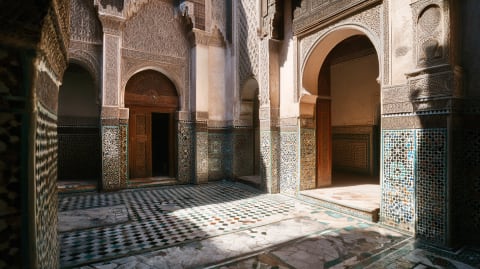
Bill Willis accompanied the Gettys on their honeymoon to Marrakech. They found a crumbling palace in the medina — the Palais de la Zahia, a former royal residence reduced to rubble. They bought it for ten thousand dollars. Willis, who would go on to invent modern Moroccan interior design, began the restoration. "Bill created the Marrakech look," the decorator Jacques Grange said later, "and it started with that house."
The Zahia became a magnet. The Rolling Stones came. The Beatles came — the Stones and the Beatles spent a Christmas there together. Andy Warhol came. Marianne Faithfull came. Yves Saint Laurent came, and what he saw changed his work permanently. "When I knew Talitha," he said, "my vision completely changed." Bergé later said she arrived like a gust of wind, bringing a tornado with her.
Talitha brought more than guests. Diana Vreeland described entertainers, dancers, acrobats, storytellers, geomancers, and magicians filling the house. A day that began with a picnic near a waterfall in the Atlas might end with dinner for a houseful of Moroccan and European friends — artists, writers, musicians. She prowled the souks, bringing back treasures for the house and the table. She wore Berber necklaces as statement pieces — heavy silver, amber, turquoise, talismans gathered from the medina. She dressed in kachaba — the loose embroidered house dress Moroccan women wear — mixed with London vintage and Balinese wraps.
Saint Laurent watched all of this. What he saw on Talitha — the kaftan as eveningwear, the embroidery as haute couture, the mixing of Moroccan craft with European cut — became the foundation of his Moroccan collections. The caftans that sold in Paris for tens of thousands came from watching a Dutch-Indonesian woman dress herself from the souks of Marrakech.
Beautiful and damned
The phrase is Saint Laurent's. "I knew the youthfulness of the Sixties," he said in 1984. "Talitha and Paul Getty lying on a starlit terrace in Marrakech, beautiful and damned, and a whole generation assembled as if for eternity where the curtain of the past seemed to lift before an extraordinary future."
The future was not extraordinary. It was heroin.
By 1969, the year Lichfield took the photograph, both Talitha and Paul were addicted. The parties at the Zahia ran on opium. Keith Richards recalled that the Gettys had access to the best and finest. Count Jean de Breteuil — a young French aristocrat — supplied drugs to the house and to musicians across two continents. He would later deliver the drugs that accidentally killed Jim Morrison in Paris, less than two weeks before Talitha herself died.
Talitha wanted to stop. She wanted to return to London with their son, Tara. She and Paul separated. She got sober. She was living in London, active, social, apparently recovered. Then in the summer of 1971 she returned to Rome to attempt a reconciliation with Paul. On July 11, 1971, she was found dead of a heroin overdose. She was thirty years old.
She died within the same twelve months as Jimi Hendrix, Janis Joplin, Jim Morrison, and Edie Sedgwick. Her friend Brian Jones — who had spent time with her in Marrakech, and who had recorded the Master Musicians of Joujouka in the Rif — had died two years earlier.
What the photograph made
The Palais de la Zahia today belongs to the writer Bernard-Henri Lévy and his wife, the actress Arielle Dombasle. It is no longer a place of parties. It is reportedly a discreet address where feuding world leaders gather in privacy. The rooftop is still there. The iron grilles through which Talitha peered in another Lichfield photograph are still there.
What Talitha left Marrakech is more complicated than a photograph. She left a template. The barefoot woman in the kaftan on the rooftop — mixing cultures, mixing centuries, mixing the medina with the jet set — became the image that sold Marrakech to the Western imagination for the next sixty years. Every riad that puts vintage Berber carpets on white walls and calls itself bohemian is quoting Talitha Getty, whether it knows it or not.
She also left an unresolved question. Talitha loved Morocco. She loved the souks, the craft, the music, the light. She wore the culture on her body. But she moved through it as a billionaire's wife, surrounded by servants and substances, in a palace that cost her ten thousand dollars in a city where most people earned ten dirhams a day. The beauty was real. The inequality was also real. Both things are in the photograph, if you know where to look.
The rooftop is empty now. The kaftan is in a museum. The woman who wore it has been dead for over fifty years. But every season, somewhere in the world, a designer sends a model down a runway in embroidered silk and harem trousers, and the ghost of Talitha Getty walks through Marrakech one more time.
Sources
- Talitha Getty. Biographical records, Getty family archives
- Vreeland, Diana. Various published interviews and writings
- Hamilton, Richard & Salmon, Xavier. Marrakech: Through Writers' Eyes. Eland, 2010
Practical questions