They came from Tyre — a city on the coast of what is now Lebanon — and they were looking for two things: metal and a route to more metal. By the 8th century BCE, Phoenician ships were threading the Strait of Gibraltar and turning south along the Atlantic coast of Africa. They were the first Mediterranean people to reach this far west. They did not come to conquer. They came to trade.
The trading posts they established along the Moroccan coast were not cities. They were small, fortified harbours — places to anchor, exchange goods, repair hulls, and wait for the wind. Tingis, now Tangier. Zili, now Asilah. Lixus, near Larache. Sala, now Rabat. And Mogador — now Essaouira — the westernmost Phoenician outpost in the known world.
The Phoenicians did not name themselves. The Greeks called them Phoinikes — the purple people — after the dye they extracted from the murex sea snail. The dye was worth more than gold by weight. A single gram required thousands of snails, crushed, boiled, and left to ferment in the sun. The smell was unbearable. The colour was permanent. Kings paid for it. The Phoenicians sold it.
On the Îles Purpuraires — the Purple Islands off the coast of Mogador — they ran a dye factory. The shells are still there, in the archaeological layer, three thousand years deep.
Lixus — the oldest city in the west
Pliny the Elder called Lixus the most ancient Phoenician colony in the far west. The site sits on an 80-metre hill overlooking the Loukkos River, four kilometres from the Atlantic, northeast of modern Larache. Before the Phoenicians arrived in the 8th or 7th century BCE, indigenous communities were already there — Late Bronze Age people who left behind megalithic blocks, locally made ceramics, and bronze weapons.
The Phoenicians built on top of what existed. Stone buildings in the temple quarter. Red slip pottery. Cruz de Negro jugs — the distinctive Phoenician storage vessels found at every western Mediterranean trading post from Cadiz to Carthage. The settlement grew. Fishing and salt production drove the economy. The marshes around the Loukkos provided the salt. The Atlantic provided the fish. The Phoenicians provided the market.
Some ancient Greek writers located at Lixus the mythological Garden of the Hesperides — the garden at the edge of the world where golden apples grew, guarded by a dragon. Whether the Phoenicians encouraged this rumour for commercial reasons is not recorded, but it would have been in character.
Lixus outlasted the Phoenicians. Carthage took it over. Then the Mauretanian kings. Then Rome. Under the emperor Claudius, it became a Roman colony with the largest garum factory in the western Mediterranean — a fish sauce production complex with a salting capacity of over one million litres. In the 3rd century it became Christian. In the 12th century a mosque was built on the ruins. By the 14th century it was abandoned in favour of Larache across the river.
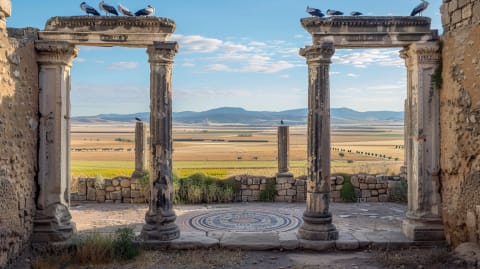
Today, the site covers 62 hectares. Only a quarter has been excavated. A Roman amphitheatre, thermal baths, a sanctuary, and the garum vats are visible. The Phoenician layer is underneath — you walk on it without knowing. The site is on Morocco's UNESCO tentative list. Almost nobody visits. It is twenty minutes from Larache and three thousand years from forgetting.
Mogador — the edge of the known world
Essaouira's island — the Île de Mogador — was the Phoenicians' furthest point. Archaeological excavations by the German Archaeological Institute found Phoenician ceramics, amphorae, and evidence of purple dye production dating to the 7th century BCE. This was the end of the line. South of here, the Phoenician maps went blank.
The name Mogador may derive from the Phoenician word for watchtower, though the etymology is disputed. What is certain is that the island served as a seasonal trading station — Phoenician sailors came with the summer winds, traded with the inland population, produced dye, and left before winter. They were not settlers. They were businessmen with boats.
The inland people they traded with — the ones the Greeks called barbaroi, meaning "those who do not speak our language" — were the Amazigh. The word "Berber" is a Greek insult that stuck. The Amazigh had been there for thousands of years before the first Phoenician keel scraped the shore. They did not need naming. They were named anyway, and the name survived longer than the people who invented it.
The alphabet
The Phoenicians gave the world the alphabet. The Greek alphabet, the Latin alphabet, the Arabic alphabet — all descend from the Phoenician script developed in Byblos around 1050 BCE. Twenty-two consonants. No vowels. Written right to left. The simplicity was the revolution — before the Phoenicians, writing required hundreds of symbols that only scribes could master. After the Phoenicians, anyone could learn to read in a week.
Whether the Amazigh Tifinagh script — the alphabet carved into rock across the Atlas and the Sahara — derives from Phoenician or developed independently is still debated. The two scripts share some characters. The timing overlaps. The contact was there. But the Amazigh, who tend to predate everyone else's claims about North Africa, maintain that Tifinagh is their own. The argument continues in academic journals. The rocks say nothing.
What they left
The Phoenicians did not build empires. They built networks. The trading posts along the Moroccan coast were nodes in a web that connected Cornwall's tin mines to Lebanon's cedar forests, Spain's silver to Egypt's grain, and Moroccan salt to Mediterranean kitchens. They moved goods, not armies. They influenced through commerce, not conquest.
What remains in Morocco is mostly underground. The Phoenician layer at Lixus. The Purple Islands off Essaouira. Ceramics in the Rabat Archaeological Museum. A few scholarly papers and a lot of unanswered questions. The Phoenicians wrote on papyrus, which rotted. Their buildings were built over by Carthaginians, who were built over by Romans, who were built over by everyone who came after.
But the name they left — the one the Greeks gave to the people they found on this coast, the word that became Berber, the label that an entire civilisation is still trying to replace with Amazigh — that survives. Three thousand years, and the insult is still in use. The purple dye faded. The word did not.
Sources
- Markoe, Glenn. Phoenicians. University of California Press, 2000
- Aubet, Maria Eugenia. The Phoenicians and the West. Cambridge University Press, 2001
- INSAP. Moroccan Phoenician site excavation reports (Lixus, Mogador)
Practical questions