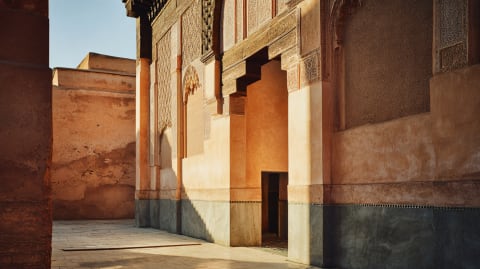
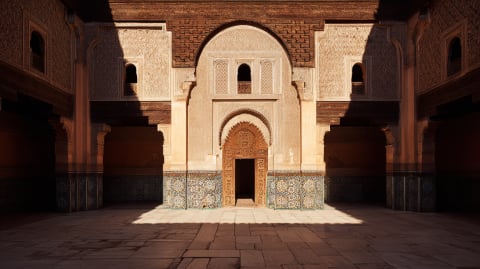
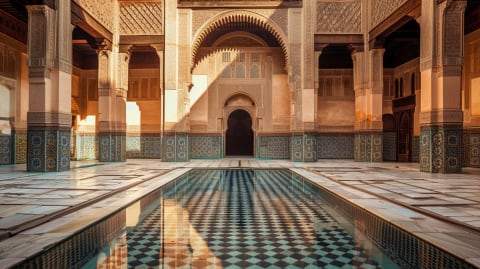
The medina is a thousand years old. The walls are twelve kilometres long. Inside them, nine thousand streets fold into each other without logic, without signage, and without apology. The city was built to be navigated by people who already knew it. If you do not already know it, the city does not care. It has other things to do.
This is not a walking tour. It is a way of understanding what you are inside.
The shape
Marrakech has two cities. The medina — founded in 1070 by the Almoravids — sits inside the ramparts. The Ville Nouvelle — built by the French during the Protectorate — spreads outside them. The Guéliz district, with its wide boulevards and café terraces, feels like a provincial French town with palm trees. The medina feels like a medieval city that never became medieval because it was already something else.
The medina's geography follows water. The Almoravids built underground channels — khettara — to bring snowmelt from the Atlas to the city. The channels determined where the mosques could be (water for ablution), where the gardens could be (water for irrigation), and where the souks could be (water for the tanneries, the dyers, the hammams). Everything you see was placed where the water allowed it.
The centre is Jemaa el-Fna — the square that is not a square but a triangle, not a market but a stage, not a tourist attraction but a UNESCO-protected masterpiece of oral tradition. The storytellers are mostly gone. The musicians remain. The food stalls arrive at dusk and the smoke rises and the noise becomes a wall. Come at four different hours and you will see four different squares.
Day one — the spine
Walk south from Jemaa el-Fna. This is the spine of the medina — the route that connects the square to the great monuments. You will pass through the souk, which is not one souk but dozens, organised by trade: metalworkers here, leather there, spices in the next alley. The organisation is medieval and still functional. The labyrinth has logic.
The Koutoubia Mosque is the city's anchor — visible from most rooftops, its minaret the template for the Giralda in Seville and the Hassan Tower in Rabat. Non-Muslims cannot enter, but the proportions are the point. The Almohads built it twice because the first version faced the wrong direction.
Continue south to Bahia Palace — a 19th-century sprawl of tiled courtyards, painted ceilings, and a garden the size of a neighbourhood. It was built by a grand vizier who wanted a palace bigger than the sultan's. The name means "brilliance." The intention was excess, and it succeeded. Around the corner on Rue de la Bahia, a small door opens into Maison Tiskiwin — the Bert Flint museum that most visitors miss entirely.
From Bahia, walk to the Saadian Tombs — sealed by Moulay Ismail in the 17th century, rediscovered by the French in 1917, and now the most ornate funerary architecture in Morocco. The carved cedar and zellige inside the mausoleum are as fine as anything in the Alhambra.
End the day on a rooftop. Not for the sunset photograph — for the sound. The muezzin calls from seventeen mosques within earshot of Jemaa el-Fna, each a few seconds apart, and for three minutes the city vibrates at a frequency that has not changed in a thousand years.
Day two — the craft
The souks are best in the morning, before the heat compresses everything. Enter from the north side of Jemaa el-Fna through Souk Semmarine — the main covered market — and then lose yourself. This is not a figure of speech. The point is to get lost. The medina will return you to the square eventually. It always does.
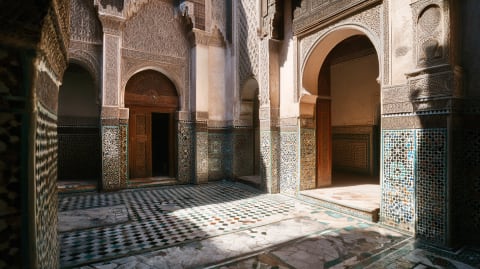
What to look for: the zellige workshops where men chip tiles by hand into geometric shapes that have not changed since the Marinid dynasty. The babouche makers — three craftsmen, one slipper. The brass workers who hammer trays that ring like bells. The leather dyers whose hands are permanently stained. None of these are performances. They are jobs.
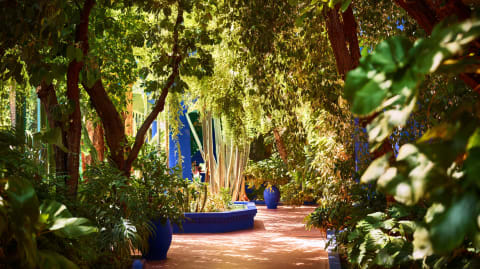
In the afternoon, leave the medina. Take a taxi to the Jardin Majorelle — the garden YSL saved — and visit the Berber Museum inside the blue studio. Then walk ten minutes to the Musée Yves Saint Laurent. The architecture alone is worth the trip.
Day three — the invisible city
The Marrakech that tourists see is ten percent of the Marrakech that exists. Day three is for the rest.
The mellah — the old Jewish quarter — is south of Bahia Palace. The synagogues are mostly closed. The Lazama Synagogue is open. The cemetery is open. The doorframes of former Jewish houses still show the rectangular indentations where mezuzot were once fixed. Muslim families live there now. Nobody has filled in the marks.
The seven saints of Marrakech — the city's spiritual protectors — are buried in zawiyas scattered across the medina. A circuit of the seven is a pilgrimage that most Marrakchis know and most visitors have never heard of.
The nineteen gates pierce the ramparts. Each had a function — military, commercial, ceremonial, or secret. Walking the full circuit of the walls takes about three hours and gives you the medina from the outside, which is the only way to understand how it sits in the landscape: the red city at the foot of the white mountains.
In the evening, eat where the city eats. Not the rooftop restaurants around Jemaa el-Fna — the ones in the side streets of the Kasbah district, or the fish stalls at the south end of the square, or the hole-in-the-wall tanjia joints near Bab Doukkala where the slow-cooked meat has been in the ashes since morning. The tanjia is Marrakech's dish. Not the tagine. The tanjia.
What Marrakech is not
It is not the medina at golden hour. It is not the riad with the plunge pool. It is not the influencer on the rooftop. These are surfaces. Marrakech is a working city of nearly a million people who live, trade, pray, argue, cook, and raise children inside walls that were built before Oxford University existed. The spectacle is real. So is the city behind it. The question is which one you came to see.
Sources
- Deverdun, Gaston. Marrakech: des origines à 1912. Éditions Techniques Nord-Africaines, 1959
- Wilbaux, Quentin. La médina de Marrakech. L'Harmattan, 2001
- UNESCO World Heritage. Medina of Marrakesh, nomination file, 1985
Practical questions