The Roman South

History

The Roman South

The mosaics are still in the ground. Not behind glass, not in a museum, not roped off — in the ground, where they were laid two thousand years ago, open to the sky and to anyone who walks across the site. This is Volubilis, and the remarkable thing is not that Rome built here but that what Rome built is still here, exposed, weathering, and more beautiful for the exposure than any museum installation could manage.

Volubilis was not a military outpost. It was an agricultural city — the administrative capital of Mauretania Tingitana, governing the fertile hinterland between the Rif and the Middle Atlas. Its wealth came from wheat, olive oil, and garum. The olive presses are still visible in several houses — massive stone wheels that crushed olives for export to Rome. The city supplied the empire's western appetite. In return, the empire supplied plumbing, law, and the mosaics that decorated the dining rooms of people who liked to eat dinner above pictures of Dionysus.

The site predates Rome. A Berber settlement existed here from at least the 3rd century BCE. The Berber king Juba II — educated in Rome, married to Cleopatra Selene, cosmopolitan in a way that would make most modern cities look provincial — invested in Volubilis before Rome annexed the province in 40 CE. What followed was two centuries of building: the Capitol temple, the basilica, the triumphal arch of Caracalla, the residential quarter with mosaics that scholars study and tourists photograph and cats sleep on.

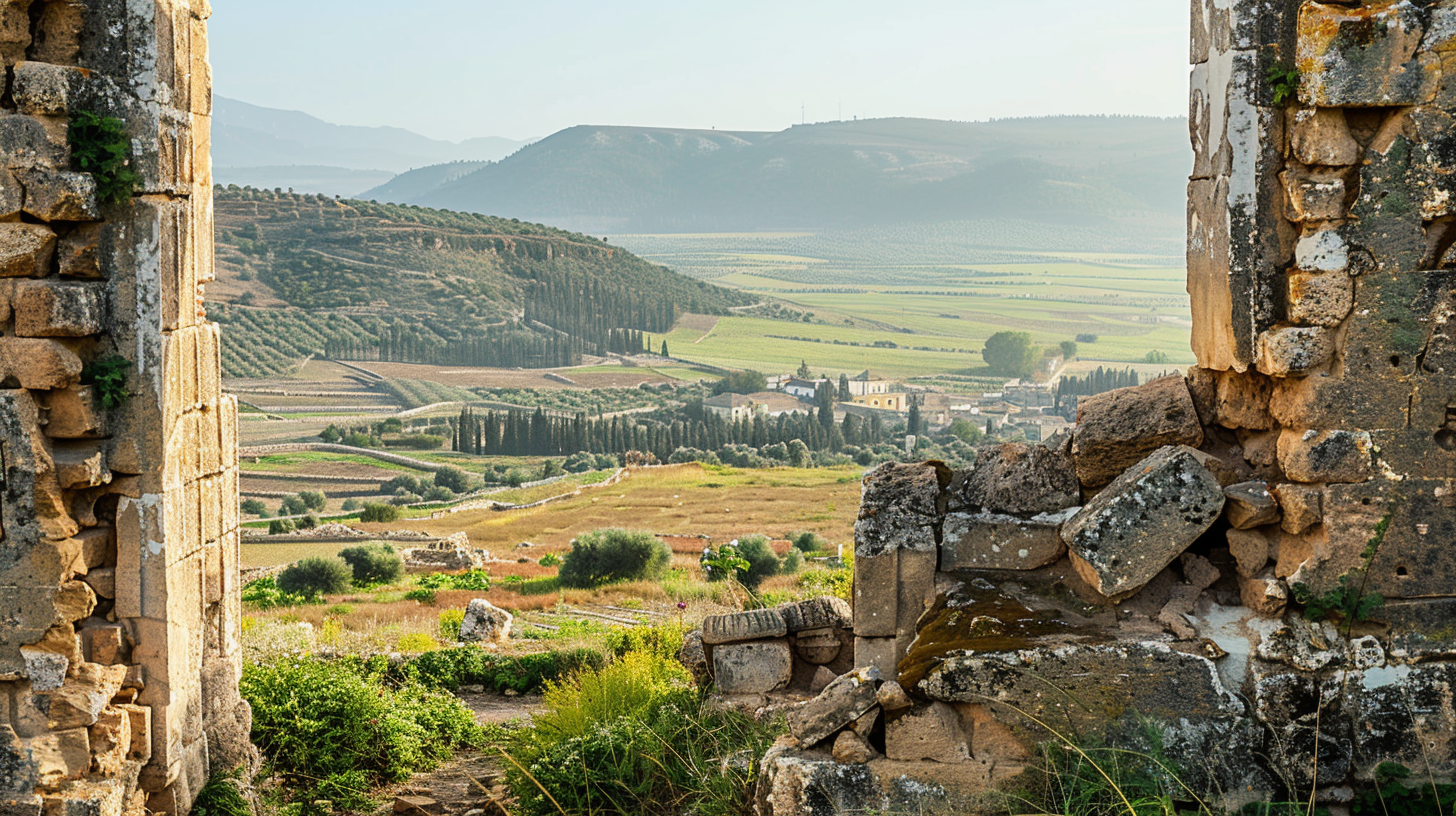
The Caracalla arch, built in 217 CE, frames the view of the countryside beyond the city. It is the most photographed element of the site, not because it is the most beautiful but because it sits at the edge of the excavated area and the landscape beyond it — wheat fields, olive groves, the hills of Zerhoun — looks almost exactly as it did when Rome was in charge. The empire changed the city. It did not change the land.

Rome withdrew around 285 CE. The city persisted — inhabited by Berbers, then by an early Islamic community under Idris I, who used it as a base before founding Fes. The 1755 Lisbon earthquake toppled much of what remained standing. The French excavated the site during the protectorate.

What strikes you is the domesticity. The mosaics decorated rooms where families ate dinner. The oil presses were businesses. The baths were social clubs. Rome in Morocco was not an outpost pretending to be civilisation. It was civilisation, transplanted and adapted and eventually left behind by an empire that moved on. The mosaics stayed. They have been staying for two thousand years, and they are very good at it.

The mosaics at Volubilis are still in the ground, open to the sky. Six days traces Rome's North African footprint.

Tell us about your trip →

The Facts

  • Volubilis: best-preserved Roman ruin in North Africa outside Libya/Tunisia
  • 30km north of Meknes
  • Not a military outpost — an agricultural city
  • Capital of Mauretania Tingitana province
  • Wealth from wheat, olive oil, garum (fermented fish sauce)
  • Mosaics still in the ground, open to the sky
  • Population ~20,000 at peak
  • Paved streets, public baths, forum, basilica, olive presses

Sources

  • Palmer, Robert. "The Master Musicians of Jajouka." Rolling Stone, 1971
  • Burroughs, William S. Liner notes, Brian Jones Presents the Pipes of Pan at Joujouka. Rolling Stones Records, 1971
  • Kapchan, Deborah. Traveling Spirit Masters: Moroccan Gnawa Trance and Music in the Global Marketplace. Wesleyan University Press
  • Davis, Stephen. Hammer of the Gods: The Led Zeppelin Saga. William Morrow
  • Bourdain, Anthony. Parts Unknown, Season 11, Episode 2: "Morocco." CNN, 2018