The fugitive arrived from the east in 788, carrying nothing but a name. Idris ibn Abdallah was a direct descendant of the Prophet Muhammad, one of the few survivors of a massacre at Fakhkh, where the Abbasids had slaughtered his family. He crossed the breadth of North Africa — Baghdad, Kairouan, Tangier — until the Awraba Berbers of Volubilis offered him shelter and declared him imam.
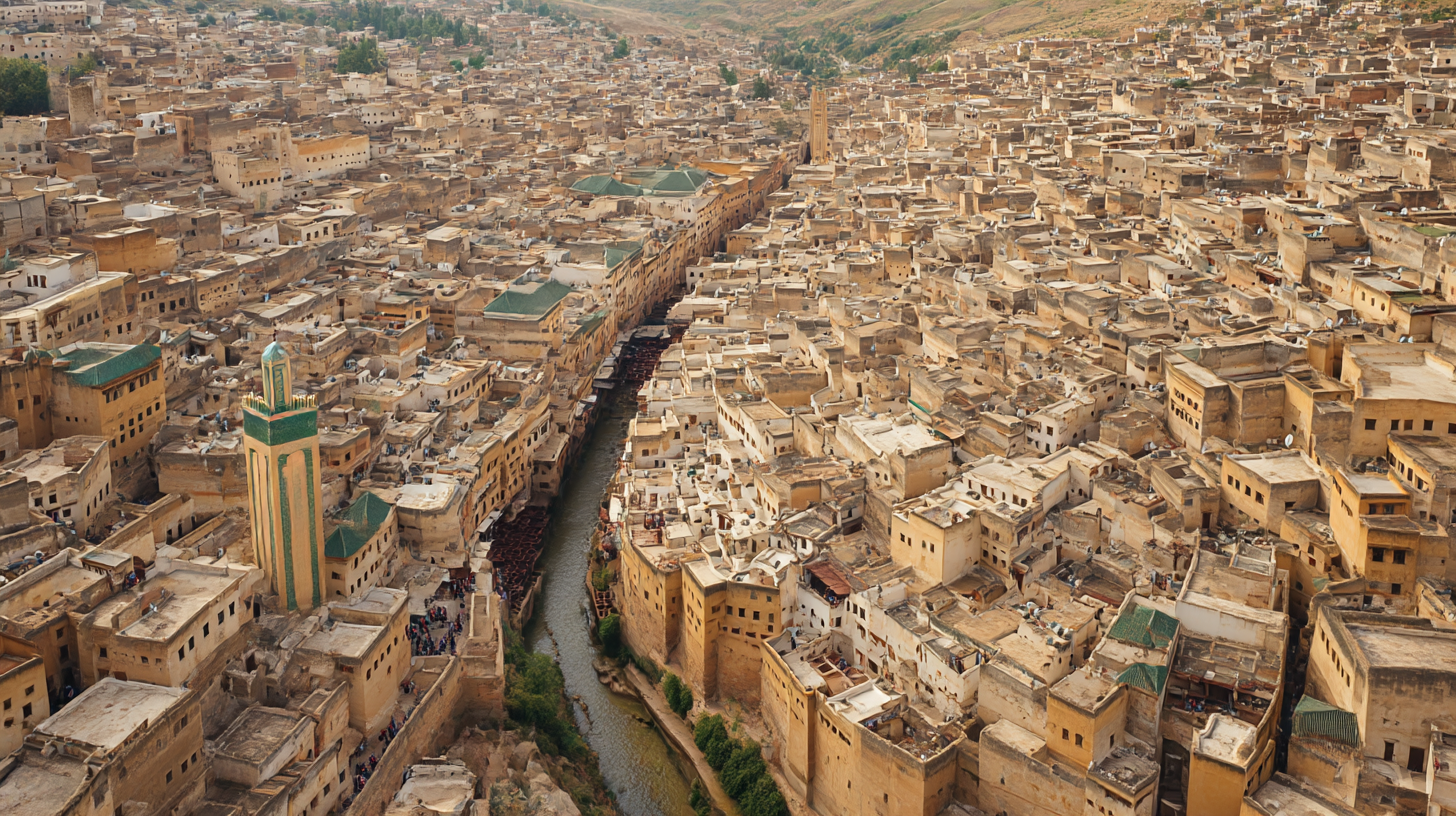
A year later, in 789, he founded a settlement on the east bank of the Wadi Fes and called it Madinat Fas. The springs nearby were famous in songs. The river gave water. The hills gave shelter. The location was perfect.
Then the Abbasids found him again. In 791, an assassin sent from Baghdad poisoned Idris I. He died before his city could grow. But his concubine Kenza was already pregnant.
The son, Idris II, was ten years old when he took the throne in 803. At sixteen, he moved the capital from Volubilis to Fes, but not to his father's settlement. He built a new city on the opposite bank of the river — al-'Aliya, "the Exalted" — and made it his seat of power.
Two cities. Same river. Different banks. Different mosques. Different everything.
Then the refugees arrived. In 817-818, nearly eight hundred Andalusian families expelled from Córdoba after a failed rebellion crossed the strait and settled on the east bank — Idris I's side. Six years later, two thousand families banished from Kairouan in Tunisia settled on the west bank — Idris II's side. The Cordobans brought their music and their gardens. The Kairouanese brought their scholarship and their trading networks.
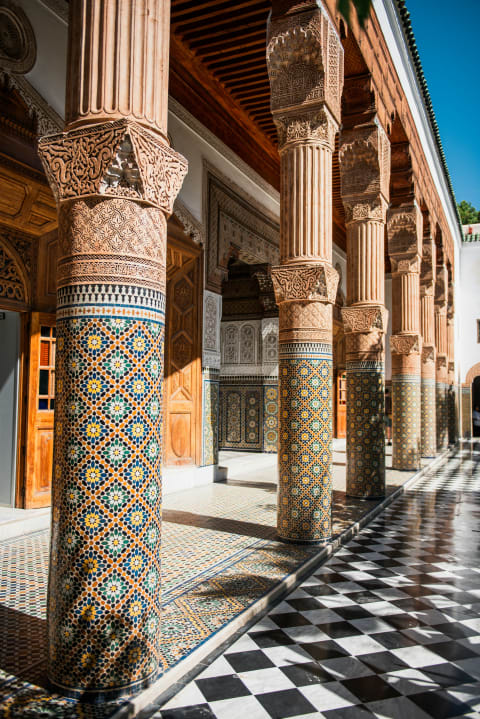
Each wave named its quarter after its homeland. The east bank became 'Adwat al-Andalus. The west bank became 'Adwat al-Qarawiyyin, named for Kairouan. Each quarter had its own Friday mosque, its own markets, its own gates, its own character. The Andalusian mosque still stands. So does al-Qarawiyyin.
For three centuries, the two cities competed across the river. Different governors, different loyalties, different allegiances in the war between the Fatimids and the Umayyads of Córdoba. The rivalry was not metaphorical. There were walls between them.
In 1070, Yusuf ibn Tashfin — the Almoravid sultan who would found Marrakech the same year — conquered Fes and did the obvious thing that nobody had done in three hundred years. He knocked down the walls, bridged the river, and unified the two settlements into a single city. What emerged was Fes el-Bali — "Old Fes" — the medina that stands today.
The Almohads rebuilt the ramparts and completed the perimeter walls in 1204, giving Fes el-Bali the shape it still holds. The Marinids, arriving in the mid-thirteenth century, added Fes el-Jdid — "New Fes" — on the hilltop to the west, with a royal palace, military garrison, and the mellah where the Jewish population was relocated in 1438.
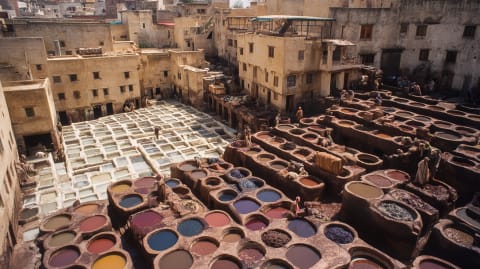
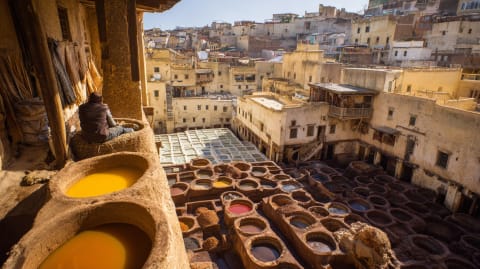
But the old city remained the heartbeat. Nine thousand streets. One hundred and fifty thousand residents. Fourteen principal gates. Zero cars. The largest pedestrian urban zone in the world, and the oldest continuously inhabited walled city in the Arab world.
A fugitive prince with a famous name, a river, two banks, and three centuries of stubbornness. That is how you build the oldest city in Morocco.
Fes was founded twice on two banks of one river. It took three centuries to bridge them. Three days is enough to walk both sides.
Tell us about your trip →The Facts
- —Idris I founded Madinat Fas on east bank, 789 CE
- —Idris II founded al-'Aliya on west bank, 808-809 CE
- —800 Andalusian families from Córdoba settled east bank, 817-818
- —2,000 Kairouanese families settled west bank, 824-825
- —Two rival mosques: al-Andalusiyyin and al-Qarawiyyin
- —Almoravids united the two cities under Yusuf ibn Tashfin, 1070
- —Almohad walls completed 1204, defining Fes el-Bali to this day
- —Fes el-Bali: world's largest car-free urban zone
- —9,000 streets and passages, 14 principal gates
- —Population of historic medina: ~150,000
Sources
- Le Tourneau, Roger. Fès avant le protectorat. IHEM, 1949
- Deverdun, Gaston. Marrakech: des origines à 1912. 1959
- Mezzine, Larbi. Le Tafilalt. Faculté des Lettres, Rabat, 1987
Practical questions