Zellige operates on geometric rules that Islamic mathematicians discovered and Moroccan craftsmen implemented for over 700 years before anyone thought to write them down. The patterns are not decorative choices. They are solutions to a mathematical problem: how to tile a plane with no gaps and no overlaps using a limited set of shapes. The answer turns out to be beautiful, which is convenient, but beauty was never the goal. Perfection was.
In 1891, the Russian crystallographer Evgraf Fedorov proved that there are exactly 17 distinct ways to repeat a pattern in two dimensions — the 17 wallpaper groups. Islamic artisans had been producing examples of all 17 for at least 500 years before the proof existed. Fedorov wrote equations. The maqlems wrote in tile. The conclusions were identical.
The basic tools are a compass and straightedge — the same instruments Euclid used, the same instruments a zellige master in Fes uses today. Every pattern begins with a circle, divided into equal parts, typically 8, 10, 12, or 16. Straight lines connect the points. Star patterns emerge from the intersections. The construction is taught by demonstration, master to apprentice, hand to hand. No textbook has ever been written. None is needed. The geometry teaches itself if you watch long enough.
Computational geometry has now formalised what the maqlems knew intuitively. Software can generate zellige patterns from parameters: symmetry group, star order, interlace depth, line width. The patterns produced are mathematically identical to hand-drawn constructions. A computer can design a pattern in seconds. This is impressive. It is also, somehow, beside the point.
Because cutting the tiles still requires years of training. Each piece is chipped from a glazed square using a sharp hammer — the menqash — by eye, without measurement, guided by a spatial intelligence that lives in the hands and not the screen. The tiles are fitted by hand, grouted face-down on a flat surface, and flipped. Tolerances of less than a millimetre across panels of several square metres. No software does this part. No software can.
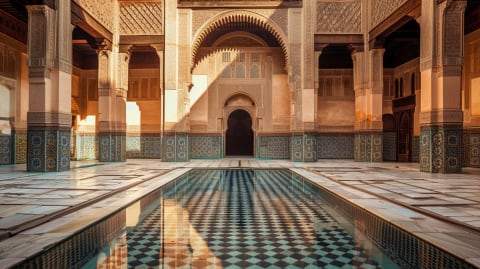
The question the digital age asks zellige is: does it matter that a human hand cut the tile? The answer, standing in front of a panel in the Bou Inania madrasa in Fes, is immediate and non-negotiable. The slight irregularities — a line fractionally off-true, a colour slightly deeper on one tile than its neighbour — create a visual warmth that perfect replication cannot touch. The mathematics are the same. The feeling is not. The hand matters.
In Fes, we take you to a workshop where a single zellige panel takes four months. The geometry is computed by hand.
Tell us about your trip →Data and visualisation by Dancing with Lions
The Facts
- —Islamic geometric patterns: mathematically perfect tessellations
- —17 wallpaper groups all represented in Moroccan zellige
- —Algorithmic generation reproduces traditional patterns
- —Craig Kaplan (2002): computational Islamic geometry
- —Parametric design tools now used by architects
- —Traditional cutters still work by eye, not computer
- —Digital preservation of endangered pattern libraries
Sources
- Castéra, Jean-Marc. Arabesques: Art Décoratif au Maroc. ACR Édition, 1999
- Paccard, André. Traditional Islamic Craft in Moroccan Architecture. Éditions Atelier 74, 1980
- Tiling Search Project, University of Oxford