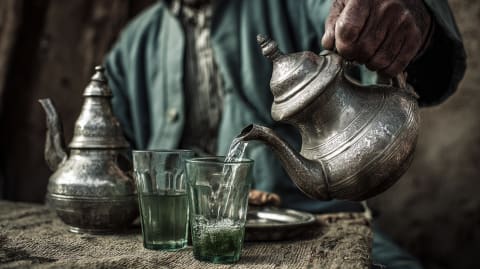
At sunset during Ramadan, Morocco stops. The streets empty. The taxis pull over. The shopkeepers close their shutters mid-sentence. Thirty-eight million people sit down to eat, and the first thing every one of them reaches for is harira.
It is a tomato-based soup. Thick — closer to a stew than a broth. Chickpeas, lentils, vermicelli noodles, celery, onion, tomato, a fistful of fresh coriander and parsley. The spicing is simple: ginger, turmeric, pepper, cinnamon. A squeeze of lemon at the table. Every family has its own recipe, and every family believes theirs is the correct one. This is not a debate that will be resolved.
The thickening is the trick. Traditional harira is bound with tedouira — a slurry of flour and water stirred in at the end to give the soup its body. Without it, harira is thin and unconvincing. With it, the soup coats the spoon and fills the stomach in a way that a light broth cannot, which matters when you have not eaten since before dawn.
Harira is served with dates — you break the fast with a date, as the Prophet did, then move to the soup. Alongside: hard-boiled eggs, chebakia, and shebbakiya, the honey-soaked pastries that no Ramadan table is complete without. Milk or juice. Then silence, because everyone is eating too fast to speak.
Outside Ramadan, harira is still everywhere. Street stalls serve it for 5-8 dirhams a bowl, year-round. It is the best cheap meal in Morocco after bissara — and it is the only soup most Moroccans will argue about with the same passion they reserve for football.
The recipe varies by city. Fes adds more herbs. Marrakech adds more spice. The north uses more tomato. The south adds more lentils. There is no canonical harira, only the one your grandmother made, and hers was better than everyone else's.
The Facts
- —Harira: tomato-based soup with chickpeas, lentils, vermicelli
- —Served at sunset to break Ramadan fast
- —Tedouira: flour-water slurry for thickening
- —Accompaniments: dates, hard-boiled eggs, chebakia
- —Street price: 5-8 MAD year-round
- —Regional variations: Fes (herbs), Marrakech (spice), north (tomato)
- —38 million people eat it simultaneously during Ramadan
Sources
- Wolfert, Paula. The Food of Morocco. Ecco/HarperCollins, 2011
- Hal, Fatéma. Les saveurs et les gestes. Stock, 1996
- Eickelman, Dale F. Moroccan Islam. University of Texas Press, 1976
Practical questions