Si Said was the brother of Ba Ahmed, the grand vizier who built the Bahia Palace. He built his own house across the street. It is smaller, older, and in some ways finer.
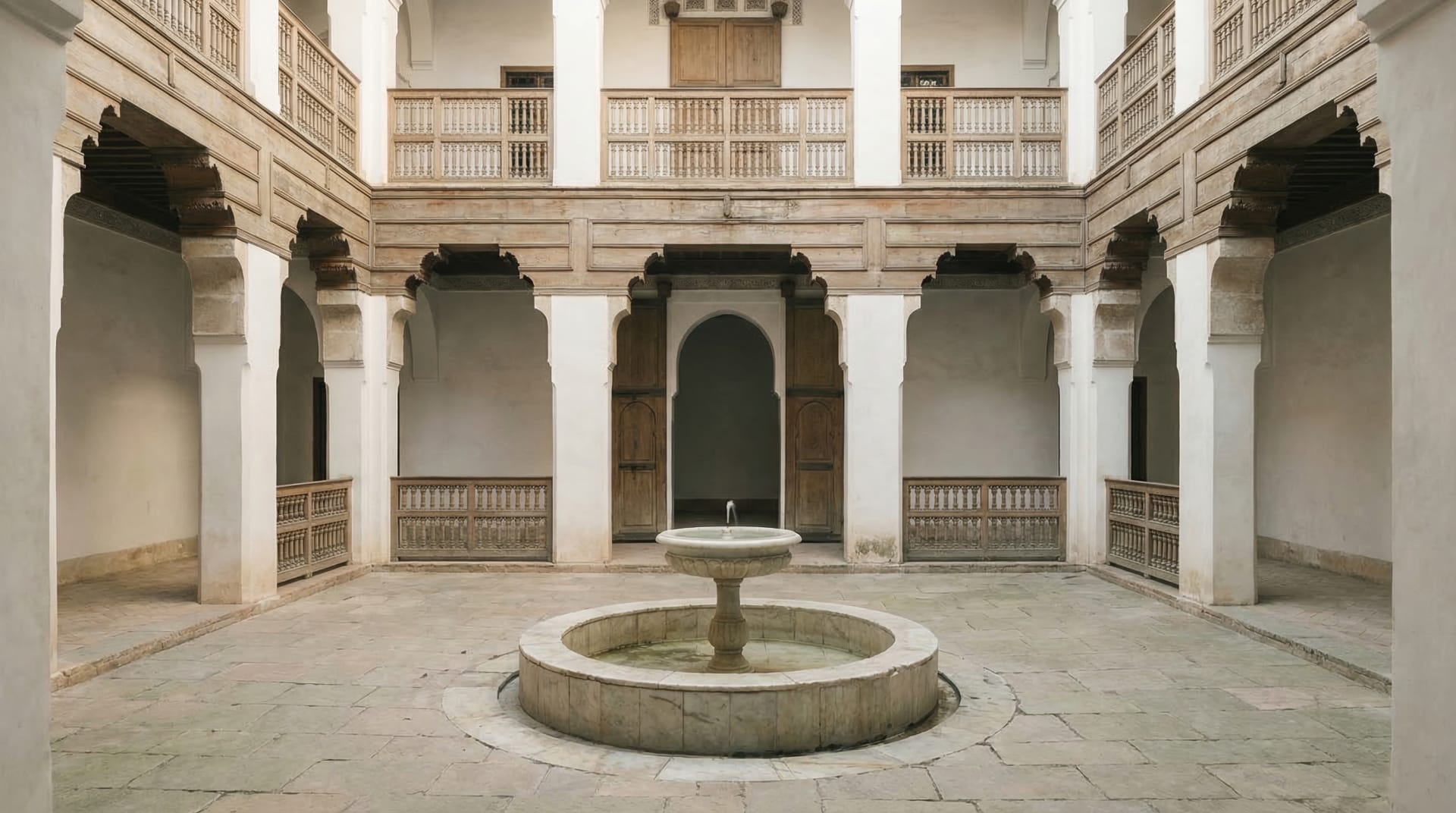
Dar Si Said was constructed in the late 19th century, roughly contemporaneous with the Bahia. But where Ba Ahmed was building a palace to rival the sultan's — a sprawling complex of gardens and harems and audience halls — Si Said built a private residence. The scale is domestic. The rooms are human-sized. And the woodwork is extraordinary.
The carved cedarwood ceilings in Dar Si Said are considered among the best in Marrakech. The central riad's painted woodwork uses colours and patterns that trace back to Andalusian traditions carried south by refugees from the Reconquista. The courtyard fountain, carved from a single piece of marble, was originally installed in a Saadian-era palace and is centuries older than the house it sits in.
Since 1934, the building has housed the Museum of Moroccan Arts — now called the National Museum of Weaving and Carpets. The collection includes Berber jewellery, ceramics, leatherwork, and textiles from across the country. The carpets are arranged by region and tribe, and if you have read anything about Moroccan weaving before arriving, the collection becomes a physical atlas.
Most visitors to Marrakech visit the Bahia Palace and skip Dar Si Said. The irony is that the smaller brother's house gives you a better sense of what wealthy domestic life in 19th-century Marrakech actually looked like — not the performance of power, but the texture of daily life with very good taste and a great deal of money.
The Facts
- —Dar Si Said was constructed in the late 19th century, roughly contemporaneous with the Bahia.
- —Since 1934, the building has housed the Museum of Moroccan Arts — now called the National Museum of Weaving and Carpets.
- —The irony is that the smaller brother's house gives you a better sense of what wealthy domestic life in 19th-century Marrakech
Sources
- Deverdun, Gaston. Marrakech: des origines à 1912. Éditions Techniques Nord-Africaines, 1959
- Parker, Richard. A Practical Guide to Islamic Monuments in Morocco. Baraka Press, 1981
- Mezzine, Larbi. Le Tafilalt: contribution à l'histoire du Maroc. Publications de la Faculté des Lettres, Rabat, 1987
Practical questions