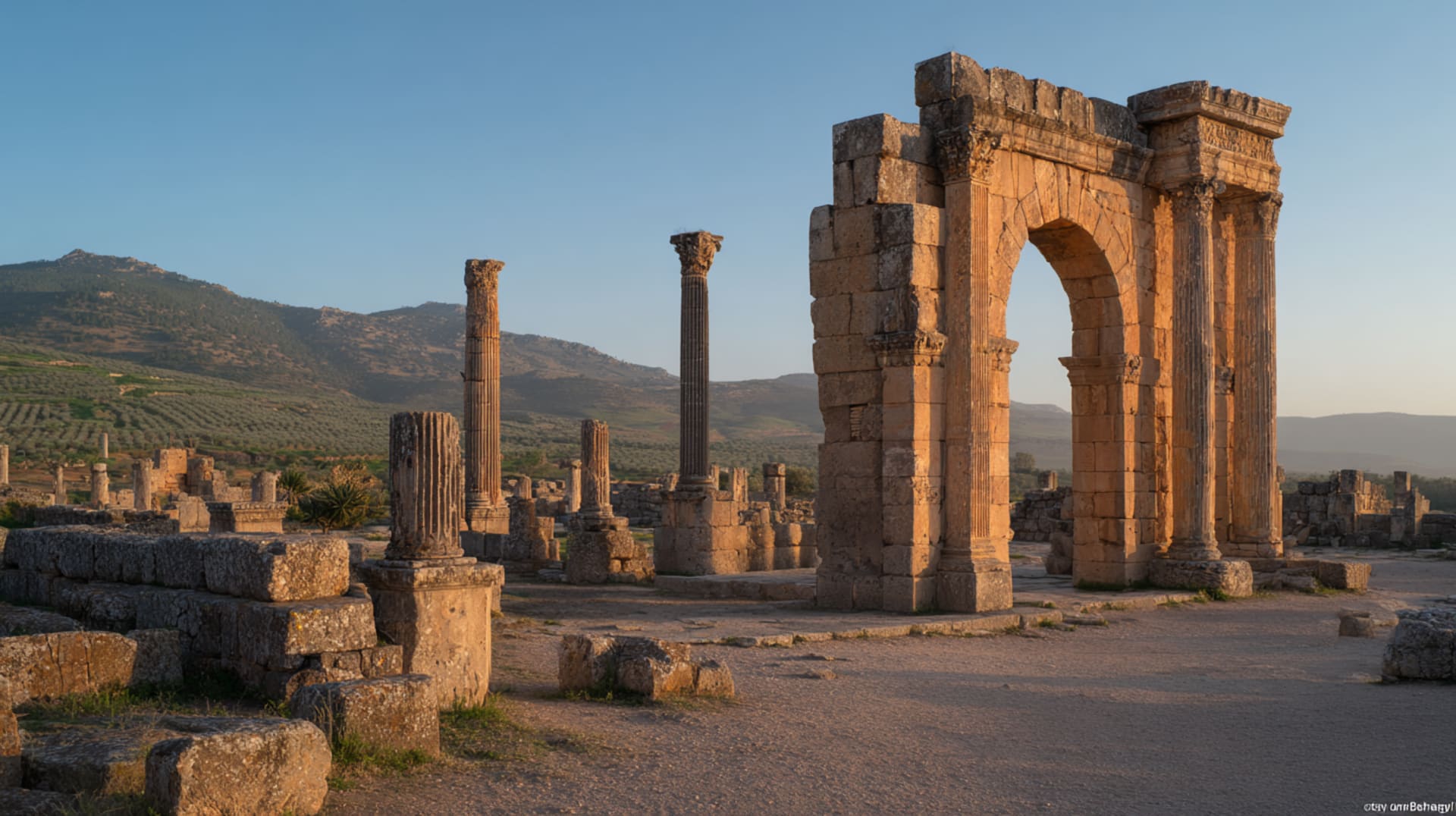
The mosaics are still in the ground. Not behind glass, not in a museum, not roped off. In the ground, where they were laid two thousand years ago, open to the sky and to anyone who walks across the site. Orpheus still charms the animals in tesserae. Dionysus still discovers Ariadne. The Labours of Hercules still unfold on the floor of a house whose owner has been dead since the 3rd century. The Romans left Morocco in 280 CE. The art, having nowhere else to go, stayed.
Morocco was the western edge. Mauretania Tingitana, Rome called it — the province at the end of the known world, where the Atlantic met Africa and the maps ran out of land. The capital was Volubilis, a city of 20,000 at its peak, with paved streets, public baths, a forum, a basilica, and olive presses that produced enough oil to supply the empire's western appetite. The Berber king Juba II — educated in Rome, married to Cleopatra's daughter — ruled from here before the province was absorbed in 40 CE, after Caligula had Juba's son murdered over a cloak, because Caligula.
Lixus, near Larache on the Atlantic coast, is older and wilder. Founded by Phoenician traders in the 8th century BCE — centuries before Rome existed — it was the largest garum factory in the western Mediterranean. Garum was the Roman fish sauce that the empire put on everything. The salting vats at Lixus held over a million litres. An amphitheatre sits halfway up the slope. At the summit, a sanctuary to Hercules. The Greeks placed the Garden of the Hesperides here — the mythological orchard at the world's end.
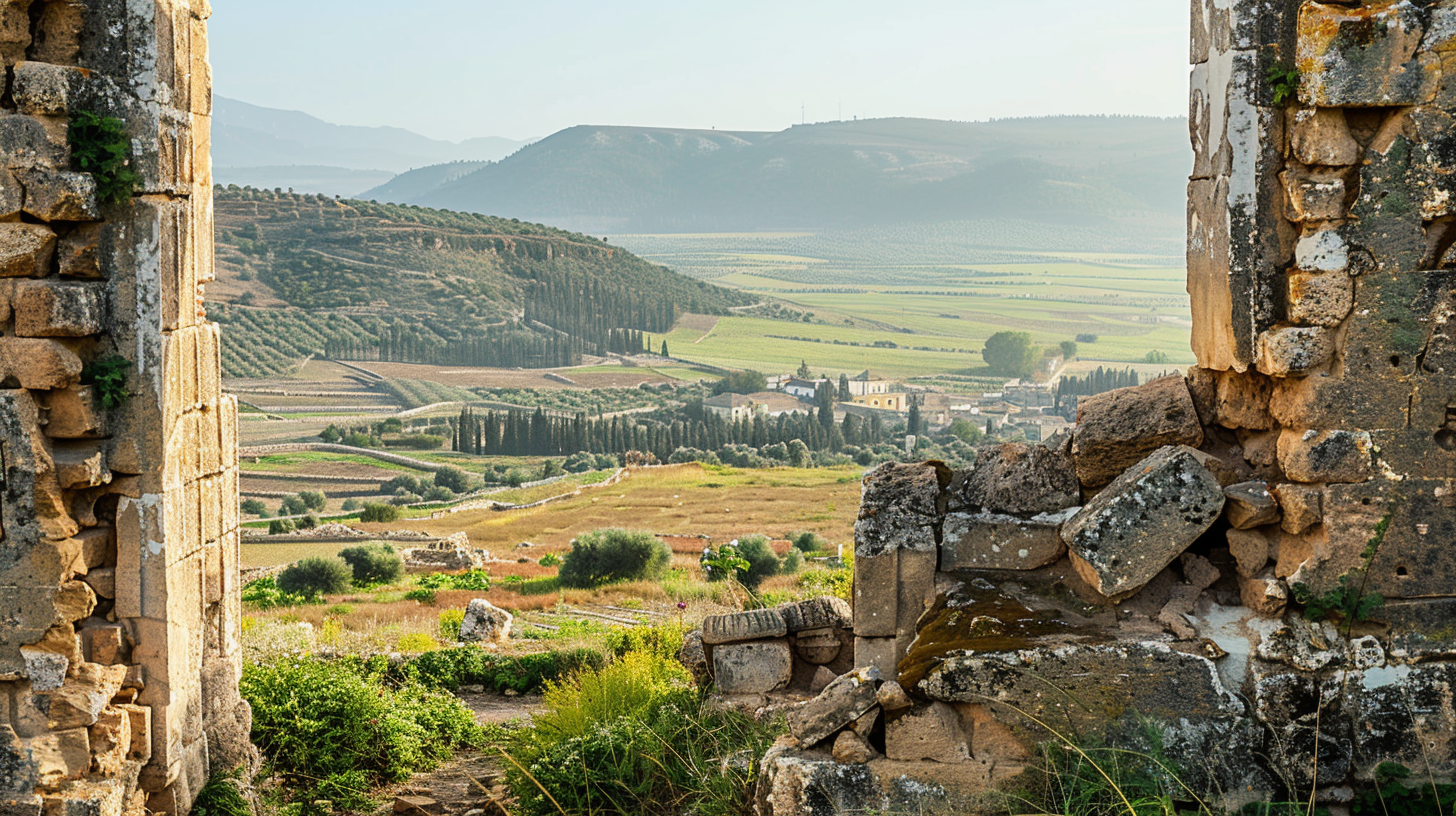
Banasa, Thamusida, and Sala Colonia complete the circuit of sites that most visitors never reach. Banasa sits in farmland near the Sebou River — partially excavated, atmospherically overgrown. Thamusida was a military camp guarding a river crossing, its walls still tracing the outline of a garrison that watched for threats coming from everywhere. Sala Colonia, beneath modern Chellah in Rabat, was the southernmost significant Roman settlement on the Atlantic coast. The Merinids later built a royal necropolis on top of it, the dead of one civilisation resting on the foundations of another.
Rome withdrew from Mauretania Tingitana around 285 CE. The province was not conquered — it was abandoned, a territory too far from the centre to justify the expense. The Amazigh reclaimed what had always been theirs. The aqueducts silted. The forums emptied. The mosaics were buried under centuries of soil, waiting for the plough or the archaeologist — whoever arrived first.
What strikes you at Volubilis is not the grandeur but the domesticity. These were homes. The mosaics decorated dining rooms where people ate dinner, gossiped, argued with their children. The olive presses were businesses. The baths were social clubs. Rome in Morocco was not a military outpost pretending to be civilisation. It was civilisation — transplanted, adapted, and eventually abandoned. The mosaics that remain are not relics of power. They are relics of life, left behind by people who thought they were building something permanent. They were right, but not in the way they expected.
Orpheus still charms the animals in tesserae laid two thousand years ago. The Roman route starts at Volubilis.
Tell us about your trip →The Facts
- —Volubilis: western edge of Roman Empire
- —Mauretania Tingitana province
- —King Juba II: educated in Rome, married Cleopatra's daughter Selene
- —City of 20,000 at peak
- —Romans left Morocco 280 CE — art stayed
- —Mosaics still in ground: Orpheus, Dionysus, Labours of Hercules
- —Olive presses supplied oil to the empire
- —30 minutes from Meknes
Sources
- Raven, Susan. Rome in Africa. Routledge, 1993
- Mattingly, D.J. "The Laguatan: A Libyan Tribal Confederation in the Late Roman Empire." Libyan Studies, 1983
- Camps, Gabriel. "Rex gentium Maurorum et Romanorum." Antiquités africaines, 1971
- Leveau, Philippe. Caesarea de Maurétanie. École Française de Rome, 1984.
Further Reading
Practical questions