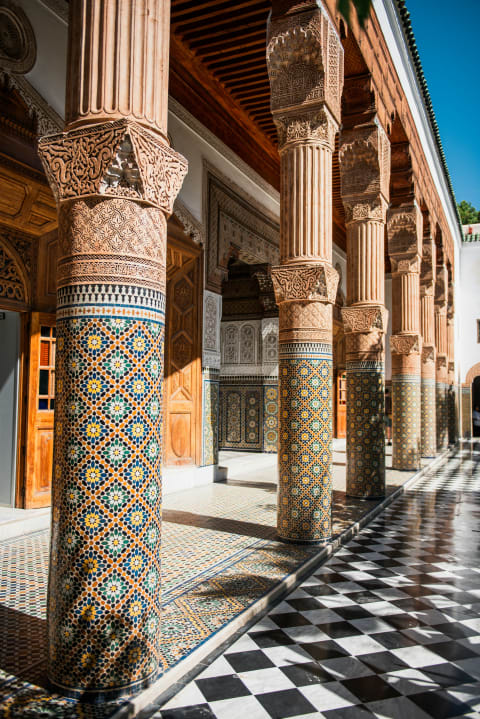
A religious prohibition destroyed one art form and created another. The replacement has been running for nine centuries and shows no sign of stopping.
Roman mosaics used tesserae—small cubes fitted together to create images. When Islam arrived, figural imagery had to go—but the method remained. Craftsmen assembled geometric patterns instead: stars, polygons, infinite tessellations. Zellige was born from this prohibition.
The earliest reliably dated zellige in Morocco appears on the Koutoubia minaret, mid-twelfth century. Green and white predominated.
The Marinid dynasty refined zellige into the form we recognize today: smaller pieces, more colors. The madrasas of Fez—Ben Youssef, Bou Inania, El-Attarine—became showrooms for the craft.
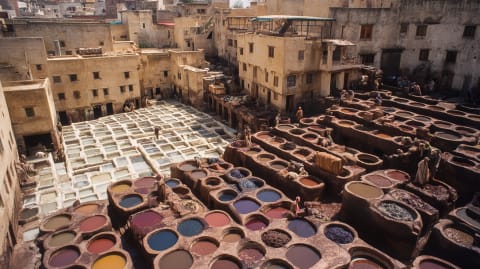
The making has not changed. Clay from the earth around Fez is shaped, dried, glazed, and fired. Then the maalem flips the tile face-down and chips away the back with a small hammer. The cuts are made freehand, by eye.
The little polished stone became zellige, which became Morocco's visual language. The craft trail follows the evolution.
Tell us about your trip →The Facts
- —Zellige = "little polished stone"
- —Born from Islamic prohibition on figural imagery
- —Earliest dated Moroccan zellige: Koutoubia minaret, mid-12th century
- —Marinid dynasty refined the craft: smaller pieces, more colors
- —Fes madrasas (Ben Youssef, Bou Inania, El-Attarine) = showrooms
- —Clay from earth around Fes
- —Making process unchanged for centuries
- —Stars, polygons, infinite tessellations from Roman tessera method
Sources
- Camps, Gabriel. Monuments et rites funéraires protohistoriques. Arts et Métiers Graphiques, 1961
- Searight, Susan. The Prehistoric Rock Art of Morocco. Archaeopress, 2004
- INSAP (Institut National des Sciences de l'Archéologie et du Patrimoine). Moroccan archaeological surveys
Practical questions