Dar Batha was built as a palace for receiving guests. Now the guests come to see what Morocco used to make.
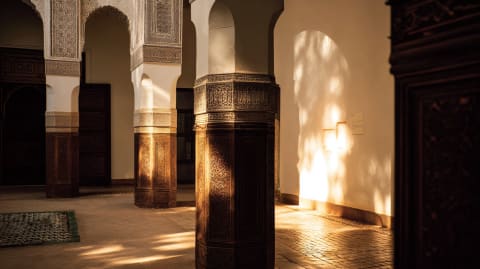
The building dates to the late 19th century, constructed under Sultan Hassan I and completed by his successor, Moulay Abdelaziz. It was a royal reception palace — a place where ambassadors were entertained and visiting dignitaries were housed. The architecture blends Moorish and Andalusian styles: a large Andalusian garden with a central fountain, tiled arcades, and reception rooms decorated in the standard vocabulary of Fassi craftsmanship — zellige, carved plaster, painted cedarwood.
In 1915, during the French Protectorate, the palace was converted into a museum of art and ethnography. The collection spans the range of Moroccan craft: Fassi ceramics in the distinctive blue and white that has been produced in the city for centuries, Berber carpets and jewellery, embroidered textiles, wrought iron, brass, carved wood, and a collection of Moroccan astrolabes — navigational instruments that Fes was once known for producing.
The ceramics collection is the heart of the museum. Fes has been a centre of pottery production since the Marinid era, and the blue-and-white tradition — influenced by Chinese porcelain that arrived via trade routes — developed into a distinctive local style. The pieces in Dar Batha range from 14th-century water jugs to 19th-century platters. The blue is always recognisable: cobalt on white, with floral and geometric motifs.
The garden is among the best surviving Andalusian gardens in Fes — a walled rectangle with mature trees, tiled pathways, and the sound of running water from the central channel. On a quiet morning, with no tour groups, you can sit on one of the benches and hear what a 19th-century palace garden sounded like.
The museum is not well-known among tourists. It appears in guidebooks as a secondary recommendation, if at all. This means it is uncrowded, the garden is peaceful, and the collection is yours to look at without being pushed along by the person behind you.
The Facts
- —The building dates to the late 19th century, constructed under Sultan Hassan I and completed by his successor, Moulay Abdelaziz.
- —In 1915, during the French Protectorate, the palace was converted into a museum of art and ethnography.
- —The pieces in Dar Batha range from 14th-century water jugs to 19th-century platters.
- —On a quiet morning, with no tour groups, you can sit on one of the benches and hear what a 19th-century palace garden sounded
Sources
- Le Tourneau, Roger. Fès avant le protectorat. IHEM, 1949
- Parker, Richard. A Practical Guide to Islamic Monuments in Morocco. Baraka Press, 1981
- Revault, Jacques et al. Palais et demeures de Fès. CNRS, 1985
Practical questions